
Source : the age
For its fourth season, SBS’s survival reality contest Alone Australia went to the ends of the earth in search of a fresh challenge – and not just metaphorically speaking.
“I would say this is quite literally the polar opposite of anything we’ve done before,” says executive producer Riima Daher of the show’s relocation to the Arctic Circle. “So many familiar features of the survival game are still there, so much of the psychological game is still there. But we basically flipped it on its head to take southern-hemisphere survivors up to the northern hemisphere to see what happens.”
Relocating to northern Finland, on the traditional land of the Sami people, meant that “the experiment got stepped up,” says Daher. “The temperature went down – and up at the same time”.
As always, it starts with 10 contestants. There’s no preamble, just them being dropped into a landscape that at first glance looks a little more hospitable than some of those the Australian version of the show has so far featured. The lake is teeming with fish, mammals wander through the woods, timber is abundant, as are ground-level foods like mushrooms and berries.
The thing is, those mammals are off-limits – they are the livestock of Sami herders. Those mushrooms have a tendency to become infested with maggots. The berries that don’t get trampled underfoot by reindeer won’t make it through the first frosts of winter. And that lake will freeze over, making fishing almost impossible. Oh. There are bears and wolves out there too.
As the conditions grew harsher as winter set in, not being able to hunt the reindeer started to weigh more heavily on the minds of those who made it that far. “It was like watching a Big Mac walk past,” says Daher, with a laugh. “There’s this sense of wonder that this majestic creature is walking past, but there’s also the realisation that ‘I really want to eat you, but I can’t’.”
Daher says the contestants knew they were going north when they applied for the fourth season, but they didn’t know where exactly until about 10 days before they headed off. Each contestant is allowed to choose 10 items to take with them, in addition to the standard items (medical emergency kit, camera gear, and strictly limited clothing). And while their items were chosen with the Arctic in mind, she says, “as soon as they knew exactly where they were going, there was some intense research to double-check they’d chosen the right fishing gear, that their sleeping bag was the right one, that their clothing choices and boots were the best”.
No amount of research and prep, though, can quite prepare contestants for the reality of the environment into which they are dropped.
“It’s one thing to understand it academically, but if you haven’t actually survived in that specific environment, all the preparation in the world … well, it can help you, but can it really prepare you? I would say absolutely not,” Daher says. “I think there was shock and learning for absolutely everyone.”
That was certainly the case for 35-year-old Dylan (SBS withholds surnames for privacy reasons, though inevitably many filter out).
An experienced hunter and fisher, the Tasmanian-raised Palawa man says he’d “never had any issues” with feeding himself in the wild. “But I’ve never tried to do it in the Arctic before, either,” he adds. “The procurement of food can be very challenging, and very frustrating, when it’s somewhere you haven’t tried to survive before.”
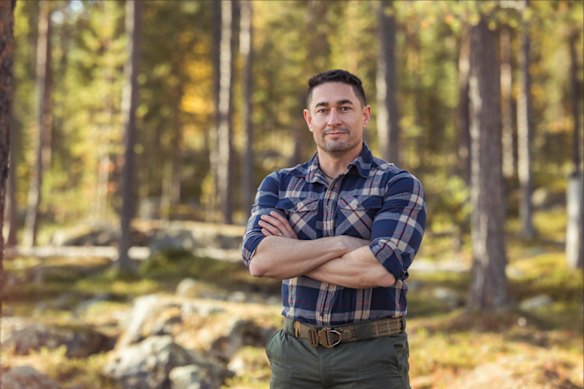
Dylan entered the military straight out of school with ambitions to join the SAS but was forced out by a back injury in his early 20s and now works in domestic-violence support services in Queensland. That experience taught him that adaptability is the most crucial skill a person can have, and being on the show only reinforced that belief.
“If you’re going into a wilderness you’ve never been in before, with nothing except what you’re carrying on your back, you need to adapt pretty quickly or you’re not going to last long,” he says. “It’s a whole different climate. It’s very cold. All the plants and animals are different. There’s a lot to consider, a lot to adapt to.”
For all the physical challenges, though, it was – as many a contender has discovered before him – the isolation that most gnawed.
“Even when I was in the Army, you’re out there with a team, you have other people you can talk to and brainstorm with, throw ideas around with,” he says. “When you’re out there on your own, it’s just you. You’ve got to get good at talking to yourself.”
And like many of the other contestants this season, he realised how much he needs other people.
He and his partner have a young son born via IVF. They’re trying for a second child, and the $250,000 prizemoney – and all the treatments it would cover – was a major factor in his decision to go on the show. But the time away from his family only made him realise how much he’d let that sense of mission get in the way of the most important thing: simply spending time with them.
“When you’re going through IVF, you spend so much time working just to be able to afford [the treatments] to expand your family,” he says. “You spend more time with your child in daycare than with them before and afterwards and on the weekends.”
The time away helped him get his head straight. “I guess I’d never really made the effort to put my energy and my actions where my words were,” he reflects. “I love my job, but now I see that work is just something I’ve got to do to make sure I can enjoy my life with my family as best I can.”
It sure beats being alone.
Alone Australia season 4 premieres at 7.30pm, July 15 on SBS and SBS On Demand.