

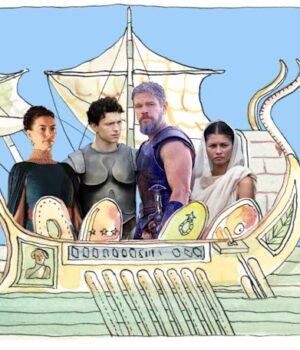
Source : the age
The Odyssey, directed by Christopher Nolan, is coming to cinemas next week. I’ll be approaching the epic blockbuster warily, just as I approached my first encounter with the poem in picture-book form when I was eight years old.
My dad has always loved the Greek poems and myths. When he presented me and my sister with an illustrated edition of The Odyssey, I was suspicious. It was a book about a man in a tunic and sandals. I’d seen these before, and I dreaded moral instruction.
On closer inspection, it was a chaotic story about a warrior-king, Odysseus, and his gruelling 10-year journey home to the island of Ithaca after the Trojan War. Along the way, he encountered terrifying characters: a man-eating Cyclops, a sentient whirlpool, the sirens with their irresistible song.
I wouldn’t say I liked the book. The illustrations were lurid; some of them were disgusting. But I respected it for being overtly unpleasant in a way my other books were not. The volume was heavy on monsters and on Odysseus’ ingenious schemes to escape danger. (My favourite was the episode where he outwits the Cyclops.) But, as a children’s book, it was light on details of Odysseus’ character flaws.
This seemed to worry Dad, who had read the full text, and who kept casting aspersions on the hero in our readings together. (“See how he puts all his sailors at risk?“; “He’s a bit of a thug”; “Do you think he was rough on the Cyclops?”) I didn’t pay much attention to this stuff. Thugs don’t wear sandals, I thought.
In high school, I was lucky to study The Odyssey, with an excellent teacher, Mr Fairweather. He brought the poem to life, with all its peculiar idiom and grisly mystery. This was the full translated text, not the kids’ version, and so was far more focused on what happens in Ithaca while Odysseus is away and what happens when he returns.
During his absence, Odysseus’ house is overrun by obnoxious suitors, competing to marry his wife, Penelope, eating his food and disrespecting his son, Telemachus. When the hero finally comes home, he (spoiler alert) slaughters the suitors with maniacal gusto.
Now I was able to see what Dad had been hinting at in terms of the hero’s less adorable qualities: his deceit, his disastrous leadership style, his dizzying egotism, his homicidal sprees.
But Mr Fairthweather warned us against judging the poem’s hero through a contemporary moral lens. The gruesome ending of The Odyssey, he said, would likely have been considered fitting and honourable by the Greeks. The boorish suitors, having invaded Odysseus’ home, had violated the sacred code of hospitality. According to the poem’s moral framework, they had it coming.
There were other exotic elements of the story. Odysseus – a symbol of masculine strength and honour – was unbelievably emotional. He was always weeping and wailing. As a teenager, I found it funny that such a tough guy was also such a cry-baby. But I guess this is the point of reading ancient texts. You discover that very few social conventions are natural, universal or timeless. Things evolve – moral codes; masculine codes – sometimes for the better, sometimes not.
I was excited, many years later, to get my hands on Emily Wilson’s brilliant 2017 translation of The Odyssey – the first translation by a woman. Famously, in the first verse she characterises the hero as “complicated” – a word that captures his moral ambiguity. (I also like Robert Fagles’ translation, suggesting duplicity: “a man of twists and turns”.) In Wilson’s Odyssey, the homecoming vengeance sequence is incredibly graphic. I had forgotten an especially charming flourish, when Odysseus orders the murder and mutilation of a disloyal goatherd, Melanthius. (His testicles are fed to some dogs – cute!)
It will be interesting to see how the revered Christopher Nolan and his all-star cast (including Matt Damon, Anne Hathaway and Zendaya) handle this complex territory. On one hand, if audiences can accept the intersection of Ancient Greece and dazzling Hollywood dentistry on screen, we should be able to handle other contradictions. On the other hand, I’m not sure we are living in a moment that can withstand too much moral ambiguity.
Can we swallow a blockbuster about a deceitful egomaniac who ruthlessly dispenses with invaders and … who is also pretty great sometimes? Will we get a more palatable Odysseus – a pining husband and father – to soothe the collective psyche and reap box-office returns? I’ll be among the first at the cinema to find out: choc-top in hand; caution in heart.
The Odyssey opens on July 16.