
Source : the age
I’m tired of art galleries. All those naked Greek nymphs. All those dreary saints porcupined with arrows, and double-chinned dukes trimmed in ermine. I soon feel headachy. I enjoy a park more than a battle scene. Cafes rather than Canalettos. Why look at paintings of dead people when, outside, living foreigners are doing strange things?
Strange to me anyway. Daily routine to them, I presume. Isn’t that the point of travel? The world is refreshingly unusual, but shares human culture, and we learn that our differences aren’t so odd after all.
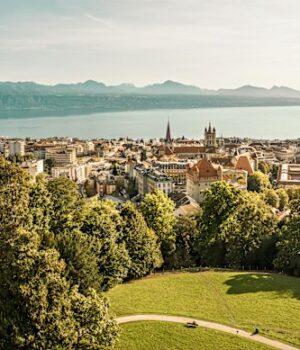
Which brings me to Lausanne, a city so buttoned up that it barely glances at its stupendous views over Lake Geneva to the French Alps, but instead looks down on gorges and railway cuttings.
For most visitors, Lausanne’s attraction is the Olympic Museum. But you won’t learn anything about scandal and corruption at the IOC’s official museum – though you will see Cathy Freeman’s running shoes.
Another museum is better. It displays art like none you’ve seen before. Walls painted black rather than white are a first indication that something interesting is going on. Black focuses attention on the artworks and increases their intensity.
Few works are well-proportioned rectangles. Who says art must be regular? Not these artists. Some paintings are long and skinny; many aren’t rectangles at all. But the unexpected has only begun.
Collection de l’Art Brut is the world’s most important collection of art brut, literally raw art, although usually called outsider art in English.
The creators whose work is displayed here spent time in mental institutions or prisons, or both. Nothing unusual there; Caravaggio and van Gogh did, too. But none had art training. They disregarded art movements and public opinion and never painted for a patron or audience.
Regular art museums have little to say about artists, but the extensive biographies here are worth reading, and fascinating.
Who decides who is an artist? Many revered artists had troubled lives and odd visions. For that matter, the poet T. S. Eliot was recovering from a breakdown at a sanatorium in Lausanne when he wrote The Waste Land. That’s one question the collection makes you ponder. Another is what art is. One person’s masterpiece might be another’s obsessive doodle.
Does it matter what art is made from? You’ll see stone figures hewn from stolen milestones, and lonely-looking people carved from cork. Collages made by a pastry cook use crushed eggshells and glued-together breadcrumbs.
Clement Fraisse used a broken spoon to carve into the wooden panels of his cell. The shadowy human figures, geometric shapes and Buddhist-like wheels of life are strangely haunting.
Franz Opitz created Swiss scenes depicting sheep in green fields and chalet window-boxes cascading with petunias. All seems bucolic. Then you notice the grass is fluorescent, the mountains like shards of stained glass. The sheep have frightening metallic faces, and flowers are cruelly imprisoned in small squares.
Fraisse’s carvings seem like an escape into a calmer world, Opitz’s paintings a reflection of his tormented life. But my favourites are the works of Willem van Genk, perhaps because, confined to an orphanage as a child, he dreamed of faraway places.
His complicated painted papercuts and collages, inspired by his adult travels, feature New York trains, serene Buddha statues, Thai beaches and Saharan dunes sprouting cherry trees. They aren’t tourist brochures however: rushing traffic, derelict buildings and shunting yards are depicted, too.
Does it take a troubled mind to be honest? Are beautiful places surrendering to urban blight? Is travel an escape from society, or only an illusion of one? And who is normal and who is mad?
Good questions. Give me a van Genk over the silly pastoral paintings of Watteau and Fragonard any day, and you have me hooked.
THE DETAILS
Fly
Swiss operates codeshare flights to Geneva via Singapore and Munich. Direct trains from Geneva airport to Lausanne take 45 minutes. See swiss.com
Stay
Ibis Lausanne Centre is conveniently located and is a short walk from Collection de l’Art Brut and the city centre. Rooms from CHF118 ($213). See accor.com
Visit
Collection de l’Art Brut is open daily except public holidays and (other than July-August) Mondays. Admission is CHF12 ($22); it is free on the first Saturday of each month. See artbrut.ch
 Brian Johnston seemed destined to become a travel writer: he is an Irishman born in Nigeria and raised in Switzerland, who has lived in Britain and China and now calls Australia home.