

Source : INDIA TODAY NEWS
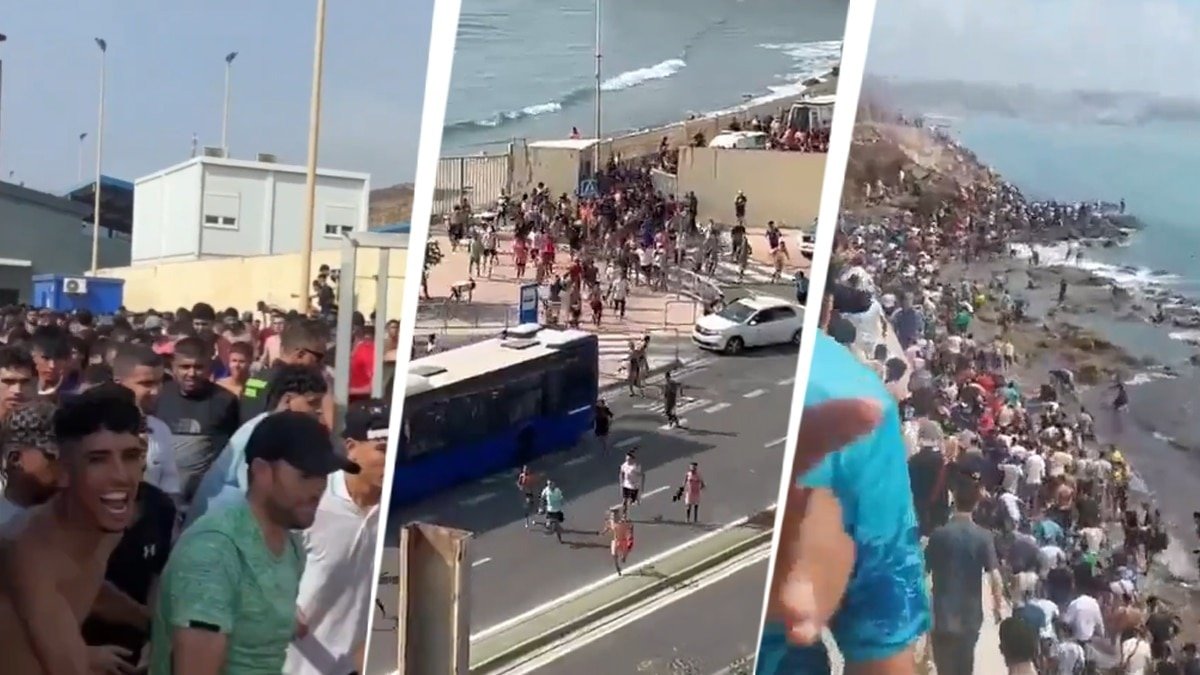
Around 60,000 migrants surged into Spain’s North African territory of Ceuta within two days, swimming across the maritime border, climbing fences and pouring towards the enclave after weeks of preparation, social media messages and, according to some migrants, directions from Moroccan authorities to “Go that way”.
The unprecedented rush into Ceuta on Thursday and Friday triggered a political storm across Europe, overwhelmed the enclave and left dozens dead in the attempt to cross from Morocco. By Friday afternoon, Spanish authorities said 48,300 people had returned to Morocco.
advertisement
The crisis also raised a bigger question: how did tens of thousands of people manage to converge on one of Europe’s most heavily guarded borders at almost the same time?
Accounts from migrants, reporting by The New York Times and the Financial Times, and footage from the border point to a combination of social media mobilisation, preparations for the sea crossing, desperation over jobs in Morocco and uncertainty over whether migrants could be returned after a recent Spanish Supreme Court ruling.
‘GO THAT WAY’: MIGRANTS DESCRIBE DIRECTIONS FROM MOROCCAN POLICE
Some migrants who reached Ceuta said Moroccan security personnel appeared to direct them towards the Spanish territory.
“They just kept saying, ‘Go that way, go that way,’” Youssef Alaoui, 26, told The New York Times, referring to police officers who he said pointed towards the route to Ceuta.
Alaoui said he eventually swam across the maritime border.
Other accounts, however, suggested Moroccan authorities were also trying to prevent people from reaching Ceuta. Photographs near the border showed Moroccan police and security forces confronting groups of young men near Fnideq, close to the crossing, including using water cannon.
At several locations across Morocco on Thursday and Friday, security forces appeared to be stopping people from travelling north. In Rabat, some passengers were prevented from boarding trains, while some local services were cancelled.
The Moroccan government had not publicly explained the surge by Friday evening.
THIS WAS NOT ENTIRELY A SPONTANEOUS EXODUS
The Financial Times reported that the mass crossing had been building for days, with around 1,800 people already swimming around a breakwater into Ceuta during the preceding week.
Some would-be migrants had taken swimming lessons or taught themselves to swim specifically for the journey.
On Facebook groups, people posted flippers and wetsuits for sale. Others shared information in Arabic about sea conditions and posted Google Maps screenshots showing routes towards Ceuta’s Tarajal beach.
By Thursday morning, groups began moving towards the Morocco-Ceuta frontier on foot, bicycles, cars and larger vehicles.
Some migrants were seen getting out of a dump truck near the border while Moroccan gendarmes monitored traffic.
Those heading towards Ceuta then moved down steep slopes towards a narrow beach before making their way to points where they could enter the water. Many carried smartphones inside waterproof pouches.
The shortest direct swimming route was only a few hundred metres, but crowds and strong currents forced some to remain in the water for hours. Financial Times report on the Ceuta migrant surge
DOZENS DIE AS MIGRANTS SWIM TOWARDS CEUTA
The crossing quickly turned deadly.
Spanish authorities cited by The New York Times said three dozen migrants died while attempting to reach Ceuta. The Financial Times, citing Spanish police and local media, reported a higher toll of at least 57 deaths.
Migrants described swimming past the bodies of those who had drowned.
At Tarajal beach, people emerged from the water with cuts and bruises after being battered against rocks. Footage showed migrants arriving soaked, some injured and others carrying bicycles.
Photographs from the shoreline showed abandoned flip-flops, sandals and clothing floating in the sea.
The scale of the crossing was particularly striking because Ceuta has a population of only about 83,000. Juan Jess Vivas, who heads the territory’s government, described the situation as “absolutely unsustainable”.
CEUTA WAS NEVER AN OPEN DOOR TO MAINLAND SPAIN
For many migrants, reaching Ceuta was seen as reaching Europe. But getting into the Spanish enclave did not automatically mean being able to travel onwards to mainland Spain or elsewhere in the European Union.
Ceuta and Melilla are Spanish territories in North Africa and form part of both the European Union and the Schengen Area. However, they operate under special arrangements requiring passport or identity controls for travel to mainland Spain and the rest of the EU.
No onward movement to mainland Spain or other EU member states had taken place among the recent arrivals, according to a senior EU official cited by The New York Times.
The migrant reception centre in Ceuta was already saturated and closed to new arrivals. Some migrants instead sat in rows on the ground under the watch of Spanish police and Red Cross workers.
By 6 pm on Friday, Spain said 48,300 people had voluntarily returned to Morocco. Later, EU migration commissioner Magnus Brunner said “practically all” had gone back.
WHY DID SO MANY PEOPLE HEAD FOR SPAIN?
For many migrants, the motivation was straightforward: work and a better life.
“I don’t want to live in Morocco, I want to live in Europe,” said Zakaria Lahmer, 23. “I want a job, I want happiness.”
Another Moroccan migrant, 24-year-old Ajoub el-Arrot, put it even more directly: “You ask why everyone came — because there’s no work in Morocco.”
Unemployment among people under 24 in Morocco remained around 22 percent, according to the World Bank, even as the country recorded its strongest economic growth in a decade in 2025.
The Spanish government’s immigration policies may also have contributed to the perception that reaching Spain could offer a route to legal status.
Spain announced this year that more than a million migrants would be allowed to apply to formalise their status.
A recent Spanish Supreme Court ruling also became a major talking point on social media. According to reporting cited by The New York Times, some migrants believed the ruling meant people intercepted while attempting to reach Spain by sea could not simply be returned.
That interpretation may have added to the lure of the crossing.
SOCIAL MEDIA HELPED TURN THE BORDER INTO A MASS MOVEMENT
Messages circulating online appear to have played a major role in bringing thousands towards the border at the same time.
Migrants interviewed in Ceuta said they had recently seen posts claiming that the border was open.
Moroccan opposition politician Abdullah Abaakil said there had been a surge of social media messages discussing the Spanish Supreme Court ruling and its possible implications for migrants.
The Financial Times found that online groups were also being used for practical preparations, with users sharing sea conditions, routes and equipment for the crossing.
The result was a movement that appeared far more organised than a spontaneous gathering.
SPAIN-MOROCCO TENSIONS ADD ANOTHER LAYER
The mass crossing has also fuelled speculation about whether diplomatic tensions between Spain and Morocco played a role.
Spanish Prime Minister Pedro Snchez visited Algeria earlier this month, with the two countries agreeing to hold a high-level summit this autumn. Immigration, counterterrorism and cultural exchanges are among the issues expected to be discussed.
Spain and Algeria have also reportedly been discussing increased Algerian natural gas supplies to Spain.
Morocco and Algeria have long been rivals, and some experts believe Spain’s closer ties with Algeria may have angered Rabat.
Lorenzo Gabrielli, a senior researcher at Pompeu Fabra University in Barcelona who studies migration in Ceuta, said the Algeria relationship could play “a fairly central” role.
But the evidence remains mixed.
While some migrants alleged that Moroccan officers directed them towards Ceuta, images also showed Moroccan forces attempting to stop people from reaching the border.
EUROPE REACTS AS CEUTA BECOMES A POLITICAL FLASHPOINT
Snchez travelled to Ceuta on Friday and announced that 400 additional security forces had been sent to the border.
“This is not the time for division,” Snchez wrote on social media. “It is time to keep building a strong and united E.U.”
The response from several European governments was sharply different.
Italian Prime Minister Giorgia Meloni called for Spain’s membership of the Schengen treaty to be suspended, while France announced tighter controls at its border with Spain.
Far-right politicians across Europe also used the crisis to demand tougher immigration controls.
The White House joined the criticism, with spokeswoman Anna Kelly saying President Donald Trump had long warned Europe about the consequences of policies that, in the administration’s view, enabled mass migration.
Yet for the migrants on the beaches of Ceuta, the wider political battle appeared distant.
Some were hungry and exhausted after spending hours in the sea.
Soufiane ez-Znafry, 26, a sous-chef from Tangier, said, “We have not eaten in two days.”
For a brief moment, tens of thousands had reached what they believed was the gateway to Europe.
Within hours, the reality was very different: a saturated enclave, a closed reception centre, a deadly crossing behind them and, for most, a return journey back to Morocco.
– Ends
SOURCE :- TIMES OF INDIA