
Source :- THE AGE NEWS
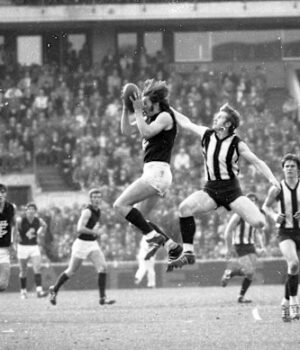
For 32 years, between the premiership of 1958 and the drought-breaker of 1990, Collingwood were a laughing stock for opposition supporters because of a mythical curse. It was known as the “Colliwobbles”, a term coined during a phase in which the Magpies went to nine grand finals and came away with not a single victory.
Their draw against North Melbourne in 1977 was as close as they came to triumph. It became a crushing weight to carry, only growing with each successive failure on the big stage.
Back when Collingwood surprised Melbourne in the 1958 VFL grand final, denying the Demons a fourth straight flag, the Magpies had 13 premierships and sat three ahead of any other club, Essendon being next best with 10.
But for three decades they could not add to their tally – eight times runner-up in that period including the fadeout from 44 points ahead at half-time against Carlton in 1970. In one stretch, the Magpies were runners-up in four of five seasons from 1977.
This is what makes the 1990 grand final, the first under the banner of the Australian Football League, so famous. I don’t think there could have been a wilder night in Melbourne, such was the emotion that spilled into the streets.
Yet Collingwood was not the best team in the competition that year – Essendon was, quite comfortably. That Collingwood won came down to the ability of Leigh Matthews’ side to perform when it counted, but also to a quirk of the finals system that has since been adjusted.
Essendon, coached by Kevin Sheedy and boasting Tim Watson, Terry Daniher, Simon Madden, Mark Thompson, Paul Vander Haar, Michael Long, Derek Kickett, Mark Harvey, Paul Salmon, Gary O’Donnell and Darren Bewick, to name but a few, went 17–5 for the season to finish a game clear on top of the ladder. When the Bombers beat St Kilda in the final round on September 1, they were firm favourites for the flag.
Under the system at the time, they had week one of the finals off so they could tend to their wounds. But three weeks after that game at Waverley, they still had not played a final. The delay occurred because Collingwood and West Coast played a draw in the qualifying final, forcing a replay the next week and pushing all the other games back.
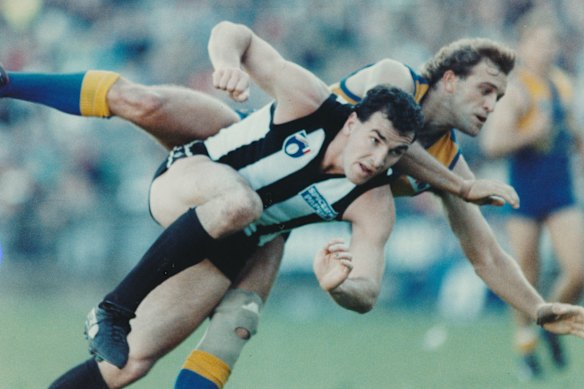
It was such a mess that the AFL introduced extra time for finals from 1991 (the extra-time rules did not apply to grand finals until 2016). Too late for Essendon in 1990, the Bombers had to wait until September 23 – a full 22 days – to play Collingwood in a semi-final. Players are creatures of habit, and the several weeks off stole their momentum; they were never the same team.
Collingwood smashed Essendon in the semi-final to win direct entry to the grand final.(The Bombers reached the grand final after beating West Coast in the preliminary by 10 goals.)
The Magpies were match-hardened and running at full tilt. But they still had to deal with the Colliwobbles. In charge of this project were two fierce competitors in Matthews and Tony Shaw, the Collingwood captain. Matthews was in his first stint as a head coach and had brought a calm to Collingwood that was epitomised by the lack of streamers or balloons in the dressing room before the grand final. He reasoned that no player needed extra motivation or adrenaline flow for this match.
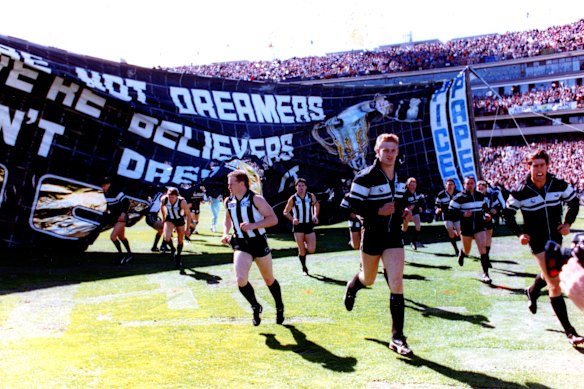
Shaw had a day job as a gardener with the Collingwood Council and was the younger brother of a former Collingwood captain, Ray Shaw. He had Collingwood in his blood, but he had seen his elder brother play in five grand finals without a win, as well as experiencing it twice himself in 1980 and 1981. Enough was enough.
Matthews recalled hearing Shaw drive his players with the message: “I’ve played in two losing grand finals. There’s not going to be a third.”
Meanwhile, across town, Essendon was worried, producing a slipshod final training session at Windy Hill and having to endure a club function at the Flemington Racecourse the night before the match.
On the day, Collingwood was much better, covering all its deficiencies. While the 205-centimetre Paul Salmon threatened early for the Dons, Matthews sent Michael Christian to curb him. Peter Daicos conjured a trademark miracle goal from the boundary to get his team up and running. Shaw beavered and bullocked through the middle on his way to a Norm Smith Medal.
Kevin Sheedy has said that Collingwood was not a great side in 1990, but the Magpies did have an all-time great in Daicos, who kicked 97 goals that season, plus Darren Millane, Gavin Brown, Graham Wright, Mick McGuane and a two-time Copeland Trophy winner in Shaw, plus numerous other outstanding players. Missing a legitimate tall forward because of Brian Taylor’s absence through injury, regular half-back Gavin Crosisca had to play at centre half-forward in a patch-up role. He thrived on the challenge.
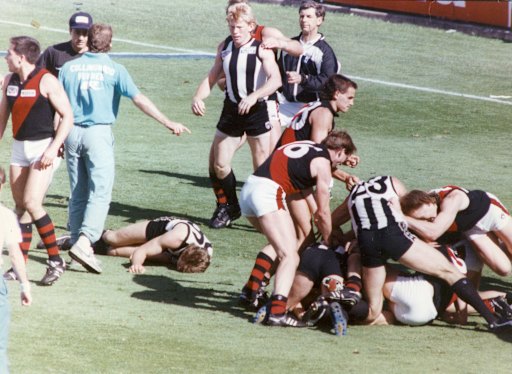
At quarter-time of the grand final, with Collingwood three points ahead, there was a ferocious brawl. As was their wont in that era, the players unloaded.
Denis Banks, Collingwood’s centre half-forward, has acknowledged that he started it by ankle-tapping Kieran Sporn of Essendon. Sporn belted Banks, Gavin Brown king-hit Sporn, and an offended Terry Daniher defended his teammate’s honour and knocked out Brown with a punch to the head.
At the first break, Matthews implored his players to keep their eyes on the ball and “be the victims”. Paul Salmon has said that Sheedy delivered the same message, but it was Collingwood’s players who settled better. Essendon conceded three 50-metre penalties with ill-discipline and the Magpies ran away to a good lead.
The tension simmered all day – and particularly at half-time, as the players left the field. In those days, the two races were side by side, and Matthews was looking for something he could use as a powerful motivational tool.
He grabbed Brown, who had spent the second quarter off the field, by the arm, and walked him towards Terry Daniher.
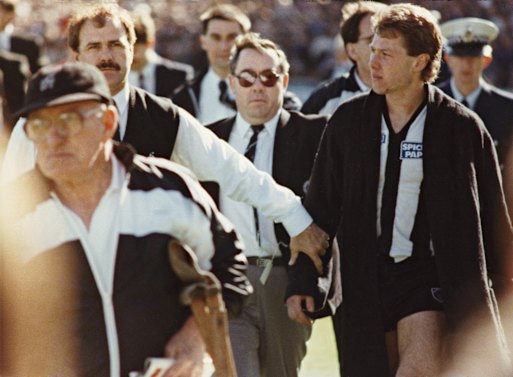
As they headed up the race, an extraordinary scene unfolded: Matthews was screaming that Brown was “coming back for you”, while Daniher was throwing punches at Collingwood’s coach through the wire netting.
Brown did come back onto the field in the third quarter, sprinting straight up to confront Daniher in the Collingwood forward line. He doubtless was suffering from some concussion – he had not moved for some time after Daniher clocked him – but his return seemed to symbolise Collingwood’s resilience and resolve.
The Magpies pulled away but the players never relaxed. Shaw would not allow them the luxury. Doug Barwick’s goal at the 19-minute mark of the final quarter sealed it, but even then, Matthews waited until Damian Monkhorst bombed one home after 25 minutes before he left the box.
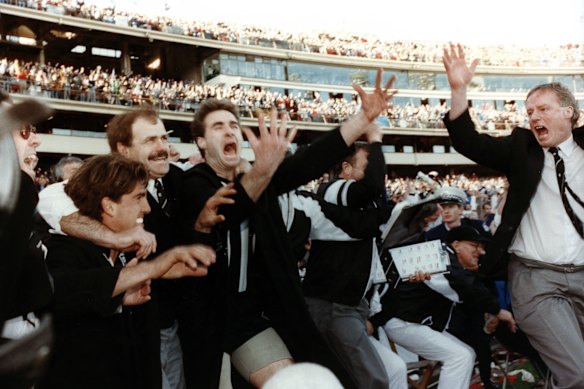
He almost broke the neck of his football manager, Graeme ‘Gubby’ Allan, in the embrace they shared down on the boundary. By then the crowd was singing the Collingwood theme song.
Darren Millane had the football in defence when the siren signalled a 48-point win and the end of the great drought. Millane, who had played the finals’ series with a broken right thumb – having it replastered after each successive match – threw the Sherrin in the air, leaving us with an image that has lingered. He died in a car accident in Albert Park just a year on.
At the siren, Tony Shaw went down on all fours. At 170 centimetres and 80 kilograms, with an abbreviated left-foot kick and no leg speed, he had defied the physical odds to be best afield. “Mentally and physically, I was shot,” he said. “I had nothing left.”
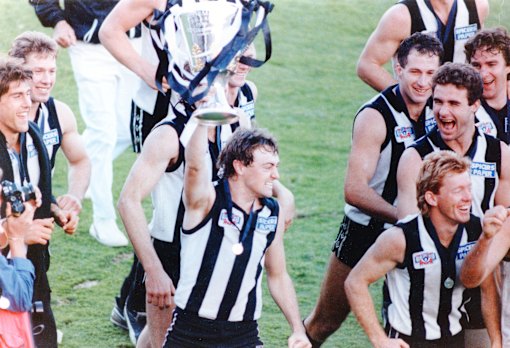
Tim Watson, his opposing captain and a class act in every way, embraced Shaw, acknowledging the workload he had carried. “He was like a wind-up doll, just going and going,” Watson later said. “He was going to take his last breath on the MCG to make sure they had victory on that day.”
It was a missed opportunity for Essendon, but the AFL’s system is not first-past-the-post, as is common in, say, soccer. Part of the beauty of this game is that the premiership has to be won on the day.
Matthews had his first premiership as a coach, on his way to four – and Australian football immortality. His record as a player and coach is remarkable, with eight flags. “I’m just so pleased for those 20 blokes who’ve written their name in history and cut down a folklore of Australian sport,” he told Channel 7.
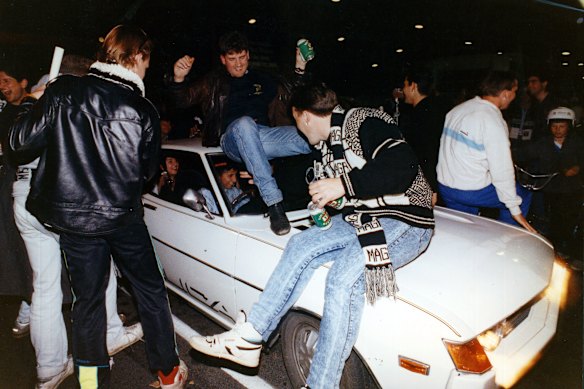
The aftermath of the 1990 grand final matched the gravity of the occasion with some irreverence and a lot of fun. Collingwood’s players celebrated at a formal function at the Southern Cross Hotel in the city and then took the team bus to Victoria Park, their home ground, amid chaotic scenes.
It took aeons to get to the ground, where tens of thousands of supporters were already celebrating. Hoddle Street was choked with traffic; at each traffic light, Collingwood fans could be seen standing on the roofs of cars, with people milling all over the road, oblivious to danger. The bus ultimately had to take every side street to spirit the players to Vic Park.
Driving home to Clifton Hill that night, I witnessed the chaos first-hand. Kevin Sheedy had to as well, heading to his northern suburbs home. A friend and colleague who was covering the celebrations found his way onto the Collingwood bus; he said he had never witnessed a scene like it in Melbourne.
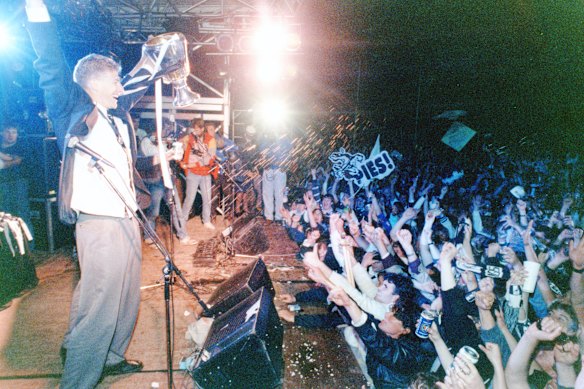
At Vic Park, the players were treated like rock stars as they made their way to the stage. “It was like being in heaven,” said Tony Shaw.
A few weeks later, Collingwood called its supporters back to Victoria Park for a funeral. Lou Richards, media personality and former club captain, was dressed as an undertaker, complete with top hat. Ten thousand people showed up to see Richards place a wooden coffin containing the Colliwobbles in the ground out on the playing arena. “It’s ashes to ashes, dust to dust, the Colliwobbles are buried, and once again, it’s them against us,” he said.
This is an edited extract from Martin Blake’s book Why We Love Footy: An Aussie Rules History in 50 Great Moments, published by Allen & Unwin; available August 4.