
Source :- THE AGE NEWS
Glasgow: These Commonwealth Games have been like the friend who is told at the last minute the dinner party is going to be at their place. They try to argue that someone else should host, but eventually, begrudgingly, they agree.
“OK, I’ll have it, but we’re only having takeaway. And don’t bring your kids, we don’t have room. And I’m working tomorrow, so you can all leave early.”
This event was winnowed back so far – to just four venues and quotas for how many athletes that countries were allowed to bring – that in Glasgow you barely know the Games are on. The Games would have had more buzz in Australia than Scotland.
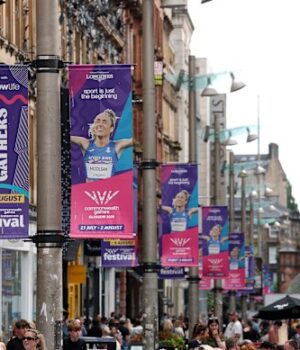
Unless you were at one of the venues – the pool, the athletics track, the velodrome or the hub that had the other remaining events – you would struggle to know the Games were happening. There is a smattering of billboards and signs, but you could easily miss them.
With so few events, no big team sports save for netball – hockey and rugby missed out – venues with small capacities and no road events that fans can watch for free, there are few tourists who have come for the Games. The result is that there is no hum of people filling the streets, pubs and restaurants.
Most critically, it’s not on free-to-air TV here. More people will have watched the Games in Australia than in Scotland. The BBC had the rights for the Games for 72 years, but were outbid for 2026 by pay TV station TNT.
If you don’t have pay TV, and most households don’t, you have to watch in a pub that has a subscription. Of a dozen pubs visited in Glasgow city centre (all in the name of research), three didn’t have TVs, five had TVs but not pay TV, four had the rights-holder TNT but didn’t have the Games on and two were showing it on their screens.
To see the Games here, you have really got to know they’re on – and go looking for them.
Glasgow’s badging for these Games is “All In”. But it’s not. We have seen Glasgow when it was all in, 12 years ago. It was brilliant. The city was buzzing, tourists flooded the streets and pubs. Glasgow had worked for years towards hosting the Games, polishing the city up, finishing all construction. The city looked great. This year the main George Square is a building site, completely ripped up and fenced off.
This is not a sledge of Glasgow. It might sound like it, but it’s not. Glasgow stepped in when others wouldn’t – and it deserves credit for that.
The city stepped in when the Victorian government embarrassed itself internationally by pulling out of hosting. Actually, it embarrassed itself by committing to an utterly ill-conceived concept in the first place – a regional Victorian Games that were little more than a thought bubble that worked well in election campaign meetings, but not in Commonwealth Games Federation meetings.
Faced with the prospect of the concept being abandoned altogether – and there was some thought the old Empire Games should go the way of the old Empire – Glasgow stepped in and said it would do it, but only on its terms.
The Commonwealth Games Federation had already pitched to prospective replacement host cities that the Games would cease trying to be a faux Olympics; they could pick and choose what sports they would have. Only athletics and swimming were non-negotiable.
And Glasgow said, “We will do it as long as it’s small and costs us nothing.”
These Games were guaranteed not to require public funding or to be publicly underwritten by the Glasgow City Council, or the Scottish or UK governments.
In fact, the Victorian government is footing most of the bill. The Games were budgeted to cost £150 million ($287.5 million), of which £100 million was from the Commonwealth Games Federation. That in turn was funded by the $380 million settlement payment paid to the federation by the Victorian government.
Commonwealth Games Australia contributed another £2.3 million, with the balance of the Games budget coming from broadcast rights and ticket sales. While organisers did not seek government funding, the UK government offered a £2.3 million contingency for security costs.
The determination to keep it small, and its costs down, meant organisers over-corrected. Commonwealth Games officials privately admit this.
At the time Glasgow agreed to host and the number of sports was decided, there was no other city interested in holding the 2030 Games and a serious doubt they would ever be held again. So everything was geared towards just getting the Games – no matter what they looked like – happening to keep the whole concept alive.
Then India said it wanted the 2030 Games. Ahmedabad would host and wants them back as a mini-Olympics because the city is also bidding to host the 2036 Olympic Games.
The Delhi Commonwealth Games in 2010 were such a debacle – security concerns, issues with venues, the athletes’ village not being up to standard, for example – the Indians know they have to prove to the world how much the country has changed since, and that they can now reliably host a big world event.
Had the federation known it had Ahmedebad for 2030, it would have extended the budget for Glasgow, knowing it could be underwritten against future earnings from broadcast sales in 2030.
Had it known Ahmedabad was going ahead, there is no doubt the program would have included hockey, badminton, shooting and probably rugby sevens in Glasgow.
Hampden Park Stadium has been empty, so it was a mistake, regardless of Ahmedabad, for it not to be included among the venues for 2026. There should also have been road racing events here. Why they retained 3×3 basketball remains a mystery.
In India, the Games will return to the idea of what they have been. But beyond India, who knows? The Games federation is open to being flexible about what sports are included, but the lesson from Glasgow is: be careful how far you trim.
Get around our Commonwealth Games coverage
Follow our coverage of the Commonwealth Games with live blogs covering every moment of the action from 6pm AEST daily.
News, results and expert analysis from the weekend of sport sent every Monday. Sign up for our Sport newsletter.
 Michael Gleeson is an award-winning senior sports writer specialising in AFL and athletics.Connect via X or email.