

source : the age
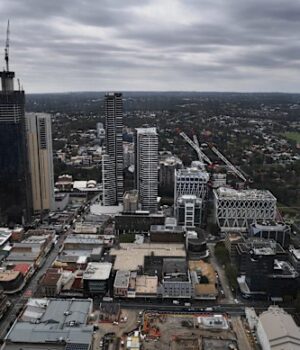
There will be up to twice the number of planned homes in Parramatta’s CBD over the next two decades under the state government’s “ad hoc” housing shortlist process, prompting the council to warn Sydney’s second CBD will end up squeezed for commercial space and miss out on jobs.
Analysis of the state government’s declarations of state-significant developments in Parramatta city shows 6858 homes are on track for approval, in addition to the 6718 that the council had planned under “strategic housing growth” in the precinct, totalling 13,576 homes if completed.
Several years after cementing itself as Sydney’s second CBD, the city is experiencing a new tension: a fight for space between offices and apartments.
The City of Parramatta has for years planned for a “commercial core” around Parramatta’s train station and main square, and presented the area in its planning documents as the “business heart” of western Sydney – a vision that requires saving land around the middle of the city for future office needs.
But the state government’s housing policies are prompting pushback from the council. The NSW Housing Delivery Authority (HDA) is allowed to override local planning rules that would ordinarily restrict development in certain areas by shortlisting plans for high-rise apartments that are “state-significant”.
The latest example came in the fight over an office block less than 400 metres from the train station. It was once home to many of the state’s public servants, but after they moved into the new Parramatta Square buildings, 10 Valentine Avenue sat vacant for years. Then developer Holdmark applied to the HDA for fast-tracked approval to turn it into rentals for students at Western Sydney University. The council objected to the plans partly on the basis that putting residential development there was “inconsistent with the strategic vision” for Parramatta’s CBD as a “metropolitan jobs centre”.
But Business Western Sydney executive director David Borger said that cities with students are “blessed”.
“They provide a workforce for local cafes, their eyes and ears on the streets,” he said. “They’re global ambassadors. So I think we need to really embrace the fact that Parramatta is becoming a university city and a university city needs university housing [that is] ideally close to the campus.”
The state government has already removed Parramatta’s immediate city centre from the HDA process. More generally, the council is concerned that more housing will appear throughout the area ahead of the infrastructure that is required to support the increased number of people living in the city.
“A significant and growing proportion of housing currently in train is progressing outside [the] council’s strategic, precinct-based planning framework through alternative state-measured pathways,” the City of Parramatta’s analysis said. “This matters because these pathways can reallocate where growth may occur and weakens the alignment between housing delivery, infrastructure sequencing, employment land outcomes and place-based objectives.”
Borger said there was a “low risk” that Parramatta would run out of commercial land over the next few decades.
“There are places like Auto Alley which will have very little to no demand for commercial office demand for many decades,” he said.
“Cities don’t work well when they stand still. Cities need momentum.”
Other critics of the city’s blueprint say Parramatta’s infrastructure is already there. “You’ve got a light rail line that almost nobody uses,” Sydney YIMBY’s Justin Simon said of the L4 line between Westmead and Carlingford, which continues to suffer from low patronage. “Then the question is, if we’re aligning housing and infrastructure, why is that [light rail line] not surrounded by housing?”
The philosophical question
The tension represents two philosophical approaches to how cities grow most effectively: should they be planned and structured? Or should their development be ad hoc?
“Cities are the results of millions of individual decisions,” Simons said. “The best thing that councils can do is create good public space … for people to be, and then let them decide what they want to do with the rest … Housing is the infrastructure that we have the biggest shortage of. The nurses and teachers and paramedics need somewhere to live, and they need to live somewhere near their workplace.”
Liberal Lord Mayor Martin Zaiter said planning was needed to avoid extra pressure on “schools, hospitals, transport, open space and essential services”.
“Parramatta’s CBD is of significant economic importance – not just to Parramatta but all of metropolitan Sydney, so we also need to be safeguarding every piece of commercial land we have zoned for future jobs,” he said.
Office vacancy data from February this year shows 22.1 per cent of Parramatta’s offices sit empty, an increase from 20 per cent last year. But the available office space is patchy and non-contiguous, making large-scale company office moves difficult.
“We want to work with the NSW government to ensure housing growth in Parramatta is matched with the infrastructure, services and employment opportunities needed to make Parramatta a city worth living in,” Zaiter said.
Planning Minister Paul Scully said the government aimed to support housing and jobs growth by funding “infrastructure including schools, healthcare, transport, and public spaces, including the Sydney Metro West and Parramatta Light Rail Stage 1 and 2”.
“The government has already recognised the importance of Parramatta’s commercial core by excluding EOIs in a designated area of its CBD in the published HDA criteria,” he said.
 Anthony Segaert is the Parramatta bureau chief at The Sydney Morning Herald. He was previously an urban affairs reporter.Connect via X or email.