

Source : THE AGE NEWS
The joint Japanese and American intervention in currency markets to prop up the Japanese yen seems to have worked, for the moment at least. Whether it lasts is another matter.
On Thursday and Friday last week, the Bank of Japan and the US Treasury were in the market, with the BoJ selling dollars to buy yen and the US selling euros, peculiarly, to add to the buying.
It’s the first time since 2011 (after the Tohoku earthquake which led to a flood of repatriated funds held offshore by Japanese investors) that the US had intervened to affect the yen’s value, although on that previous occasion it was to weaken, rather than strengthen, the currency.
The BoJ and Treasury were prompted to intervene after the yen fell to 40-year lows against the dollar, despite the BoJ’s attempts to put a floor under it. With short-sellers piling in, the yen had weakened to more than 163 yen to the dollar, its weakest level since 1986.
The BoJ spent an estimated $US53 billion ($75.7 billion) on Thursday and another $US36 billion or so on Friday, with the US support likely to have been a fraction of that in dollar terms, but far more potent in terms of the signal it sent the market. The yen is now trading around 157 yen to the dollar.
Japan’s interest in strengthening its currency is obvious, America’s less so.
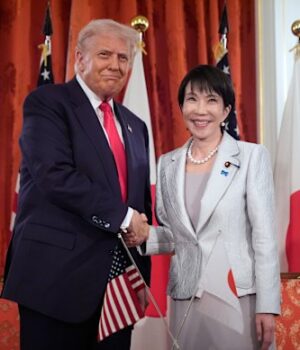
The inexorable slide in the value of the yen has, despite unsuccessful attempts by the BoJ in April and May to arrest it, been driven by Japan’s poor fiscal position, with Prime Minister Sanae Takaichi planning an expansive program of tax cuts and spending in an economy where government debt is already more than 200 per cent of GDP (albeit that about half that debt is owned by the government itself).
That fiscal strategy is out of kilter with the BoJ’s monetary policy, where the bank has been cautiously edging up its policy rate, which now stands at 1 per cent, as the economy emerges from decades of stagnation.
With Japan’s interest differentials widening against the rest of the world, it is the currency that has had to absorb the pressure. The US Federal Reserve Board’s federal funds rate target is between 3.5 per cent and 3.75 per cent and the market expects a Fed rate rise before the end of the year – and Japanese bond yields are suppressed by the BoJ’s monetary policies (it is still buying long bonds to keep the yields low).
With a growing yield differential and Japanese inflation rising, the currency has succumbed to that pressure, creating new stresses for a country reliant on imports of energy and food.
The war in the Middle East has caused oil and LNG prices to soar, with the weak yen exacerbating the cost of commodities that are priced in US dollars and adding another layer to inflationary pressures and the pressure for more Japanese interest rate rises.
The explanation for America’s willingness to lend its firepower and credibility to the defence of the yen is less obvious, but probably multi-layered.
It is almost certainly more prosaic than Donald Trump’s explanation that it was a display of friendship.
The US had intervened “because we have a good relationship with Japan. We’re very strong, very strong financially. Japan’s been very good to us, with the exception, of course, of Pearl Harbour,” he said, in his usual tactless fashion.
Among the lesser motivations would have been concerns that a cheap yen makes Japan’s exports more competitive and could also undermine its ability to deliver on the pledge Trump extorted from it, using the threat of tariffs, to invest $US550 billion in America.
More significant would be the fact that Japan is America’s biggest foreign creditor.
It holds about $US1.1 trillion of US Treasury securities. If left to defend the yen by itself, it would probably have to dump sizeable volumes of those holdings, pushing up US bond yields in a market where the US 30-year bond is already at levels last seen in 2007.
For an administration facing debt levels rapidly nearing $US40 trillion, or about 123 per cent of GDP, running fiscal deficits close to 6 per cent of GDP and having to refinance about a third of its debt as it rolls over this year, that would mean even higher US interest costs.
In the background is a larger threat, and not just to the US and its markets.
The significant interest rate differential and persistently weak currency have made the yen a popular funding currency for hedge funds and other traders, who borrow yen to invest in higher-yielding assets elsewhere.
While that trade has been slightly diminished as the BoJ has inched up short-term interest rates, there are estimates that the “carry trades” still amount to more than $US1 trillion.
If those were to unwind, the trillions of dollars of Japanese holdings offshore – apart from the bond holdings, Japan’s institutions hold about $US1.2 trillion of US equities and hundreds of billions of other assets – might flood back to Japan, igniting financial stresses, perhaps crises, in the markets they are exiting.
Japan, the US and other central banks and governments want a controlled rather than disruptive unwinding of those trades – if the gradual normalisation of Japan’s economic settings that began under Shinzo Abe and is accelerating under Takaichi continues and rate differentials become tighter.
Having decided to come to Japan’s aid, US Treasury Secretary Scott Bessent – a former hedge fund manager with George Soros who made a lot of money in currency trading – chose a novel approach.
Instead of using the dollar as the funding currency for buying yen, he used euros. And to head off a firesale of Japan’s Treasury holdings if it ran out of dollar liquidity, he convinced the Fed to increase the size of a repo facility that enables governments to get access to US dollars by using their Treasury holdings as security.
The use of euros was presumably to avoid the US having to sell dollars and devaluing its own currency.
The BoJ and US Treasury are buying Japan time.
While Trump might like a weaker dollar to improve the competitiveness of US exports, a strong dollar is a weapon the administration has wielded, or threatened to wield, in imposing sanctions against its perceived foes.
It also gives the US a unique level of influence over the world’s financial system and global trade while lowering US interest costs and raising the US standard of living relative to what it might be if the dollar weren’t the world’s reserve currency.
Bessent would be reluctant to jeopardise that status, hence the selling of euros (or using derivatives to effectively sell them) to buy yen.
The expanded Fed line – normally, the Fed gives access to a maximum of $US60 billion a day – is another strategy for protecting the US bond market. By borrowing dollars from the Fed, using its Treasury securities as collateral, the BoJ avoids having to sell down its Treasury holdings.
Interventions in currency markets tend to be briefly successful before the underlying economic and financial settings again prevail.
The BoJ and US Treasury are buying Japan time, and perhaps a more orderly adjustment in the near term, but Japan’s weak fiscal position will remain weak, as will the yen, until there is structural change within the Japanese economy and financial markets.
The Business Briefing newsletter delivers major stories, exclusive coverage and expert opinion. Sign up to get it every weekday morning.