Source : ABC NEWS
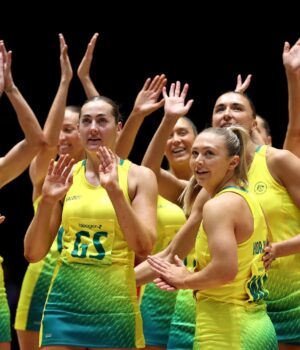
The Diamonds’s 2026 Commonwealth Games campaign may well go down in history for all the wrong reasons, remembered not only for a shock semi-final loss to Jamaica but the dress controversy that preceded it.
After the Diamonds’ 99-38 demolition of Tonga, media coverage focused not on the lopsided result but on the ill-fitting dresses players tugged at throughout matches.
Players like Sophie Garbin may have insisted the outfits were fine, but as ABC journalist Britt Carter put it, “if a shooter has to pull it down more than 10 times in a quarter, how much of that energy could be re-directed?”
Loading Instagram content
For elite women athletes the problem is not just the impact poor-fitting uniforms have on performance.
Research shows that many adolescent girls drop out of sport citing body image issues, while concerns about uniforms have also been identified as a barrier to participation.
These are not just problems for younger people or community sport.
The ABC and Deakin University’s recent survey of elite Australian athletes in women’s sport found that 25 per cent have negative feelings about their body image, while 44 per cent have experienced an eating disorder and/or disordered eating.
The latter figure is much higher than what the Butterfly Foundation, a national charity for anyone affected by eating disorders and body image issues, estimates at 17 per cent for the general population.

Teigan O’Shannassy wants to see women and girls feel more comfortable in their bodies on the netball court. (Getty: Sanka Vidanagama)
Sydney-based netballer Teigan O’Shannassy is one of those who lives with a history of eating disorders and disordered eating.
She argues more awareness about the struggles elite female athletes face is key.
Dresses an issue during Super Netball season
O’Shannassy, who the ABC interviewed prior to the Commonwealth Games, admitted having issues with the Swifts’s dress in the most recent Super Netball season, with teammates seen adjusting them during some matches.
“When you’re playing in a dress in front of thousands of people you want to be able to perform, and don’t want to have to think about how you look or how you feel in the dress,” she told the ABC.
“If you’re struggling with your body image, having to do that and put on something that you don’t want to wear, or you don’t feel comfortable in, is really hard.“
Teigan O’Shannassy (left) has played for the Canberra Giants and the Sydney Swifts in her netball career. (Getty: Jason McCawley)
O’Shannassy, 27, has previously been diagnosed with anorexia nervosa and remembers vividly the moment her career came to a crossroads.
She was playing for the Giants at the time, in the middle of COVID-19 lockdowns, and was about to leave with the team for a Queensland hub.
O’Shannassy was called into a meeting with her head coach, assistant coach, dietitian, doctor and physio and told she would be staying behind so she could see a dietitian and therapist weekly.
“Looking back I think that was probably the best decision they could have made,” she said.
“I think it was one of the best things that could have happened to me. But obviously I was absolutely gutted. I thought my career was over.”
Those feelings intensified when the Giants told her they would not offer her another contract, but invited her to stay on as a training partner.
The Swifts called with the same offer before O’Shannassy made the decision to leave.
Netballer Teigan O’Shannassy has struggled with body image throughout her career in the national league. (Getty: James Worsfold)
“Something needed to change,” she said.
“I just felt like I was stuck in this constant cycle of injuries and under-fuelling because I felt like I wasn’t training [enough] and I didn’t deserve to eat.”
‘The more we can talk about it, the better’
Given her personal experience, O’Shannassy says she was “unfortunately not surprised” by the results of the ABC and Deakin survey.
“When I was really struggling I honestly thought I was the only person that was struggling with my body and food and having all these negative thoughts around it,” she said.
“But since I’ve spoken up about it, people have come to me and said ‘oh, I struggle with this too’, which in a way I think is helpful, that we’re so open about it.
“I think the more we can talk about it, the better. Even for me, talking about my body in a positive way is still something that I need to work on, and I think everyone can do that every day.”
Teigan O’Shannassy now teaches other women about nutrition and health. (Getty: Brett Hemmings)
O’Shannassy, who has since trained as an associate nutritionist and runs a business called Tossed Together, is passionate about building community understanding of the unique challenges athletes face.
These include, in a team sport like netball, the pressure to be more like your teammates or competitors.
She remembers first coming through competitive pathways at 17 and having her body compared unfavourably to others by her coaches.
“We got told, ‘you should be lifting this amount of weight, you should all look like this player, you should be able to do what certain players can do,'” she said.
“That stuck so much in my head. I’d have niggle after niggle and just felt like my body was never good enough.
“I just wanted to be like the other netballers who were so strong and looked like athletes.”
By contrast, O’Shannassy described her younger self as “tall, lanky and uncoordinated”, and says she “never felt like I looked like an athlete”.
Teigan O’Shannassy began playing for the Canberra Giants in her late teens. (Getty: Mark Nolan)
The requirement to undertake body composition testing, including skin folds and DEXA scans, also bred unhealthy comparisons.
“I remember being 19, 20, and hearing some girls saying what body fat [percentage] they were, and thinking ‘oh god, I’m a bit higher than them’ and just freaking out about it,” O’Shannassy said.
Social media exposes further body scrutiny
Danni Rowlands, the Butterfly Foundation’s director of education initiatives, is a former state netballer herself and shares a similar story to O’Shannassy.
She was diagnosed with an eating disorder at age 21 and remembers skin fold testing significantly influencing how she felt about her body as a junior athlete.
A former netballer herself, Danni Rowlands now advocates for a shift in sporting cultures through the Butterfly Foundation. (Supplied.)
“I was identified as being too high in body composition so I was supported through a dietitian to reduce body fat,” she said.
“I went on to make the state team and play nationals, which was amazing, but unfortunately played the entire tournament with a stress fracture in my ankle which was later identified as being caused by under-nourishment and over-training.
“That just kicked off this whole cycle at a very vulnerable age where I connected my weight to my worth and success as an athlete.“
Since retiring from sport she has worked to shift sporting cultures, heading Butterfly Foundation’s BodyKindSports initiative which recognises adolescence as a vulnerable time for athletes’ relationship with their body, particularly young girls.
“We want to protect and support athletes in those early pathways so that they can thrive, and that the consequence of participating in sport isn’t a lifelong struggle with eating, training and poor body image,” Rowlands said.
The Diamonds claimed the bronze medal at the Commonwealth Games in Glasgow. (Getty: Lintao Zhang)
She holds particular concerns for contemporary women athletes who are more accessible to the public than ever on social media.
“This idea that athlete bodies are commodities and we can all have a piece of them, and critique as we want [online], absolutely adds a layer of pressure for athletes that makes it more intense than ever before,” Rowlands said.
“There are intense appearance pressures on women athletes to look pretty, and feminine, but not too muscular, or too thin. They just can’t win, which is tough.“
She added that when players do have issues with their uniforms, as in the Commonwealth Games example, this can generate further unwanted attention on their bodies.
“Looking at women across a lot of sports, there’s much more exposure of body parts compared to men,” she said.
“I think we have to ask: why is this the case? Is it because it’s going to help them perform better, or is it because we’re treating female bodies differently in sport?”
O’Shannassy admitted being under the spotlight, and being photographed or filmed constantly, added a layer of discomfort for those with body image issues.
“For a female that can be really triggering. You’re always being watched, and I think that’s something that can be kind of daunting,” she said.
“As an athlete, obviously it’s such a cool job, and there’s so many positive things that come out of it, but the highs are high and the lows are low.
“If you’ve never done it you just really don’t know what it can be like.”
Athletes ‘not immune’ to body image issues
Moving forward, both O’Shannassy and Rowlands shared messages of support for women in sport.
Rowlands encouraged athletes who might be struggling to “seek support sooner rather than later”.
“Being an athlete doesn’t make you immune to any of those pressures. If anything, it intensifies them further. So be kind to yourself, and if you are struggling reach out,” she said.
All Teigan O’Shannassy ever wanted to do in her life was play netball. (Getty: Jason McCawley)
O’Shannassy, meanwhile, hopes sharing her story will continue to inspire others who may be experiencing something similar.
Although her worst days are well behind her she says it can help to acknowledge that an eating disorder is not “something you can just turn off, or wake up and you’re fine”.
“You might have that voice in your head forever,” she said.
“For me, it’s just, I hear that voice and I acknowledge it, but I don’t let it control me anymore.”
She says it is important to find the thing that motivates you to keep fighting, which for her has always been her chosen sport.
“For me it was netball, all I ever wanted to do was play netball,” she said.
“And I knew that if I didn’t eat or didn’t fuel myself I was never going to get there.”