Source : INDIA TODAY NEWS
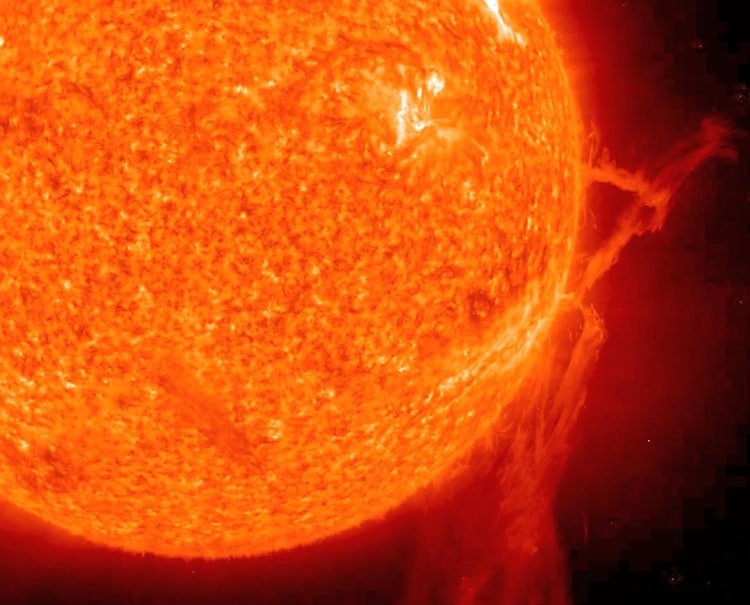
The Sun has just revealed a side of itself that scientists have never seen so clearly before.
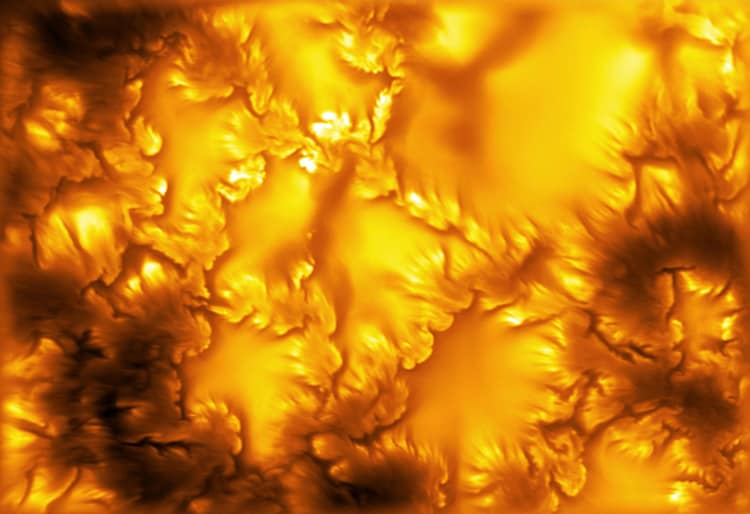
Astronomers using the US National Science Foundation’s Daniel K Inouye Solar Telescope in Hawaii have captured the highest-resolution images yet of the Sun’s visible surface, revealing tiny, swirling patterns in its superheated plasma.
The structures are not random either.
Researchers have identified them as Kelvin-Helmholtz instabilities (KHI), a phenomenon produced when fluids or gases moving at different speeds interact and create swirling vortices.
WHAT DID SCIENTISTS SEE ON THE SUN?
The observations focused on the Sun’s photosphere, the relatively thin layer that forms its visible surface.
The photosphere is about 100 km deep, tiny compared with the Sun’s roughly 1.4-million-km diameter.
A powerful telescope allowed researchers to see structures as small as about 19 km across, with the observed vortices extending up to roughly 170 km.
These are made of hot plasma, a gas so energetic that electrons break away from atoms. The plasma was seen moving through the Sun’s magnetic field.
Time-lapse observations showed the whirlpools growing and evolving rather than remaining static.
Friedrich Woger, a senior scientist at the National Solar Observatory and co-lead author, explained the process.
“The interface can become unstable and develop wave-like vortices that grow in size until they break apart, not unlike waves out on a lake or out on the ocean in windy conditions,” said Woger.
KHI is already known on Earth, including in oceans, lakes and clouds, and has been observed in the atmospheres of Jupiter and Saturn.
But this is the first detection of the phenomenon on a star’s surface.
WHY IS SUN’S CLEAREST PICTURE A BIG DEAL?
The discovery could help scientists understand one of the Sun’s biggest mysteries: why its outer atmosphere, or corona, is millions of degrees hotter than its visible surface.
The researchers say the constant twisting generated by these instabilities can transport and redistribute energy and magnetic fields.
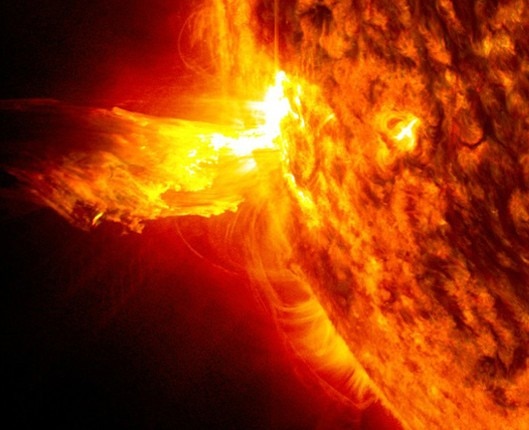
That process may help explain how magnetic energy builds up and eventually contributes to explosive events such as solar flares and coronal mass ejections.
Those eruptions matter much more on Earth as powerful solar activity can disturb satellites, GPS navigation, communications and power infrastructure.
“The sun and sun-like stars are extremely dynamic systems, characterised by a whole spectrum of rapid, explosive events within their magnetic elements,” said David Kuridze, an astronomer and co-lead author. “How these explosions are triggered is one of the main frontiers in modern solar physics.”
The discovery opens a new way of studying how the Sun moves energy through its atmosphere, and potentially how similar processes operate on other stars.
– Ends
SOURCE :- TIMES OF INDIA