Source :- THE AGE NEWS
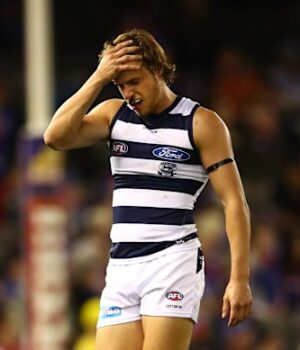
Geelong premiership defender Jake Kolodjashnij has identified himself as the player at the centre of a secret concussion deal, which was scrapped this week after the AFL said they did not approve it.
Kolodjashnij didn’t directly address signing any document pertaining to his playing contract but said he “participated fully” in the AFL’s concussion panel process and is forthright that he is fully healthy and fit to play at the highest level.
He’s also hit out at the media for publicising what he says is his “private medical information”.
Kolodjashnij, 30, has played 11 games for the Cats this year, most recently in round 18.
“While I appreciate the efforts made not to identify me, the speculation has left me feeling I needed to address this personally,” he said in a statement on Friday.
“I participated fully in the AFL’s independent concussion panel process, respected its independence, and was comfortable with the outcome. I have continued playing AFL football since.
“What disappoints me most is that my private medical information has been made public. Everyone deserves the right to keep their confidential medical information private.
“I am healthy, feeling good, and focused on playing my role for the team for the remainder of the season.”
Kolodjashnij is the brother of Kade, who also played 80 games at the highest level; 78 for Gold Coast and two for Melbourne.
He arrived at the Demons with a history of head knocks, including suffering symptoms of delayed concussion in a 2019 game against Essendon. He returned to the VFL seven weeks later but never played AFL football again.
Kolodjashnij’s statement comes after the AFL wrote to Geelong demanding a “please explain” as to why it did not seek the league’s approval before allowing a player to sign a waiver that saw him assume responsibility for future on-field head injuries.
It comes less than 24 hours after the league issued a statement saying it was “satisfied” the Cats had not used the letter to allow a medically unfit player to return to the field, and that the club had advised it would remove the waiver in question.
The response included no mention of a sanction, sparking widespread condemnation, and calls of double standards in light of recent penalties imposed on Carlton for their handling of Elijah Hollands’ on-field mental health episode.
Speaking to media on Friday, Geelong chief executive Steve Hocking described the secret player agreement as a “process misstep” that the club was now looking at.
That misstep, he said, was the failure to lodge it with the AFL and the AFLPA – an error he took full responsibility for.
He was less quick to disavow the actual concept of a such a waiver, defending the “extensive process” the club had gone through two years ago – which he said took “two months of work” – and reiterating that the player was not coerced into signing it.
“It was really important to make sure the player was stepped through his rights and the options on the table for him,” Hocking said. “It was about achieving informed consent … The player was keen to continue to play I think it’s really important to know that.”
Hocking said senior coach Chris Scott was always kept “at arm’s length” from discussions on player health and had no knowledge of the contract in question.
“I’m CEO of the Geelong Football Club. We’ll work through it over the coming week as we have been over the last couple of days,” he said, adding he had not put any thought to his future at the club as he had been “busy working through this”.
Hocking evaded a question around whether there had been any fallout within the club, and “I’ve spoken to that player today, and he still feels that care from the club is as strong as ever,” he said.
Hocking avoided giving straight answers to questions about what penalty the Cats expect to cop, how this issue might be perceived by others, including rival clubs, or the involvement of AFL chairman Craig Drummond, who was president of Geelong, and part of the deliberations and ultimate decision.
“Whatever the AFL decides to do from here is up to them … what I can reinforce is what an excellent chairman Craig’s been down here,” he said.
Drummond was also a director of the Florey Institute of Neuroscience and Mental Health – a brain research centre – from 2009 to 2017.
The institute led a much-criticised past-player project from 2014 to 2019 investigating the brain health of former footballers.
More to come
Keep up to date with the best AFL coverage in the country. Sign up for the Real Footy newsletter.
 Sam McClure is an award-winning AFL journalist and broadcaster.Connect via X or email.
 Bridget McArthur is a sports affairs reporter at The Age, covering the intersection of sports and politics/business/economy/society.Connect via X or email.