source : the age
Capped daily car park rates of $2 at the Melbourne Zoo could be abolished to encourage public transport travel under a new Royal Park masterplan.
After key community and environmental groups criticised a draft proposal for the 161-hectare inner-city park, including proposals for increased lighting and more sports ovals, a revised pitch was published by the council on Friday afternoon before a meeting on August 18.
One of the proposals most likely to prove contentious is to lobby the state government to remove the parking fee cap at the zoo.
“Parking around the zoo is capped at a daily fee of $2, based on state government legislation from 1985,” the masterplan said. “Low parking fees encourage people to use private vehicles and discourage public transport, thereby entrenching the need for internal roads and car parks.”
Lord Mayor Nick Reece said changes to the zoo parking cap would need to be voted on by the council. “Anything to do with parking will be done in a sensitive and strategic way,” he said.
“I am also keenly aware that there are eight hectares of bitumen parking in Royal Park and, if we are smart, we can liberate a lot of that, get good parking outcomes and create new green space.”
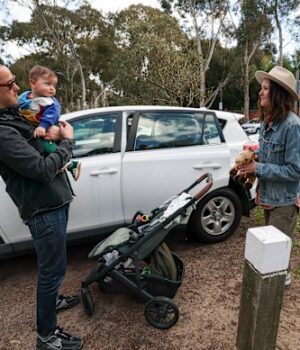
Jill and Todd Watson, who visited Melbourne Zoo with their 10-month-old son Max on Friday, said it was disappointing to learn the council might abolish the parking cap.
“As a family, we travel with a pram, and it is more practical to drive,” Jill Watson said. “Going to the zoo is a family-friendly activity and should be accessible.”
She pointed out the cost of visiting the zoo was $58 for a one-off visit, or $150 for membership. “We paid $300 today on our first visit,” she said, after they each bought a membership.
“I can see both sides, though. I understand the need for planning to encourage the use of public transport.”
According to the masterplan, the council is considering acquiring nearby land to increase the footprint of the city’s prized nature reserve. Where suitable land adjacent to the park is offered for sale, the City of Melbourne will consider strategic land acquisition to increase the size of the park, the plan says.
The council is eyeing land bounded by Oak and Park streets, in the city’s inner north, currently occupied by the Melbourne Youth Justice Centre, global biotech company CSL’s former headquarters and the Royal Melbourne Hospital.
“We must be nimble to capture these opportunities when they arise, with a particular focus on land bounded by Oak and Park streets, which historically formed part of the park,” the masterplan said.
The land where the old CSL headquarters sits is now owned by the Victorian government, after the company relocated in 2023 to Elizabeth Street.
The council has proposed to limit artificial light in the park to improve night sky viewing and adopt “strict lighting curfews to minimise impacts on biodiversity”.
Lighting should be used only up to 10.30pm to maintain a dark park between 10.30pm and 5am, under the plan, except for walking and cycling thoroughfares and major destinations within the park. These include the State Netball and Hockey Centre, the zoo, Royal Park station and tram stops.
The masterplan also noted it was “challenging to reduce lighting to minimise impacts on wildlife, while maintaining perceptions of safety”.
The council plans to register the park as an Urban Night Sky Place with the International Dark Sky Association by ensuring that areas deemed suitable or designated as “dark sky refugia (for example, the Grassland Circle and the golf course) remain unlit for the duration of the night”.
Royal Park Protection Group convener Paul Leitinger welcomed the masterplan revisions, including plans to keep Royal Park dark.
“The lighting issues are a great advancement,” he said.
“In the original plan they had crisscrossed the whole park with paths of desire, new walking tracks going all over the place carving up the park. We objected to that because you want to be in the wilderness.”
The masterplan also paves the way for more sports ovals, but they will be subject to a framework to evaluate their necessity. The plan aims to avoid further expansion of major sport facilities in the park while increasing the capacity of existing sports grounds by extending operating hours, particularly in winter.
Leitinger said he hoped criteria to evaluate the installation of new ovals would uphold the values of the park as a green space.
“We must have the full support of the council, and I suppose the Victorian government, to uphold those principles and apply them,” he said.
Protectors of Public Lands Victoria president Fiona Bell has previously opposed the construction of new sports grounds at an area known as lawn seven. According to the revised masterplan, the area will be turned into a formal sporting zone.
Reece said the revised masterplan addressed concerns of community and environmental groups and would deliver “more park for more people”.
Addressing concerns about lawn seven, Reece said no new sporting facilities would be constructed in the area, but it would be “utilised” for formal activities.
“The balanced approach we are taking in this masterplan is to say lawn seven will have work done on it, so it is more usable as a sporting area. But we are going to do it in a sensitive way,” he said.
Overall, the masterplan proposes increasing the physical green space of the park by reducing street level car parking and removing roads.
There are 3087 above-ground parking bays, many of which could be replaced by possible underground parking at the zoo and State Netball and Hockey Centre to preserve precious outdoor space for biodiversity and recreation, according to the masterplan.
Reece said safety was a top priority for the park.
“We have moved away from the concept of a uniformly dark park, to a balanced, zoned lighting framework. Key pathways and destinations can be appropriately lit with environmentally sensitive areas to remain darker to protect wildlife,” he said.
Start the day with a summary of the day’s most important and interesting stories, analysis and insights. Sign up for our Morning Edition newsletter.