

Source : THE AGE NEWS
For more than 600,000 Kmart applicants each year, the CV is dead. In its place, people seeking jobs at the national retail chain face an AI screening tool that promises to offer personalised feedback, bias-free assessments and – perhaps most importantly for the company – speed.
But as experts and politicians warn that AI hiring tools risk entrenching biases and locking unorthodox candidates out of the job market, this masthead decided to test the Kmart tool. We applied for a “holiday casual” role at Kmart and went through the interview process designed by Australian AI chat interview software provider Sapia.ai.
After putting in standard details on Kmart’s job application webpage, we were invited via email to complete an interactive chat interview.
“We’ll ask you five thought-provoking questions that will reveal your strengths and help you identify areas for growth,” the email read. “And don’t worry, there are no right or wrong answers.”
That’s despite the tool giving recommendations to the employers based on the answers given, which employers adopt about 90 per cent of the time.
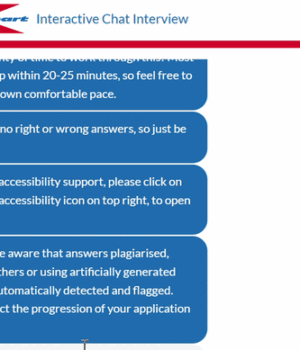
Upon entering the interview screen, a slew of “chat window” style information and pointers were given to us.
“You’ve got plenty of time to work through this!” one message read. “Most people wrap up within 20 to 25 minutes, so feel free to take it at your own comfortable pace.”
It also warned that answers “plagiarised, copied from others or using artificially generated content” would be automatically detected and flagged. “This may impact the progression of your application with us.”
The questions covered standard topics such as multitasking ability, reliability and ability to think on your feet. One question asked applicants to “tell us about a time when you had to work as part of a team to achieve a goal. What role did you play in the team’s success?”
About two hours after completing the assessment, we were emailed “personality insights” gathered from the interview as well as a coaching tip.
“Putting the needs of the group ahead of your own personal gain seems to come naturally to you,” one insight read. “Service over self is probably a good description of how you operate. At work, that kind of integrity is something people notice and trust.”
At the same time, however, the email said to, “be careful to not dominate group conversations and projects,” and “create space for others to share their ideas”.
The feedback was broadly accurate in some ways, but seemed generic enough that it could have applied to large swathes of applicants. And the notion that the applicant was both someone who puts others’ needs ahead of their own and yet risked dominating conversations appeared potentially contradictory.
Kmart is part of a growing group of Australian companies, especially in the consumer space, using AI in their recruitment processes. The country’s biggest employer, Woolworths, for example, also uses Sapia.ai to conduct the early stages of their recruitment process, as does Bunnings and Qantas.
Kmart declined to comment, but the company’s chief people and corporate affairs officer Tristram Gray previously told The Australian that applicants rated the experienced highly because it was “no longer impersonal”.
It has also increased company diversity. First Nations people now account for 8.25 per cent of those hired. At the last census, in 2021, Aboriginal and Torres Strait Islander people accounted for about 3.2 per cent of the population.
Sapia.ai founder and chief executive Barb Hyman said the software, which was established in 2018 in Melbourne, and has so far assessed more than 10 million people, reduced unconscious bias as well as time and financial costs for businesses, and also made the recruitment process for candidates more accessible.
“We don’t time the interview, which can make it more accessible for people such as those with a disability, and the lack of video can make it less intimidating,” she said.
Hyman, who has raised more than $17 million for the company, also said the company frequently tested for bias based on attributes such as race, age and disability.
Asked about the larger share of First Nations people hired at Kmart after implementing AI interviews, Hyman said the AI likely made the process more comfortable.
“Given the disadvantage they face, they might just feel more comfortable with this way of hiring,” she said. “They also might assume they’ll be discriminated against in a face-to-face interview, but not in a blind interview.”
Hyman said about 90 per cent of candidates recommended to a firm through the AI process were ultimately hired and that strong written responses given by applicants also correlated with higher verbal communication skills.
“Frontline retail candidates often don’t have a lot of experience, but need to be able to communicate with people, which isn’t something that you can test through a CV,” she said. “Everyone also gets feedback, so applicants aren’t getting ghosted.”
Asked about candidates using AI in their responses, Hyman said the software could identify when AI had been used about 92 per cent of the time, but that how this was assessed depended on the firm.
“Use of AI is flagged, but it depends on the company that is recruiting whether this rules someone out, reduces their chances of getting the job, or if it doesn’t affect the application,” she said.
Hyman said Sapia.ai served 35 per cent of ASX100 companies, largely made up of consumer brands, and that it was continuing to grow.
Australian HR Institute chief executive Sarah McCann-Bartlett said most organisations were using AI in their recruitment processes to some extent and that it was partly a response to the huge uptick in AI-generated job applications.
“More candidates who aren’t suitable for particular roles are applying to jobs using AI, creating a need and desire for employers to lean in to AI to filter through them,” she said. “Most standard recruiting software has AI built into it now, especially through upgrades or updates to existing packages.”
While she said AI could be incredibly efficient when hiring for a large number of roles and filtering through a higher volume of candidates, McCann-Bartlett said that, especially for senior roles and towards the pointy-end of the hiring process, there needed to be a human making the decisions.
McCann-Bartlett also said companies needed to be transparent when using AI and that while the technology was good for creating structured interview guides, employers needed to make sure the software had the right data to work with.
“If data initially fed into AI is not correct, it won’t be able to target the right candidates,” she said. “There’s also a lot of research on bias and discrimination in hiring. If an AI system is trained on historical data that reflects past biases or discrimination, it may replicate that.”
Get workplace news, advice and perspectives to help make your job work for you. Sign up for our weekly Thank God it’s Monday newsletter.
 Millie Muroi is the economics writer at The Sydney Morning Herald and The Age covering workplace and economics. She was formerly an economics correspondent based in Canberra’s Press Gallery and the banking writer based in Sydney.Connect via X or email.

