Source :- THE AGE NEWS
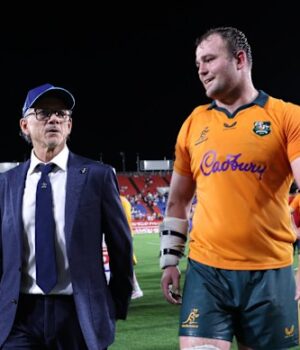
A quick flash of the Australian coaching box in the 68th minute of the Wallabies-Japan clash on Saturday caught an interesting moment: there was Les Kiss, laughing.
For context, Australia led 28-25 and were in a real fight. Players were out on their feet, Japan had belief and an historic/disastrous first win by the Brave Blossoms over the Wallabies was very much in the offing.
But if Kiss was feeling the tension, he wasn’t showing it.
“It wasn’t a frivolous laugh,” Kiss explained later. “Internally we’re learning about each other in the [coaches] box. At one moment where someone said something, one of the coaches looked at me [and said] is that all right to say that?
“So we’re just seeing how we sit in the coaches box and how we communicate. They’re a good bunch. We’re getting on well.”
Kiss did not elaborate, but the laugh came after Declan Meredith put a disappointing night with the boot behind him and kicked deep into a corner after a penalty. Taniela Tupou scored a crucial try soon after.
“It was just a nice little moment where we had a bit of humour in it,” Kiss said. “I know it was tight, but it’s got to be fun doing this too, eh?”
In keeping with the “evolution, not revolution” line often rolled out about the Joe Schmidt-Kiss transition, one of the shifts in the new environment seemed to be captured in that light moment.
But that’s not to say Kiss is happy-go-lucky. His opening Test was a pretty stern examination of his coaching – preparation and decision-making during the game.
Wallabies players said they felt well prepared for the Osaka oven, having started a heat-acclimatisation plan on day one of camp in Sydney. Kiss noted Japan even had more players than Australia cramping near the end of the game.
And the red card for Miles Amatosero also tested Kiss’ adaptability. Captain Harry Wilson spoke about the clear plan given to the players at half-time to play more narrowly, to conserve energy.
The bench rollout was worked well – forwards such as Angus Bell had a strong impact as finishers – and Kiss was not afraid to switch multiple backline positions in the final 20 minutes.
“The intensity is there,” Kiss said about coaching in Test rugby for the first time. “Intense and probably too close to the wire, but yeah, it was good.”
Value of a win not always on the stats sheet
Eddie Jones wasn’t interested in talking to Japanese media about the Wallabies after the match.
“I only care about Japan, mate,” he said. “I had my turn to coach Australia.”
But he still inadvertently made a point about the Wallabies’ win when he was questioned about some of his players’ efforts in the loss.
“I don’t know what the stats will show, but sometimes there’s more important things than stats,” Jones said.
The stats sheet wasn’t overly complimentary about the Wallabies’ performance, but the value of a tick in the only column that counts – win or loss – can’t be underestimated, given the context.
The heat was discussed all week, but it was not a minor thing filling out the news cycle. Tragically, a second division Kyuden Voltex player died last week after being taken to hospital after training on Monday in Fukuoka, reportedly with heatstroke symptoms.
The Test was played at night, but the heat still sapped the players’ energy, and the Wallabies could have wilted. We’ve seen it before: witness Santa Fe in 2024, when Australia lost 67-27 to Argentina.
But they didn’t wilt in Osaka and instead ground out an ugly win.
It was a hiding to nothing kind of Test for the Wallabies. Japan’s improvement recently hasn’t been digested by most – they beat Italy and also pushed world No. 3 Ireland – and there is still a memory of them from decades ago, and a default expectation Australia should towel them up. It is the same when Australia play Italy and Scotland, and, for some reason, Argentina, too.
But the value of a tough win like that, on the road and amid adversity, can be high.
The good vibes of a happy shed, and the confidence that comes from consistent wins, can’t be underestimated. The Wallabies haven’t made winning a habit this decade: that was just the fifth time since 2020 they have won two or more Tests in a row.
Japan left kicking themselves
With hard-running forwards and a special young talent in Ryunosuke Ito at No.10 – who was plucked out of university rugby and had not played a professional game before his Test debut – Japan were well poised to beat the Wallabies.
Jones pointed to fundamental errors as the reason for his side’s loss – 16 in total – but the wisdom of captain Warner Dearns taking a penalty goal in the 50th minute, when Australia still had a player in the sin bin, was baffling.
Jeremy Williams was standing on the sideline, ready to enter the fray and return Australia to 15 players. But if Dearns had pushed for a try, he would have had to wait for a stoppage, thus extending the advantage for a few minutes.
Not to mention a try that could have got Japan to 28-26 with half an hour to play.
Defensive changes and challenges
The one big change the Wallabies spoke about to start the Kiss era was adjusting their defence under former All Blacks defence coach Scott McLeod.
The conditions and the red card clouded the picture somewhat, but it appeared the Wallabies were looking for much more line speed at set pieces, and a mix of styles in phase attack, holding off to make calls on second-wave plays, but also with a willingness to have a shooter race up.
It was mostly a decent first outing, with an 88 per cent effectiveness of the whopping 165 tackles made. But there was also issues to work on near the breakdown, with players switching off and allowing Japan to attack behind it.
 Iain Payten is a senior sports reporter for The Sydney Morning Herald.Connect via X or email.