Source : Perth Now news
Indonesia is ramping up efforts to combat wildfires across the archipelago, deploying helicopters and thousands of firefighters as blazes spread through a popular national park in East Java and peatlands on Sumatra and Borneo islands during an unusually dry season.
Scores of firefighters, backed by 43 helicopters, have been deployed to battle wildfires that have burned more than 107,000 hectares of forests and other land across the Southeast Asian nation as of Monday, said Coordinating Minister for Political and Security Affairs Djamari Chaniago.
Strengthening El Niño conditions have raised the risk of more forest and land fires during the peak dry season, he said.
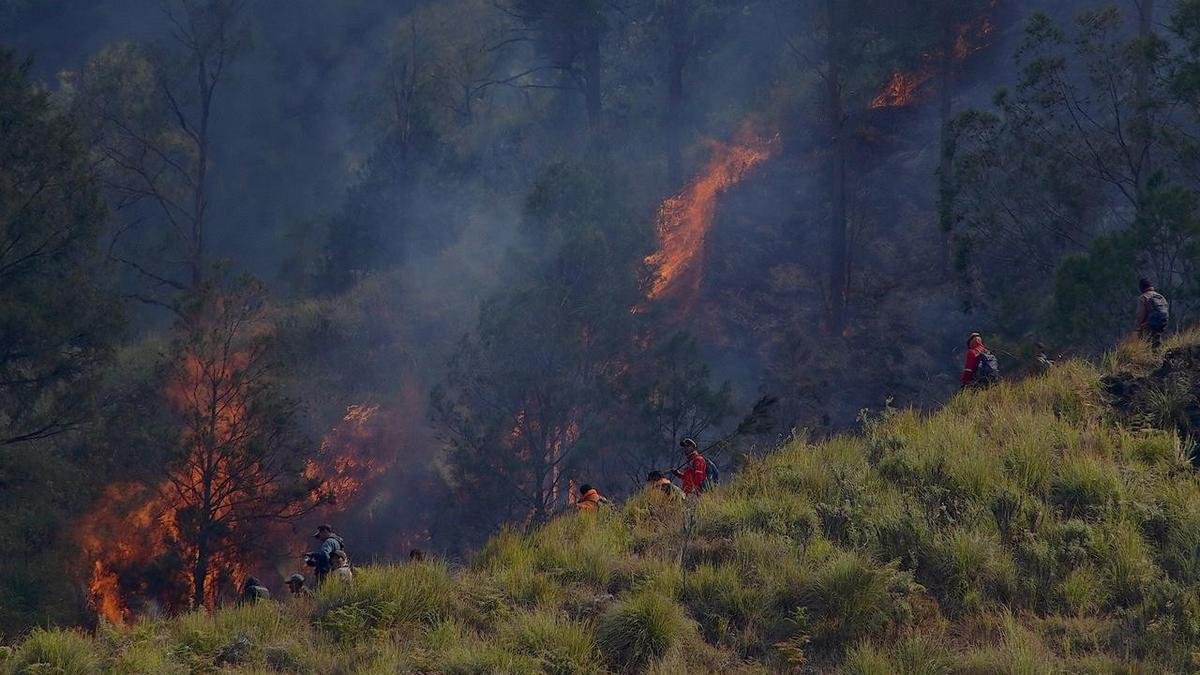
East Java authorities said the largest blaze is burning in Bromo Tengger Semeru National Park in East Java province, where about 743 hectares have been scorched.
Authorities have closed the park to visitors until further notice.
It said the fire has burned large areas of dry grassland, vegetation and protected edelweiss flowers as flames have spread to the Penanjakan area, a popular viewpoint for tourists visiting the volcanic landscape of Mount Bromo, one of Indonesia’s best-known attractions.
No injuries or evacuations have been reported.
Chaniago said weather-modification, or cloud-seeding, operations are considered one of the most effective ways to help firefighters combat wildfires by inducing rainfall through the dispersal of salt particles into suitable clouds.
However, the effort would be difficult to carry out because scientific monitoring “found no rain-bearing clouds suitable for weather-modification operations through August 18,” Chaniago told a news conference Monday.
With cloud-seeding ruled out because of unfavourable weather conditions, “we are relying solely on water bombing and ground firefighting teams,” said Forestry Minister Raja Juli Antoni while visiting Mount Bromo on Sunday.
He urged the public to avoid activities that could spark new blazes, including discarding cigarette butts and clearing land by burning.
Wildfires have been reported in several of Indonesia’s most fire-prone regions, including 48,890 hectares of peatland that have burned in the provinces of Riau, Jambi and South Sumatra on Sumatra island, and Central Kalimantan and South Kalimantan on Borneo island, forcing regional authorities to deploy over 48,000 firefighters and disaster personnel, the National Disaster Management Agency said.
The blaze has scorched about 540 hectares of peatland in Jambi alone, causing choking haze in some areas and raising concerns about worsening air quality.
In the village of Sungai Gelam in the Muaro Jambi district, dozens of hectares of palm oil plantations owned by local residents have been destroyed.
More than 5800 firefighters have been deployed to battle the fire in Jambi.
Officials said deep peat soil, limited water supplies, difficult access and strong winds have complicated efforts, even with three helicopters conducting aerial firefighting operations.
Forest and peat fires are an annual problem in Indonesia that strain relations with neighbouring countries.
Malaysia has reported unhealthy air-quality levels in parts of Sarawak state on Borneo island, with officials saying winds were carrying smoke from hot spots in neighbouring areas. In Singapore, authorities have warned that prevailing south-easterly winds could carry smoke toward the city-state, with dry conditions expected to prevail.
“We must uphold the nation’s credibility by showing that we can bring these fires under control,” Chaniago said.
Indonesia’s Meteorological, Climatological and Geophysical Agency said August and September are expected to be the most critical months as dry vegetation and strong winds create favourable conditions for fires to spread rapidly.
Wildfires in Indonesia, an archipelago nation of more than 17,000 islands, are often started illegally by plantation owners or traditional farmers to clear land for planting.