Source :- THE AGE NEWS
In David Gung’s first season of senior football in 1968, the speedy rover arrived at games well into the first quarter due to his work at a Chinese church on Sundays. When he won the best and fairest award that year, the club president presented him with an electric clock.
“I got that to remind me to play on time,” Gung said.
Harold Chin Quan was the centreman in that team. At 52kg, he was built to be a jockey rather than negotiating the chaos after a centre bounce.
“I played scared for the first two years,” joked Chin Quan, a third-generation Australian whose grandfather came to the country in 1897.
Peter Louey was the ruckman. Standing 5′10 (178cm), he was undersized.
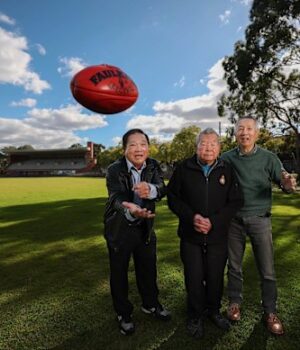
The trio formed the heart of the midfield of a team called the Young Chinese League, a social football side consisting of Chinese Australians whose story of resilience and love of the game during the White Australian policy era has been turned into a short film by director Angela How.
Premiering on Wednesday at the Melbourne International Film Festival, Carn the Chinese! explores how sections of Melbourne’s Chinese community embraced the game long before names such as Barassi, Jesaulenko and Silvagni became synonymous with the code.
How, a Singapore-born Australian, first saw the game after her family moved to this country in the 1990s. She was captivated by the speccy.
“What intrigued me was you climbed on someone else to get to the ball,” How told this masthead. “I’d never seen anyone jump so high. It was quite a sight.”
Because of the lack of Chinese or Asian involvement in the sport, “I didn’t feel like the game belonged to me culturally”, How said.
So she set about finding stories of Chinese Australians playing the sport. Though Chinese immigrants have been in Australia since the days of the gold rush, very few have reached the top level.
Wally Koochew played for Carlton in 1908. George Tansing played five games for Geelong that year, Ernie Foo represented St Kilda four times in 1913. More recently, Fremantle’s Bailey Banfield is the most prominent men’s footballer with Chinese heritage, while Darcy Vescio is the torchbearer in the AFLW. They are also an executive producer of the film.
Though the YCL played for about 50 years from the 1930s to 1986, not much is known about the team beyond a chapter in author Patrick Skene’s book Celestial Footy, which chronicles the participation of Chinese immigrants in the game.
Formed in the 1930s after a merger between the Chinese Progress Association and the Chinese Athletics Association, the YCL was not part of an official league. They quickly made an impression.
“By 1938, weekly Young Chinese League matches in Albert Park were a much-anticipated fixture on the calendar of the Melbourne Chinese community; a meeting point to build friendships and keep community strong,” Skene wrote.
The YCL played all around Melbourne and in the bush, arranging games against companies such as Ford, Holden and Kraft.
How cannot remember how she came across the YCL, but the more she learned, the keener she was to tell its story. Filming started in 2022, but other projects took up How’s time until last year.
“I wanted it to be done and them to be celebrated while they’re here,” How said. “That was really important to me and I felt a responsibility to do the work and finish it.
“Because they played through the White Australia Policy era, the thing that struck me was they were quintessentially Aussie with their larrikinism and attitude to life.
“Peter warmed to the game so naturally and played really well. By embracing the game, he became accepted. Just the fact he was good at sport, it broke a lot of barriers for him.”
Louey, 88, came to Australia on a boat at the age of 12. He lived in West Melbourne, became a North Melbourne supporter, and was a good enough footballer and cricketer to captain Brunswick Tech’s school team in both sports. He also led the YCL. In 2016, he was awarded an OAM as part of the Queen’s Birthday Honours for service to the Chinese community in Victoria.
“In Australia, if you’re a good sport, they admire you,” he said in the film.
Chin Quan is a third-generation Australian whose grandfather arrived in the country in 1897 and settled in Darwin. His grandfather grew vegetables on a farm that now sits on a golf course and the Darwin Botanic Gardens. The road dividing the two – Chin Quan Road – is named after him.
Born and raised in Melbourne, Chin Quan lived in St Kilda as a child. After playing little sport at school, he was introduced to the YCL by two cousins from Western Australia.
A metallurgist for the defence department, Chin Quan played more than 250 games for the club from 1964 to 1986.
“I could run all day,” Chin Quan, who was a lightly-built rover, said of his playing style. “I got a lot stronger. I learned how to tackle, dodge elbows. Over 20-odd years, I had a broken thumb and collarbone – that was it, other than the odd hammy. I stayed out of the way a little bit.”
Gung was one of the team’s better players. As a junior, he played for North Melbourne’s under-15 and under-17 teams, and tried out with Essendon, where he was zoned.
“When I played with North Melbourne, I had empty beer bottles thrown at me, all sorts of racist remarks: ‘Go home you chink’,” Gung said.
“The coach was a former North Melbourne player, Cole Spratling – he was a very good person. He pulled me aside after the game and he said ‘Look Dave, if you’re going to play football at that level you have to learn to live with it’.
“There weren’t rules and regulations to deal against racist remarks like they do today.”
Disillusioned after being given just five minutes by the Bombers, he gave up on a league career.
“I don’t think I was given a fair go,” Gung said.
At University High, he played alongside future league footballers Robert Peterson and John Scholes. Scholes also played cricket for Victoria, and later coached the state team.
Playing against University High’s old boys team, Gung crossed paths with Allen Aylett, who played 220 games for the Kangaroos, then – as chairman of the VFL – oversaw the league’s expansion outside of Victoria to Sydney. In an attempt to slow him down, Aylett stomped on his Gung’s toes. Worse was to come.
“To rub salt in the wound, he got the ball facing the boundary, kicked it over his shoulder and scored a goal,” Gung said.
Gung reminded Aylett of the incident when the pair ran into each other decades later at Marvel Stadium.
“We had a good laugh about it,” Gung said.
For a team of Chinese Australians that played when the White Australia policy was still active, racism was surprisingly not a big issue for the YCL, whose players won admiration from opponents for their tenacity.
“After a while, the guys realised we were a team that loved our footy,” Chin Quan said. “We played the right way – hard – and we got a lot of respect for that. We got along really well most of the time.
“There were a few incidents with people who were a bit ignorant, but by and large it was not a problem for me.”
Despite his family’s long history in the country, football made Chin Quan feel more Australian.
“Very much so, I met so many guys on the footy field,” Chin Quan said. “We’d have a barbecue afterwards and have a drink.”
Forty years after the team’s last game, the ties that bind remain strong. They’re too old to lace the boots now, but several gather for a hit of tennis and to reminisce over a meal. Gung takes Louey to the gym twice a week.
“When he was captain and I was at uni, I wasn’t earning any money and couldn’t afford the end-of-year trip to Stawell,” Gung said.
“He said ‘I’ll pay for your weekend away, accommodation and here’s a few pounds pocket money’. I’ve never forgotten that.”
Keep up to date with the best AFL coverage in the country. Sign up for the Real Footy newsletter.