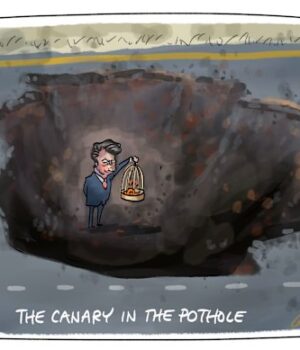
source : the age
To submit a letter to The Age, email letters@theage.com.au. Please include your home address and telephone number below your letter. No attachments. See here for our rules and tips on getting your letter published.
INFRASTRUCTURE
It would be overkill to list the grievances or problems Victorians have had to deal with during the last decade or so of Labor government. It hurts to say this, but Victorians have had to put up with a government that is increasingly revealed to have been a closed shop of factional power.
While COVID was difficult to manage, Daniel Andrews got the state through it but had to give up the Commonwealth Games at great cost. Under Jacinta Allan, it appeared only those who wore high vis garments to work were sure of work while criminal factions allegedly took their cut of taxpayers’ money aided by one thuggish union in particular.
Meanwhile, state coffers were plundered of funds that should have gone to state schools, hospitals, teachers and nurses, and roads throughout the state crumbled.
The pothole state, or the state of potholes, is the final straw (″Drivers stranded as potholes wreak carnage in wild weather″, 11/8).
Unless these holes are fixed properly for the long term, road traffic throughout Victoria will slow to a crawl and the economy, dependent on trucking, will suffer as a result. And so will we.
John Whelen, Box Hill Sth
When vital services fail, who is accountable?
Yet another day of significant delays and non-arrivals for passengers on V-line services. Passengers were delayed by up to three hours. This is not a minor inconvenience. The loss in productivity and the emotional turmoil is significant and to hear more hapless apologies is wearing thin.
There are two questions.
Firstly, is the government doing anything about the apparent lack of technical expertise that leads to these catastrophic maintenance failures?
The Telstra outage and the debacle of August 10 when a vital piece of infrastructure failed are maintenance failures. Is anyone held to account? Both the minister for transport and the minister for transport infrastructure remain silent, and for all we know so far, indifferent to these disruptions. What actions are being taken?
Secondly, given the inevitability of major disruptions on V-line services, there is no management plan to mitigate disruptions. In the latest maintenance failure, the fault happened at 6.30am of a working day.
Passengers should have been alerted and given the choice to either work from home or find alternative transport.
The government needs to address these problems urgently and explain to the public why these disruptions keep occurring and what they are doing about it.
Anne Bourke, Ocean Grove
Excessive bureaucracy before best-practice services
I totally agree with Professor Pat McGorry’s major concerns about the standards of care and safety for both patients and staff working in Victoria’s public mental health services (″FIFO boss leads Victoria’s flagship youth mental health service amid reports of patient deaths and violence″, 11/8).
I have not worked in the system for several years but have a partner and a number of close friends who recently worked or continue to work in this system.
These are experienced clinicians who have the skills, commitment and fortitude to provide the best care and humanity to people (at all stages of life) who are experiencing extremely distressing and debilitating mental health conditions.
Yet, so many of these clinicians are being hounded out of the services by management that appears more focused on maintaining an image of excellence through corporate awards, arbitrary KPIs, and excessive bureaucracy than on delivering genuine best-practice services.
Another royal commission bites the dust.
Jenny Hutchens, Greensborough
Sustainable goals
For many years now, we have been seeing increasing pressure on our systems. Existing infrastructure is being run down, suburban and rural roads are increasingly potholed and damaging vehicles, governments face workforce and funding constraints, schools and hospitals all seem on the never-never road to funding, while proposed developments such as data centres will create enormous additional demands for electricity, water and other infrastructure and cost.
At the same time, our natural environment is being depleted at an ever-increasing rate. Climate change adds another layer to the problem. More extreme heat, flooding, storms, bushfires and pressure on water supplies will require additional investment simply to maintain the resilience of existing communities and infrastructure.
This needs to be factored into decisions about what new development we can realistically afford and sustain. Simply adding more projects to the pipeline does not make us sustainable.
If we do not have the workers, money, energy, water or infrastructure capacity to maintain what we already have, we need to ask whether continually expanding development is economically or socially sustainable, let alone environmentally sustainable.
Paul Caine, Glen Huntly
From zoom to doom
I have a friend who claims he’s an expert on potholes. I call him the Roads Scholar (RS for short). He says our number plates should say “Victoria – The Holey State” or “Victoria – State of Holeiness”.
RS says that repairs are too superficial and don’t go deep enough. He says that one day, a distant car ahead suddenly disappeared. When he got there, he said he looked into a gigantic pothole to see the car, which would have been more severely damaged if it hadn’t landed on a B-double!
RS does tend to exaggerate. He says the Hume Highway has gone from zoom to doom. Thank God, RS doesn’t write to The Age, or it could be a very tedious run-up to the November election.
Kevan Porter, Alphington
Pothole detector
Cars nowadays are fitted with all sorts of safety technology, such as autonomous emergency braking, lane-keeping assist and adaptive radar cruise control. The car company that develops a system that detects and warns the driver of any upcoming potholes will be an absolute winner in Victoria.
Graeme Daniels, Balwyn North
Cars must adapt
The recent wild weather (″Tyres completely shredded: Motorists stranded for hours after falling victim to massive potholes″, 10/8) is only part of the equation in the ″carnage″ reported on country roads across the past few days and makes meaningless any claims of technological progress represented by the cars being sold nowadays.
It’s time consumers stood up against vehicles that aren’t even equipped with spare tyres, instead boasting expensive oversized wheels and fragile low-profile tyres, for little purpose beyond fashion. In addition, the hefty weight of electric cars in particular means that when they encounter potholes, they hit hard. As with extreme climatic conditions, these are predictable variables that need to be addressed by savvy consumers seeing through superficial showroom sheen.
Marish Mackowiak, Ormond
Spending our money
Whose bright idea was it to spend an enormous amount of money on bringing an NFL team to Melbourne, estimated to cost
$10.7 to $15 million? Surely, this event would appeal to a very niche market at most.
New South Wales was smart enough to reject the proposal as too expensive. Victoria could spend that money on far more essential things such as addressing the appalling state of the mental health system.
Or even, dare I say it, the truly horrendous condition of Victoria’s roads. Victoria was once ″the Garden State″; it is now ″the Pothole State″. What happened to common sense?
Oriana Collins, Hawthorn
THE FORUM
SRL will benefit us
Your correspondent (Letters, 11/8) comments on the two Suburban Rail Loop tunnels, saying they will require energy, and create pollution and transport disruption during construction.
If these are not constructed, just think of all the additional energy, diesel and petrol needed along with the pollution and transport chaos caused by the transport of the growing population.
I think the savings in terms of energy, fuel, pollution and disruption from the use of the SRL will outweigh its construction.
Laurens Meyer, Richmond
Densified already
The Age reports (5/8) that urban planning expert Carlos Moreno says Melbourne needs to become a more densely settled city. If we do, he says, this will promote liveability.
The problem with his claim is that census data shows that between 2006 and 2021, Melbourne did “densify” (especially in the inner municipalities – “Tram Track Melbourne”). Yet, at the same time, according to Mercer and The Economist Intelligence Unit, liveability fell.
A further significant problem with densification is that such construction is relatively complex and has shown to be subject to rorting.
The future of housing Australians is actually in the regions, and in DIY construction such as what Robin Boyd facilitated with the Small Homes Service, and Tasmanian architect Jiri Lev is promoting now.
Alun Breward, Malvern East
Deaf political class
Ehsan Noroozinejad’s article, “Why Australia’s megaproject boom may deepen the housing crisis” (11/8), is well written and to the point about infrastructure and planning in Australia, but the political elite doesn’t listen to common sense.
Gaye Bryant Burwood
Albanese’s punt
The deal is done. The major parties have sorted out their gambling problem. Aussies can still “have a punt” as the prime minister likes to say. That is a big red herring: gambling is legal and no one was calling for a ban.
So now, against the advice of the Murphy report that the major parties led, gambling ads stay and regulation remains weak.
The gambling lobby will be happy, they can still have confidence to send complaints to the regulator as it remains under-resourced and out of sight in the Northern Territory.
The major parties have bet that gambling reform is not the top issue for ordinary people as we manage cost of living. Sadly, for too many people, the cost of living with gambling is just too high.
When the major parties fail us, do we need more courage and clear thinking of independents like David Pocock to hold the powerful lobby groups and big donors to account?
Jenny Kashyap, Bentleigh
Twiggy’s data centre
Andrew Forrest, sometime champion of salmon farmers and giant green energy projects, is planning a super-sized data centre in Australia’s arid Pilbara region.
He may have the clean energy to run his behemoth, but so far, has failed to say which water source will nurture his data centre. The daily water usage of a large data centre is equivalent to that used by a town of up to 50,000 people.
The health of rivers is reliant on ground-water. Maltreating and misusing the waters above or below the earth affects the lot.
Nature is reality. We must protect it. Without water, we living things die.
Yvonne Parker, Portarlington
Awash with stupidity
Having seen the awkward snippet of our prime minister with some influencer referring to those melons, it wasn’t Albanese who was making offensive comments or gestures. The real issue here is politicians lowering their standards of communication efforts to engage with influencers on social media.
Looks like we’ll either have to raise the voting age to 40, or ban social media altogether.
Enough with this unaccountable drivel as entertainment for young people who’ve never been taught how to think for themselves.
No wonder we are awash with so much stupidity these days.
Bernadette George, Mildura
Netanyahu’s agenda
Of course, Benjamin Netanyahu has rejected the latest US-brokered plan for Gaza (″Netanyahu rejects plan for Hamas″, 11/8). It involves Israel gradually withdrawing from Palestinian land. That is not on the agenda for Netanyahu nor his right-wing allies.
The demands for complete disarmament of Hamas are not genuine negotiating tactics; they are simply a way to prolong Israeli occupation of large swaths of Gaza. The “yellow line″ is moving inexorably forward, squeezing Gazans into a smaller and smaller portion of their own country. The “yellow line’ is moving inexorably forward, squeezing Gazans into a smaller and smaller portion of their own country.
Lorel Thomas, Blackburn South
Smart phone problems
Smart phones are radically different to pinball machines, colour television or video games (“″Not snowflakes’: Severe mental disorders surge among young people,” 11/8). Smart phones are carried 24 hours a day, potentially exposing their users to parasocial media and preventing or reducing rsocial contact with friends and family .
The young are particularly susceptible having grown up with smart phones while their brains are developing.
There’s nothing intrinsically wrong with smart phones; they’re great for making phone calls, receiving texts – it’s many of the parasocial apps and games that cause the harm.
Wayne Robinson, Kingsley, WA
AND ANOTHER THING
Anthony Albanese
Anthony Albanese needs to stop going on podcasts. He has neither the wit nor dexterity required. In his attempts to appeal to increase his reach and popularity, he only reveals his limitations.
Russell Kidd, Carnegie
Anthony Albanese can dismiss his tasteless comments about Japanese melons as much as he likes but his body language was explicit.
Robyn Williams, Sale
When it comes to real gambling reform, Anthony Albanese is a complete melon.
Geoff Allen, Parkdale
A great cartoon from Cathy Wilcox (10/8) on the PM and gambling! He prefers to see it as a harmless punt and ignores its potential to destroy lives and families,
Phil Lipshut, Elsternwick
John Howard served his time years ago. If I were Albanese or Taylor (or should I say if I were in the shoes of either of them), I’d ignore him too.
Brandon Mack, Deepdene
Furthermore
Barnaby Joyce says why can’t Australians pick strawberries and not migrants? Off you go then Barnaby.
Ross Hosking, Blackwood, SA
The government can no longer be in any doubt. The state of potholes in our roads is a big issue in the upcoming election.
Matthew Hamilton, Kew
Gridiron comes to Melbourne – do the helmets protect their heads one wonders? At what cost?
Greg Curtin, Nunawading
Could I remind your correspondent (Letters ″Global and local″, 11/8) the reason for expending all the energy on building the Suburban Rail Loop tunnels is ultimately to remove vehicles from the road, thus reducing greenhouse gases.
Suzanne Palmer-Holton, Seaford
Is Trump trying to avenge the humiliating hostage crisis of 1979, when Iran imprisoned 52 Americans in the American embassy in Tehran for 444 days? I think he’s just opened the door to more humiliation.
Tim Durbridge, Brunswick
The opinion newsletter is a weekly wrap of views that will challenge, champion and inform your own. Sign up here.