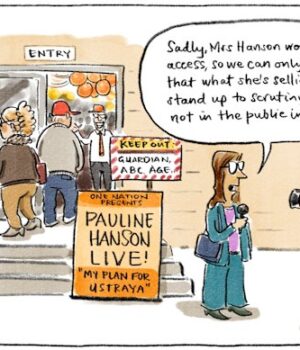
source : the age
To submit a letter to The Age, email letters@theage.com.au. Please include your home address and telephone number. No attachments, please include your letter in the body of the email. See here for our rules and tips on getting your letter published.
Surely, Anthony Albanese’s diplomatic gaffe is far from “a hanging offence″. Yes, it was disrespectful and inappropriate, but can we leave it at that? There have been other instances emanating out of parliament that are far more disturbing. Julia Gillard was constantly being referred to as a “witch″. Do we recall the way her figure was portrayed by cartoonists at the time? Gillard had the intestinal fortitude to deal with her tormentors.
Albanese naysayers should look at the bigger picture – the Japan-Australia alliance has been significantly strengthened by the visit of the Japanese PM to our shores. It is time for the media to “sink their teeth″ into issues of greater substance.
Noel Butterfield, Eltham
An apology is in order, PM
Regarding the melon brouhaha, your correspondent (Letters, 13/8) notes that anyone who views the video will appreciate its tawdry innuendo. However, they then proceed to advise the prime minister to apologise privately to the Japanese about it, and otherwise to ignore the issue and instruct his ministers to do likewise. So much, then, for responsible government.
What about an apology also to the Australian people for demeaning our international reputation, and the PM’s office?
Peter Drum, Coburg
An interview he should never have done
Surely, there are much more important issues than the interview with Anthony Albanese and a podcaster about melons. The objective of the interviewer was to make sexual innuendo of his comments and she succeeded, so much so that we are still hearing about the impact. Japan has been dragged into the event and both Albanese and Japan are apologising.
There is more to Prime Minster Albanese than this, and he should never have agreed to do the interview.
Julie Ottobre, Brunswick East
Can’t imagine Menzies doing it
I hereby admit that I am a failure – even an abject failure. I am trying to visualise Sir Robert Menzies cupping his hands in front of his chest and talking about “two beautiful melons”. And I just can’t do it.
David Rose, Nollamara WA
The Bragg manifesto in spotlight
Having watched Andrew Bragg’s speech at the National Press Club, one can be certain about three things.
One: Apparently, we live in a communist country. I’ve never heard the word communist used so many times in such a short period of time.
Two: He very obviously hates superannuation. The greatest failure of public policy since Federation. I think not.
And three: He wants people to live in sheds because they’ve got a roof and a window and they’re cheap to build.
Bragg could be the first “moderate″ Liberal to join One Nation, considering his simplistic solutions to complex challenges.
Philip West, Jan Juc
Joyce use of words just wrong
Barnaby Joyce reckons “you meet [migrants] when you’re trying to drive a car to work. That’s why you can’t get anywhere”. Does he ever consider that the ″migrant drivers″ might be a heart surgeon, an aged care worker or our next Socceroo?
Is this the best One Nation can come up with? Migrants are not the enemy.
Nick Toovey, Beaumaris
A poor reflection from an elder
When did it become OK for a former prime minister and supposed luminary of the Liberal Party to describe a duly elected government as a ″miserable rotten mob″ (″Howard’s advice to Liberals″, 12/8)? If the Coalition wants to turn their political fortunes around, they need better than such offerings from one of their elder statesmen.
David Brophy, Beaumaris
THE FORUM
Fresh air vital
Denying prison inmates regular time outdoors doesn’t just take away outdoor air. Ten to 20 minutes of sunlight a day produces vitamin D for bone health, helps set your body clock, and produces brain chemicals that boost mood (″Labor blasted on prisoner rights″, 12/8). Has anyone properly considered the true cost of depriving prisoners of fresh air?
Marianne Dalton, Balnarring
Census omission
My wife and I dutifully filled out the census. It was user friendly and not too long.
We were surprised, however, that there was no question on investment properties. It would seem that knowing how many investment properties people owned and whether they were rented or vacant would have been essential information in judging future housing demands and the effect of taxation changes.
Maybe this information is already known through other sources, but it seemed like a big omission from those who plan census questions.
Graeme Lechte, Pascoe Vale
Welsh history
Like your Welsh-born correspondent (Letters, 13/8) I was surprised that Wales was omitted as a country of origin in the census. While Wales was officially incorporated into England in 1536 (but never accepted by most in Wales), in 1999 the Welsh Assembly was allowed limited self-government.
Maybe the census should get up to date.
Dick Davies, North Warrandyte
A premier deep thinker
It was interesting to read about what makes new premier Ben Carroll tick (“The 2300-year-old advice and the AFL coach whose wise words helped shape Ben Carroll’s rise”, 13/8). Regardless of what you might think of his policies, it is refreshing to have a politician who is thoughtful and a deep thinker rather than a show pony who regards any publicity as good publicity. Considered responses to complex problems is what we need at all levels of politics in this country. Childish antics in parliament and headlines based on “gotcha” moments leave many of the voting public in despair.
Judy Williams, Beaumaris
For the common good
Shane Wright does a depressingly good job of analysing our collective misery scale (“You’ve got company on misery index”, 13/8). He talks about the problems of inflation, unemployment, rising interest rates and the war on Iran. Well, thanks we didn’t know about that. Could the misery also be due to the fact that there is less community solidarity these days? More division it would seem. Of course, One Nation likes to exploit this, which makes it worse.
I’m sure world wars were the most awful experience to live through, but the death and sacrifice united people against a common enemy. If you are part of something larger, bigger than yourself there is reason for cheer. It seems now that politicians refrain from acting against huge problems, like climate change, due to fear of offending some big group or other and thus damaging the chances of re-election. People are against housing density, fearing loss of their own amenity. Perhaps if leaders were more visionary and less self-seeking and we all thought more of the common good, we would be happier. This is not Pollyanna-ish, but isn’t it worth a try?
Jan Marshall, Brighton
Regardless of the facts
Melanie La’Brooy imagines a polite conversation about Australian immigration over afternoon tea (Comment, 13/8).
The guest, who is ″angry or frightened by immigration conspiracies″, might respond to La’Brooy’s facts on current immigration levels by repeating the old line about ″lies, damned lies and statistics″. Or they might say that regardless of facts and figures, they can see the country has changed and they do not like what they see. And when offered a slice of spotted dick, they might say, ″Yum. Haven’t had that for years. Have you got custard to go with it?″
Rod Wise, Surrey Hills
Shield us from Trump
Donald Trump is attempting to protect his own power to the detriment of democracy and the truth (″Trump hints at emergency powers″, 13/8). The powers he wants to use are meant to allow a president to act quickly, against extraordinary threats from outside the US or from natural disasters like hurricanes.
The real problem for Trump is the midterm elections, with the Republicans likely to lose control of a rubber-stamp Senate. The Trump government denies accepted science on climate change and much more. Your correspondent, a doctor, points out that children’s health in the US is being undermined by Trump’s view that vaccinations cause autism (Letters, 13/8).
The views of Trump sycophants in America are copied by some in Australia, not least within One Nation.
Democracy and science are under attack in the US. We cannot let the same happen here.
John Hughes, Mentone
Funding disgrace
Many state schools don’t get enough funds to cover general running and resourcing costs and repairs, let alone updated buildings to state-of-the-art learning facilities, like private institutions.
They are obliged to take the highest needs children in the state and the most disadvantaged. How can state and federal governments defend paying even one cent in funding to non-government schools, when they won’t resource state schools adequately?
What a disgrace.
Lynnette Patullock, Blackburn
Real housing factors
There is a housing problem in Australia, however the blame being placed on migrants is very frustrating. Other factors such as 10 per cent of properties being empty each night, short-term rentals and the price of both buying and renting are significant parts of the problem.
In the early 1990s the average household was 3.6 people in the suburban part of Sydney where I worked. It dropped to 3.3 then to below 3. That generated an immediate need for 10 per cent more housing.
Anecdotally, COVID caused a significant drop in the number of people in share households. It will be very important to see the household size shown by this census. This change represents demand increases which become supply shortages. Nothing to do with migration or the cost of building comfortable and sustainable housing.
Greg Cooper, Mount Martha
Wrong priorities
Letter writers (13/8) lament the reported $15 million for NFL and the $100 million for the grand prix plus $400 million for its new ″pit stop″. Add to that, the annual $100 million or so for ″hunting, fishing and boating″, and that’s the best part of a billion dollars. How many potholes would that fix?
Joan Reilly, Surrey Hills
Overpopulate risks
Your correspondent (Letters, 12/8) says that we need to think about all the additional energy needed, along with the pollution and transport chaos caused by the transport of the growing population. Exactly. Our fast-growing population is the main cause of nearly all the major problems we currently face as we do not have the resources or capacity to meet our needs. We expect future generations to pay the price for our environmental, social, and economic neglect, yet we are leaving our descendants very few good quality resources to work with. We need to open our eyes to see the overpopulation elephant in the room.
Jennie Epstein, Little River
Shrubbery figures
Expensive office plants in public service offices (CBD, 13/8)? Yes, we had that long ago in my day. There was a theory that much office greenery was good for mental health and improved office air quality. Once a week, a woman would water them and dust their leaves. Then one day they were all removed but, at some point, they must have re-emerged for some lucky public servants.
David Fry, Windsor
Stronger code needed
The federal Liberal Party wants to trim down the building code so that cheap, more affordable homes can be built; as if the code is the only thing stopping that happening. The building code works as a prevention to stop shoddy homes being built by unscrupulous builders.
Under the Liberal plan, people, who invest their life savings and mortgage their future earnings to get a house, may have increased their risk of ending up with one that is substandard, and they will have little comeback. It would be far better to beef up the compliance regulations and penalties to protect consumers.
Greg Tuck, Warragul
Takes the cake
Andrew Bragg, reputedly a moderate Liberal MP, has stated that low-income people should “definitely” accept living in sub-standard housing. What might his next statement be? Let them eat cake?
Mike Smith, Sandringham
Protect the citizenry
The bird flu, the COVID pandemic,and the frightening intensity and escalating frequency of extreme climate events worldwide should be blatantly clear signs to governments that they need to prioritise allocation of resources to research, planning and implementation of world’s best practice,to protect its citizens.
Kevin Burke, Sandringham
Like, but, yeah, nah
So I was looking at correspondents’ complaints about language, and the thing that irks me most is the pervasive tendency to begin answering an inquiry with ″so″, a conjunctive that requires a preceding statement like ″but″.
So annoying.
Jayson Argall, Northcote
AND ANOTHER THING
Politics
A suggestion for a potential bestselling book title: The Wit of Albanese.
Benedict Clark, Ryanston
Political discourse: Melons and indoor plants. Really?
Bill Burns,Bendigo
Whichever way you look at it, “Melongate” looks like a lemon.
Andrew Norris, Sunbury
What a pity the opposition can’t find any more serious a topic to attack the Labor government over than a tawdry spat about breasts and melons. Angus Taylor, let’s get serious.
John Walsh, Watsonia
Does Barnaby Joyce seriously think young people can’t think for themselves and come to their own conclusions (″Socialist teachers encouraging protest: Joyce″, 13/8)? He is underestimating them at his peril.
Rosslyn Jennings, North Melbourne
Is the Victorian parliament also considering bringing back the lash while legalising the ability to deny prisoners one daily hour of fresh air?
Malcolm McDonald, Burwood
Furthermore
Potholes – solution – road patrol crews – ongoing maintenance.
Vivienne Whitehead, Paynesville
Here’s a thought: how about ceasing the building/updating any of Victoria’s sporting facilities until we’ve built enough homes?
Margaret O’Connor, Balwyn
Some people think that Europe’s unprecedented heatwave has nothing to do with climate change because such conditions are not uncommon in Australia. But isn’t that what change is all about?
Bernd Rieve, Brighton
And speaking of migration, perhaps all the Anglo-Celtic arrivals post-1788 should also
be repatriated.
Dianne Lewis, Mt Martha
Finally
A question for the language pedants (Letters, 13/8): Would you be able to understand the reports if Shakespeare was reading the news on television?
Malcolm Fraser, Oakleigh South