Source : INDIA TODAY NEWS
Astronomers using NASA’s James Webb Space Telescope (JWST) have discovered a mysterious object in the early universe that appears unlike anything ever seen before, a gigantic structure larger than our Solar System that shines with the power of 100 billion Suns.
The object, detected just a few hundred million years after the Big Bang, is so unusual that researchers have proposed an entirely new category of cosmic object: a “black hole star.”
advertisement
The discovery, published in the journal Nature, was made by a team led by researchers from the Massachusetts Institute of Technology (MIT) during a survey searching for some of the universe’s earliest galaxies.
Initially, the object appeared as an intensely bright red dot in JWST images. But closer examination revealed something strange. It was far too luminous to be an ordinary star, yet its structure did not match any known black hole or galaxy.
“We think there is a central black hole that is 100,000 times as massive as the Sun,” said lead author Rohan Naidu of MIT. “Around this black hole, there would be a very extended envelope of gas that looks like a star the size of the Solar System.”
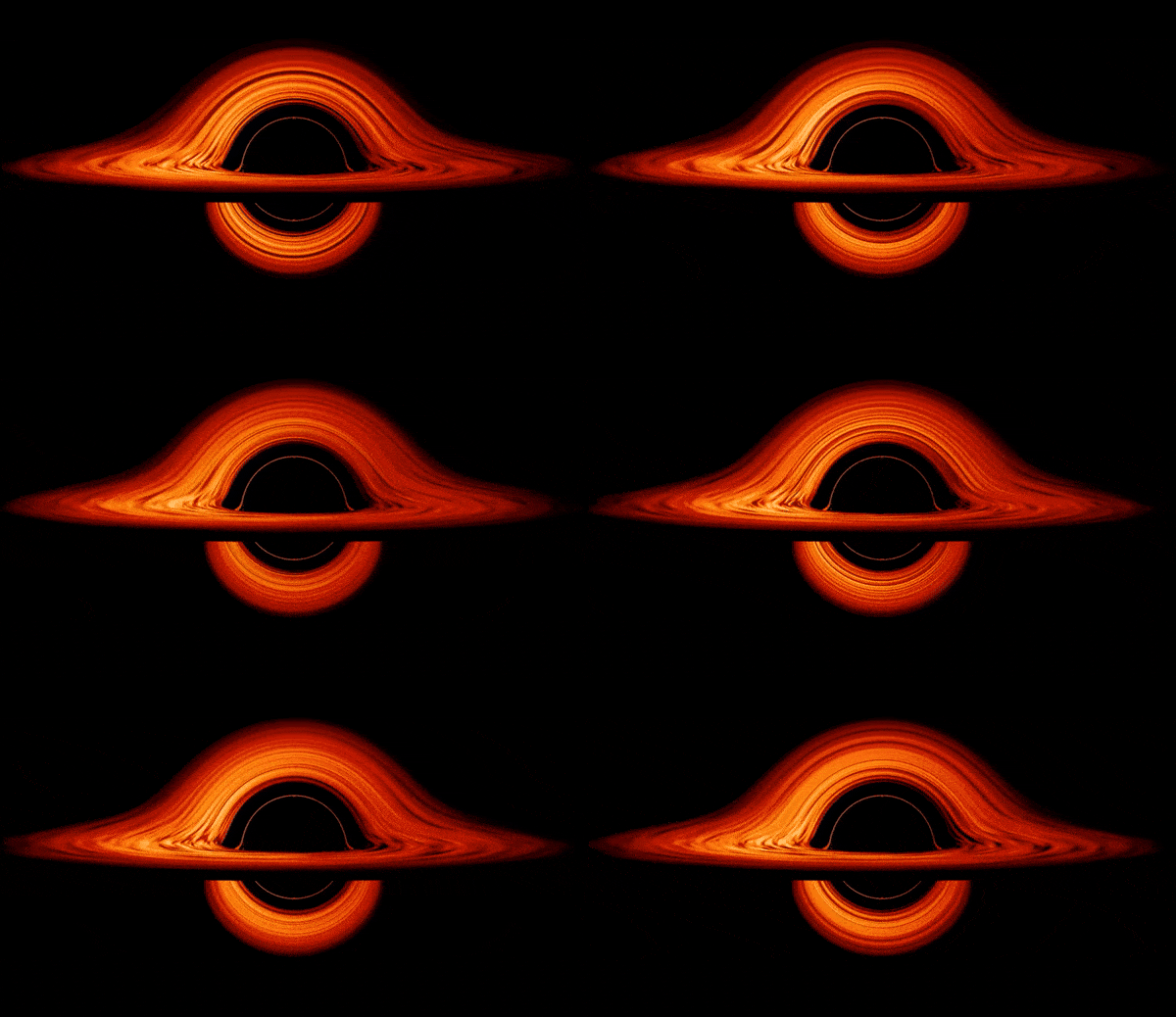
The object, named MoM-BH-1*, appears to consist of a supermassive black hole wrapped inside a dense cocoon of hydrogen gas. Unlike normal stars, which generate energy through nuclear fusion, this cosmic giant is likely powered by matter falling into its central black hole.
Researchers found that the object contains almost no heavy elements, consisting primarily of hydrogen and helium, the first elements created after the Big Bang. It also displayed an unusually deep “Balmer break,” a signature that could not be explained by ordinary stars.
Computer simulations showed that only a black hole embedded within an enormous star-like hydrogen envelope could reproduce the object’s extraordinary brightness and spectral features.
The discovery could also solve one of the biggest mysteries of the JWST era: the origin of countless “little red dots” seen across the early universe. Scientists now suspect many of these enigmatic objects may be black hole stars in various stages of evolution.
If confirmed, MoM-BH*-1 would represent the first known member of a previously unknown class of cosmic objects, offering a rare glimpse into how the first black holes and galaxies may have formed shortly after the birth of the universe.
– Ends
SOURCE :- TIMES OF INDIA