source : the age
Like Clover Moore, we all love a square, or at least the idea of one. The City of Sydney has just unleashed its plans for a big beautiful square in front of Sydney Town Hall, the fruit of a 40-year plan to replace the existing buildings around the intersection of George, Park and Druitt Streets with our own Piazza San Marco.
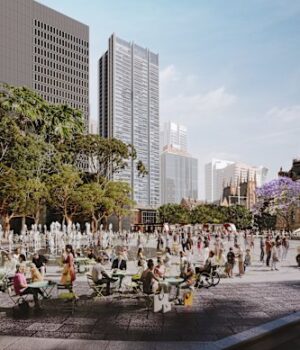
The $150 million budget has been criticised, but the council says it has long factored this into its plan and points to the re-pedestrianising of George Street as a model of economic cost-benefit. The design for the 4500-square metre square, with 30 trees, “an interactive water feature” and fixed and movable chairs, expresses the council’s vision: “Like other great global cities, Sydney needs well-designed public spaces where people can come together, spend time and connect. A civic heart belongs to everyone – a welcoming place where everyday moments and civic life sit side by side.”
The Lord Mayor, Clover Moore, who has dedicated much of her 21-year tenure to increasing shared public spaces, says, “All the people now living in the city will enjoy it very much. It’ll be a Trafalgar Square, a Piccadilly Square, like Piazza San Marco in Venice.”
The new square will open up views of some of the city’s historic buildings such as Sydney Town Hall, St Andrews
Cathedral and the Queen Victoria Building (and, um, the Citigroup and Ausgrid towers). Ah, the idea of a square. Old nonnas gossiping over a coffee in the morning, kids chasing balls during the day, open-air aperitifs in the twilight. In Europe, which the lord mayor likes to reference, the culture of town squares is a direct rebuttal to the Donald Trump-JD Vance lecture series on a continent “going to hell”. (If they want to see a culture going to hell, have they tried visiting the USA?)
But then, you might also wonder when our own visionaries last visited Europe and Britain. Trafalgar Square is a nasty roundabout jammed with open-top tourist buses and menaced by a ring of Pret A Mangers and Caffe Neros. It compares unfavourably with Trafalgar Square in Marsfield, which at least has ample parking and a bottle shop. “Piccadilly Square” is not a thing, but Piccadilly Circus is another commuter hellscape where people have to wear their mobile phones on wires around their necks while photographing the Eros statue to stop them being stolen. And Piazza San Marco might have been the “drawing room of Europe” when Napoleon was there 220 years ago, but today if you want to escape getting caught up in a group trailing after a flag, your only option is to flee into a queue for a $12 espresso.
Only in our dreams is the big European city square what we want it to be. In Paris and Rome, the Notre Dame and Louvre forecourts and St Peter’s Square are congested, configured around metal barricades, places you go to obey police and stand in lines. Istanbul’s Taksim Square is an intersection, and in Florence’s Piazza della Signoria you can watch the world go by in the guise of monstrous facial surgeries, American nepo babies and Ferragamo bags.
The ideal European squares are not the famous ones; they’re the small ones in big towns or the big ones in small towns. In square-filled cities like Madrid, Bologna and Brussels, the main square is the crappiest one, the retail and restaurant culture blighted by extortionate rents and overtourism. The squares that still manage to embody our ideals are the little out-of-the-way ones, with old cafes and bars and communities centred usually around churches, where competition does not dictate behaviour and where you can be as contented-looking as the folk in the City of Sydney’s artists’ impressions of its new square. It’s a dream, but it’s not in the middle of the big city and it’s contained in complex cultural traditions rather than utopian social engineering.
Which brings me to my point, which is that a town square is cultural more than physical. Small squares based around the way people live in apartment cities, “where people come together, spend time and connect”, have emerged organically over time. A big square can’t magically invent those customs: at best, it can only express what is already in the culture. The new square, says the lord mayor, isn’t going to try to copy the European ones; it’s “going to be very Sydney and it’s going to be very Australian”.
But what does that mean? How do Sydney’s built public spaces express who we are? Pedestrian malls like the Manly Corso, Oxford Street Mall in Bondi Junction and Parramatta Square hardly bring to life the vision splendid. Stepping out of the way of oncoming ebikes and wiping the bird poo off the public seats, our mall life is hobbled by the Australian disease of high rents and short-term retail tenancies. In 20 years, our summertime climate will have turned concrete outdoor squares into no-go zones.
If the City of Sydney wanted to study how we actually use public spaces, it might look out the window. A pebblecrete wasteland, home to the homeless, Town Hall Square could be Sussan Ley’s next project when she wants to see how the Australian other half lives. Town Hall Square belongs to that 20th-century utopian planning notion that if you build an open space you will change people’s behaviour; architecture can create community.
In Town Hall Square, architecture has created a community for pigeons and a small quota of allowable protesters, largely a place people rush through as if avoiding sniper fire. Finally admitting defeat on Town Hall Square, the council is to refurbish it next year as “Sydney Square”, a new experiment to see if removing pebblecrete and changing a name can re-engineer the way we live.
As much as we would like to see the $150 million square, which will have a “Sydney Aboriginal” name, realise the council’s 40-year vision, it’s also possible that Sydney people just don’t do public squares. We do Westfields and food courts, we do parks and green spaces (sometimes), we do sports grounds and fish markets, but throughout the Sydney suburbs our built public spaces are often dispiritingly windswept and avoidable, a disappointment to the dreams of those who planned them.
The City of Sydney envisions “a lively gathering place for generations to come”. In its artists’ impressions of the new square, those generations walk, talk and smile, or (Clover Moore’s words) sit as they already do on George Street “on those seats every day under the trees, looking at the flowers, chatting to their friends”. In the drawings, not a single one is doing what Sydney people actually do, which is rush somewhere else, scarf takeaway while wearing earpods, or sit in a Talmudic hunch over their phones, living their lives in the virtual town square, the only one they know.
Nobody in the artists’ picture is squabbling over a table, nobody is dealing with a previous occupant’s rubbish, and nobody is staring blank-eyed at the overpriced coffee and muffin they have just been forced to acquire from the chain eateries which are the only ones that can afford the surrounding rents. It’s hardly the Europhile vision, but here we go, we’re optimists, always ready to give ourselves another try.
Malcolm Knox is a journalist, author and columnist.
The Opinion newsletter is a weekly wrap of views that will challenge, champion and inform your own. Sign up here
 Malcolm Knox is a journalist, author and columnist for The Sydney Morning Herald.