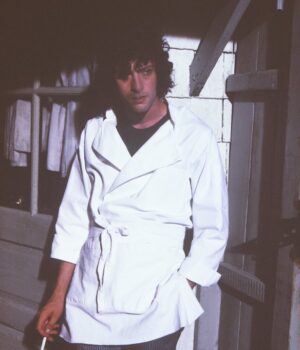
Source : the age
In Sydney, in Melbourne, in Boston and New York, haloed murals of “Saint Tony” – the beloved chef, writer and TV personality Anthony Bourdain – pay tribute to his rebellious spirit and moral integrity. On Instagram and Reddit threads, fans cite his quotes like ancient scriptures that hold the meaning of life: “Your body is not a temple, it’s an amusement park. Enjoy the ride.”
After his tragic death in June 2018, aged 61, Bourdain’s mythical pull has only intensified. It’s amusing then that, in the face of such reverence, A24’s new film Tony beckons cinemagoers with an unsuspecting whisper: You love Anthony Bourdain? Come, let us tell you the story about when he was a young piece of crap.
Dominic Sessa laughs mischievously at my summation. Before making the film, he couldn’t have picked Bourdain in a police lineup, anyway.
“I know he means something important to so many people, but for me, I wasn’t a huge fan. He didn’t exist in my life the way he does for millions of people. And that was the reason I felt comfortable doing it,” says Sessa of taking on the role of a man who, even from the beyond, remains a daily household fixture in reruns of his hit TV series, No Reservations and Parts Unknown.
Tony is a film that could be subtitled “Bourdain: The Incel Years”. It takes the early chapters of Bourdain’s bestselling 2000 book Kitchen Confidential – mainly his evocative telling of absconding at 19 to Provincetown, off Cape Cod, where his kitchen journey began – and crafts an affecting coming-of-age tale.
When we first meet Sessa’s Bourdain, he’s bloviating to college literary professors about his plans to update Orwell’s Down and Out in Paris and London. He stalks bars with a pair of nunchucks in his pants, hitting on sorority girls and bartenders with uncomfortable desperation. Painfully insecure, he lies and lies and lies. With the notch turned up slightly, he’d be Rick from The Young Ones.
You’d imagine this was an odd invention from writer-director Matt Johnson (in Johnson’s hands, even Bourdain’s infamous oyster awakening gets twisted towards shame), if it wasn’t all there in Bourdain’s own writing. From the beginning of his public profile, Bourdain never hid his demons and was quick to self-scrutiny. An “insider’s edition” of Kitchen Confidential, released in 2013 and featuring scribbled footnotes from the author, finds Bourdain furiously taking the piss out of sentences he’d written just over a decade before, fed up by a tone he now saw as pompous and self-important.
The film revels in that disposition – the man on the way to the man – taking as its starting gun a quote from the same book where Bourdain summed up his own youthful (un)appeal. “I was a spoiled, miserable, narcissistic, self-destructive, and thoughtless young lout, badly in need of a good ass-kicking.”
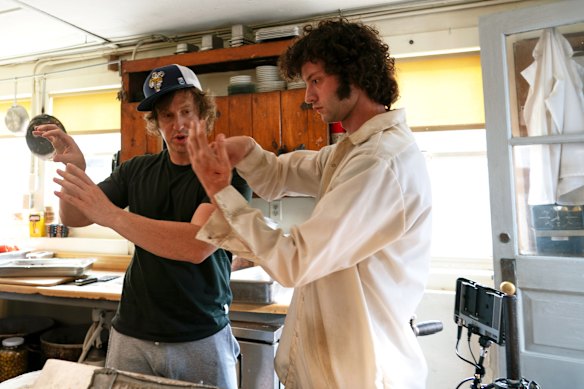
In a culture struggling to salvage young men from the clutches of toxic masculinity, it’s a loaded launch. After #MeToo, Bourdain apologised for how Kitchen Confidential – full as it was with fighting and f—ing, as much as food – might have contributed to the era’s “boys will be boys” permissiveness.
But in the film, he’s still a young scrub in search of a role model, latching onto mentors both bad (Leo Woodall’s drug-abusing, womanising line cook Sal) and good (Antonio Banderas’ wizened, zen-like Chef). For Sessa, this was the appropriate entry point.
“I can’t relate to the Bourdain everyone knows, this guy who is writing novels and working in kitchens in a professional sense, but I can relate to being an impressionable young person with pessimistic views on the world and a sense of entitlement. I know what that feels like,” he says.
“For the first time in his life, he saw like, ‘Wow, I can live my life this way? I can party and drink and do drugs and have sex and also make incredible food at the same time?’ It was in that excitement, at that moment of being opened up to this, where this person was formed.”
Sessa is speaking over Zoom from high above the Los Angeles skyline, in the office headquarters of film distribution darling, A24. The sun is beaming in LA, but with his mussy hair and sunken eyes – a ’70s character actor out of time – Sessa looks exhausted. Deep into the film’s press campaign, he’s been answering the same inane questions about his cooking skills for days. Well, he’s not getting a reprieve from me. How are his cooking skills now?
“About the same,” he says. “I mean, I can shuck an oyster and I can sauté some vegetables. I know how to make a paella now, thanks to Antonio Banderas. Not an incredibly difficult thing, but it feels good. And I know how to hold a knife a little bit better, which is encouraging.”
At 23, Sessa is only marginally older than Bourdain was when he took up the dishwashing job that set the path to his life in food. Born in New Jersey to a teacher mother and a father who worked in payroll (his father died when Sessa was 14), in tenth grade he earned a scholarship to the elite boarding school Deerfield Academy in Massachusetts to play ice hockey. When he broke his femur before his first season, he shifted his interest towards drama classes. He was still at school when he landed his first professional role in Alexander Payne’s The Holdovers, where he held his own against prime Paul Giamatti.
“In the same way that Tony is in the movie, I’ve felt myself role-playing some sort of version of myself that I thought I had to be in order to be respected,” says Sessa. “When I was in high school, I put a lot of pressure on myself to seem smart and capable. But it wasn’t until I started acting that I was like, ‘Oh, I actually could be good at this in real life, not just in my head.’
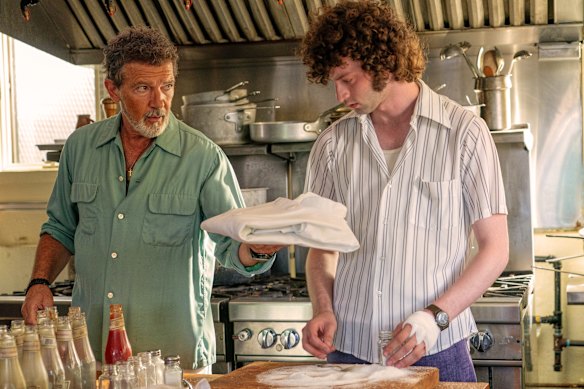
“That’s sort of the moment that Bourdain is having in this movie. For so much of it he’s telling people, ‘I’m good at writing, I’m going to be the next great American novelist’, but he has nothing to show for it. And then he has this experience working in a kitchen where he actually does something and gets better at it. He learns how to make a Lobster Thermidor! I think that’s pretty relatable for people. When you’re able to work with integrity and honesty, it changes your life. It happened for me and it happened for Bourdain, and I hope it encourages people to participate in voluntary hardships.”
Before Tony started shooting, Sessa did a brief placement in a Brooklyn bistro to learn the kitchen environment. Much of the film’s authenticity, however, comes from the cast’s rakish camaraderie.
“We didn’t have that much time [filming], but when we were in Provincetown that’s where we really bonded,” Sessa recalls. “Leo would do barbecues. He had a really cool house that he rented in Cape Cod with a backyard and a grill, so every weekend we would just go to his place and have a barbecue, drink some beers, enjoy the summer.”
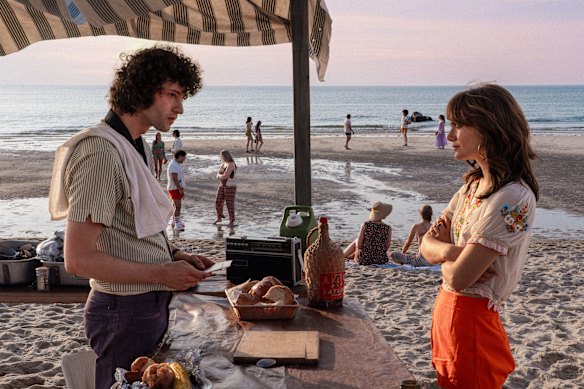
The film’s other star is Provincetown, those seaside streets where Bourdain walked and worked. In Kitchen Confidential, Bourdain wrote about the town evocatively as a Portuguese fishing community turned “pirate colony”, a home to burnouts, stoners, hippies and freaks. Sessa says there are still people living in the community who remembered Bourdain, and were eager to share their smallest interactions with him.
“A few of the restaurants he worked at are still there and operating. The pizza shop in the movie, Spiritus Pizza, the same family owns that place and they all remember him because he used to sleep above that place during the summers,” says Sessa.
“Another is a restaurant called Ciro and Sal’s, owned by the Luster Brothers. These guys are younger than Bourdain but they worked with him when he was the same age as me, early 20s, working in the kitchen, washing dishes, trying to cook. They told us endless stories. But, I mean, a lot of the stuff we couldn’t really utilise because it was too graphic,” Sessa adds with a laugh. As ever, Bourdain’s spirit lives on.
Tony is in cinemas from August 20.