source : the age
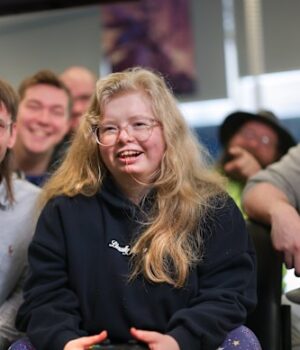
Ella jolts around in her chair playing pigeon simulator. She laughs, then screams with delight as her bird takes to the sky and wreaks havoc.
Her best friend Jen* is playing Animal Crossing on a screen beside her, and the two chat, joke and help each other navigate their respective virtual worlds.
Behind them, with his back turned so he can concentrate on the cards on the table in front of him, Tim* is too focused on a game of Magic: The Gathering to notice their laughter.
But the real magic here is that the three are not only gathered, but have become friends.
Brought together by the National Disability Insurance Scheme – or, more in particular, genU’s NDIS-funded Gamer program – the unlikely Geelong friends have intensely different personalities but a very similar need: to build social skills, confidence and ways to navigate the world outside.
They also hold the same fears: that community service cuts to the NDIS will mean the end of their Gamer funding – and their pathway into the world.
Seeing the benefits Gamer has for Ella – who has a rare chromosome abnormality, resulting in intellectual disability, global developmental and cognitive delay, speech delay, restricted growth, and low muscle tone – her mother Debbie is distressed by its potential loss.
“Over the years, we have tried many different programs that haven’t worked, [but] she just loves Gamer. All the kids are open-minded and have accepted Ella for who she is and what she is, they are very understanding,” Debbie said.
“She comes out beaming most days and lets me know she loves it. She is very, very excited to get up and motivated get to Gamer on time.
“If Ella’s funding was cut, even just a little bit or altogether, it would be just devastating for the whole family. She would probably just spend all her time in her room, and I wouldn’t be able to get her out, which would affect not only her physical health, but her mental health.”
Run by care provider genU, the Gamer program is like tens of thousands of other programs designed to provide formal social and community participation opportunities for up to 350,000 NDIS-funded participants across the country.
When The Age attended Wednesday morning’s Gamer session, there was another, larger group of participants playing games at the back of the room, separated from Ella’s gathering by tables covered with jigsaws, 3D printers and dozens more activities waiting in boxes.
But much of the talk throughout the room centred on events in another far less colourful room, 730 kilometres away in Canberra, where a Senate committee was preparing to hand down its final report on how $150 billion can be cut from the bloated NDIS over the next decade.
Like hundreds of other NDIS providers, genU had earlier made a submission to the inquiry outlining its impacts on real people, including Ella and her friends, and warning that community programs served a far greater purpose than fun and games.
“Where community participation supports are withdrawn, the evidence in this submission shows the resulting pressure does not disappear – it moves to hospitals, families and carers, mental health services, and in some cases justice and crisis response systems. This is inappropriate and ineffective substitution of services,” the genU submission to the senate committee states.
When the Senate inquiry’s report was handed down late on Friday, it all but confirmed those fears. While a Labor-led human rights committee will continue to push for ways to stop vulnerable people falling through the cracks, the report paved the way for the government to rein in the NDIS by removing 240,000 participants over the next five years, and to slash the social and community participation budgets of those who remain.
Debbie, Ella and her friends are all too aware that the Gamer program looks like an easy target for those cuts, at least on paper.
The genU program focuses on young people and attempts to engage them in interests they already have, by setting up games and drawing people in to play together, while its workers then fade into the background and subtly try to steer the interactions when needed.
Its success is that from week to week participants such as Ella, Tim and Jen increasingly need fewer interventions during their Gamer sessions, and far beyond.
“The NDIS is important because it gives me access to communities that I would normally not have,” Tim told The Age, after winning his Magic: The Gathering game.
“I suffer mass anxiety, depression, and I am autistic, which doesn’t help making friends and all that. Here [Gamer] can bring a lot of frustration because I don’t always agree with people, but that is necessary.
“It is the only reason I went out and got a job – actually, I got two jobs – because this reduces all my stress and allows me to be natural when I am outside.”
As Ella returns to Pigeon Simulator, surrounded by all her friends and carers, Debbie just hopes the NDIS cuts don’t hurt too deeply.
“It’s a worry. But we have been blessed. Ella joined up on the NDIS pilot and was one of its first participants, and we’ve been very happy. We’ve never asked for anything we didn’t need – and we’ve had that back in return,” Debbie said.