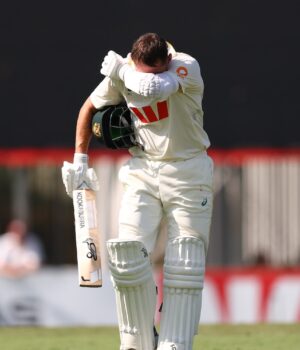
Source : ABC NEWS
You could pick a handful of moments during the first Test at Marrara Oval in Darwin where it was clear not everything was as it seemed on surface level.
On day two, Marnus Labuschagne sprinted off with his usual exuberance from the infield to chase down a shot that trickled towards the boundary.
The immaculately manicured outfield, offering a playing surface that was nigh on pristine, had already been praised for its lawn-like quality.
Mark Waugh on Fox Sports noted you could probably play bowls or tennis on it.
Yet as soon as Labuschagne slid for the ball, the ugly truth was revealed, as a huge clump of turf was ripped up in a heaped mass of mud and grass and injury potential.
This was a pattern repeated throughout the match: The outfield’s undoubted beauty was only surface deep.
- As it happened: Bangladesh beats Australia by nine wickets
- Quick hits: Das’s redemption and Mehid’s Messi attempt

Australia’s standing at the top of the Test match rankings may only be surface deep, as deep fissures have been revealed in Darwin. (Getty Images: Robert Cianflone)
An analogy to what transpired over the next four days, as the number nine-ranked Test team that were missing two of their best bowlers, thumped the world number one side at full strength on their own turf, could not have been clearer.
Bangladesh’s stunning victory in Darwin has delivered Australian cricket the shock that it undoubtedly needed.
A team that arrived without fanfare or pedigree has slapped down the world’s number one Test playing nation by playing simple, sensible Test cricket.
The bowling was slow but accurate. The batting, unspectacular but patient and disciplined.
The Tigers’ attitude was exceptional.
As the growth of the big three has accelerated inequalities between the haves and have-nots of Test cricket, Bangladesh are one of those teams that have been left firmly on the outer, yet proved in Darwin that the paucity of opportunities that have come their way has in no way blunted their potency or hunger for success within the format.
They were here to play Test cricket and play it well.
Najmul Hossain Shanto led his team with skill and composure throughout. (Getty Images: Cricket Australia/Albert Perez)
Given it had been 23 years since they last played a Test on Australian soil, their commitment to playing such an impressive style against a country that has snubbed them for so long was more than admirable.
Credit for that has to go to coach Phil Simmons and unflappable skipper Najmul Hossain Shanto.
Shanto made correct decision after correct decision on the pitch, Bangladesh never succumbing to the pressure or enormity of what was transpiring around them right up until Mominul Haque crushed Beau Webster through the covers to seal victory, a simple hug between the two not out batters sufficing as the bench finally exploded in joy on the boundary.
Bangladesh’s historic win deserves all the praise that will undoubtedly be heaped upon it, the context of which will forever be extraordinary.
Bangladesh held their nerve throughout a tense contest. (Getty Images: Albert Perez/Cricket Australia)
Legendary English cricket writer Neville Cardus once wrote that to properly consider Test cricket, you need to see the big picture.
“I wish to present the Test matches in their setting,” he wrote in the introduction to his book chronicling the 1936/37 Ashes series.
“To me cricket must be put against a background.”
So what is the background here for Australia?
Australia is about to embark on as busy a Test match year as they have ever had, playing as many as 20 Tests in the next 12 months.
From the Top End, the men’s Test team will head to South Africa, play New Zealand and England at home, then face overseas tours to India and England for the Ashes in 2027.
It is a demanding schedule both as physically gruelling and mentally taxing as they come.
Steve Smith and Australia have a lot of thinking to do ahead of the next Test. (Getty Images: Cricket Australia/Albert Perez)
Starting off with a two-Test series against Bangladesh, a country Australia has only deigned to host once before for a Test series and only played against in red ball cricket six times in total before this week was considered by most to be a friendly warm up, a competitive practice during a winter sojourn in the Top End sun.
It is, of course, incredibly admirable Cricket Australia is taking Test matches to regions that cannot ever hope to host an Ashes contest.
For financial reasons as much as from a societal responsibility, playing these sorts of Tests in this continent’s more remote, northern reaches is undoubtedly the right thing to do.
But maybe there is a sense that this is considered a form of benevolence to the lesser-populated areas of the nation.
Perhaps, for some, even playing Bangladesh is a form of charity to a nation that simply does not have the financial pull of the major nations, little more than an obligation to the World Test Championship.
Maybe, despite protestations to the contrary, that attitude sneaks into the minds of the players, so subliminally that they themselves do not even notice it.
Pat Cummins defended the team’s preparation, but perhaps they didn’t even realise they were underdone. (Getty Images: Robert Cianflone)
For how can playing in front of about 5,000 spectators in a venue where only half the oval is bordered by a grandstand compare with the cathedral-like cavernous majesty of the MCG, or the lack of pressure contrast with the parochial furnace of a packed Gabba?
Marrara Oval offers neither the stately splendour of the Adelaide Oval or SCG, nor the admittedly under-populated grandiosity of the new Perth Stadium.
Darwin is definitively off-Broadway.
And although Australia’s defeat didn’t seem to be for lack of effort, the application and necessary quality was lacking throughout the match.
Horror drops from Steve Smith and Nathan Lyon were surely aberrations, but the lazy stroke play and jittery, muddled thinking of the batters was very not.
Steve Smith was not his usual best in the field. (Getty Images: Robert Cianflone)
This shock to a team that has been creaking under the weight of their own success for a number of years now is one that has probably arrived eight months too late.
It was due last summer against England before those Bazballers tripped up over their own hubris.
A papering of the cracks was the result of that emphatic 4-1 Ashes victory, the foundations of sand upon which the top order was built were never tested, the supposedly seismic impact of a fired up England bowling attack never coming to bare, self-sabotaging itself amidst a storm of recriminations in the boozy sand of Noosa.
So on we continued. Australia’s brittle batters went off to earn their coin in meaningly limited overs matches and failed to address the issues that have plagued them in red ball cricket, perhaps even accentuating the problems by promoting angled bats and rash shots.
Now the show moves to Mackay and presents Australia with an ever-bigger list of questions and problems to face.
Jake Weatherald’s status as opener has to be looked at. (Getty Images: Robert Cianflone)
Australia were rusty and not up to speed in Darwin.
Even if Mackay’s Harrup Park, the newest venue to host a men’s Test in Australia, provides a suitably refreshed outlook and attitude from Australia next Saturday, will victory there do anything else other than to plaster even more paper over gaps that are swiftly turning into chasms?
It’s been eight years since a rambunctious tour almost boiled over, a sorry spectacle that was quickly overshadowed by a sandpaper-scraping that was barely as coarse as the friction generated by two teams flirting on the edge of respectability throughout.
Any weakness in Australia’s psyche will be ripe for exploitation in southern Africa, and the venom is unlikely to be as hidden as it was in the far north of Australia.