

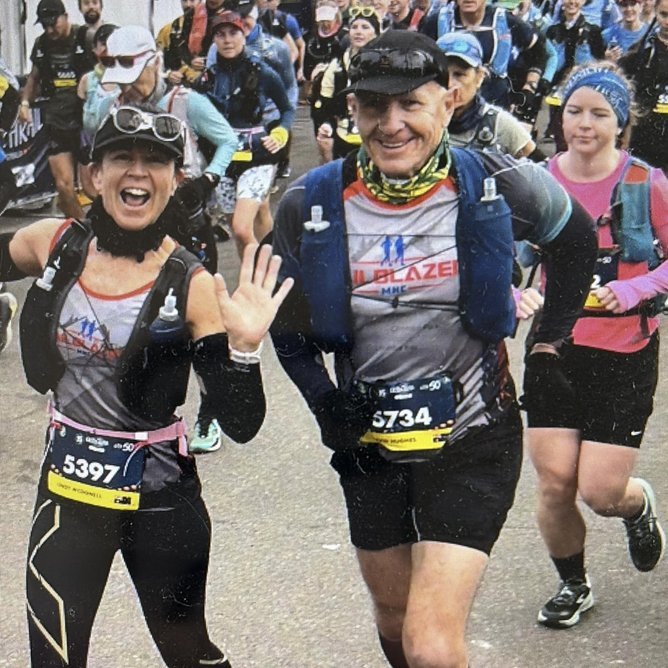
Source : Perth Now news
More older Australians are lacing up as running becomes less about speed and more about staying strong, mentally sharp and physically capable in later life.
Research is increasingly showing that running at an older age can help preserve fitness, support brain health, strengthen bones and maintain independence, provided training is managed properly.
For David Hughes, 71, those benefits have been life-changing.
Mr Hughes took up running at 62 after surviving stage three melanoma and has since completed seven marathons and ultra marathons, more than 200 parkruns and a long list of other races.
“In 2013 I was diagnosed with stage three melanoma cancer and was advised I have an 80 per cent chance of it returning within five years,” Mr Hughes told NewsWire.
“It was a depressing time and I gained so much weight.”
When he reached that five-year milestone cancer-free, he decided it was time to change his life, beginning with one short, brutal attempt at exercise.
“I initially decided to do a crazy thing and run 100 meters,” he said.
“It was horrible and as I lay on the footpath gasping for breath I decided running was not for me. Until it was.”
What followed became a second act built on persistence rather than speed.
His story mirrors a broader shift in running, where older athletes are becoming an increasingly visible part of the sport, from local 5km parkruns to some of the country’s biggest marathons and toughest ultras.
Analysis of the 2025 Sydney Marathon found nearly 6000 finishers were aged 50 and over, making up about 18 per cent of the field, while 249 runners were in their 70s and five were aged 80-plus.
At parkrun, research has found the average Australian participant is about 40, while one Albert Melbourne event recorded more than 90 finishers aged 60 and over.

The science is also catching up with what runners like Hughes have discovered first-hand.
Studies on older adults have shown aerobic exercise can increase brain volume and improve memory, while long-term physical activity has also been linked to lower rates of bone loss.
“My biggest challenge is to slow down the decline in strength, muscle mass, flexibility, vo2 max and balance as I age into my late 60s and early 70s,” Mr Hughes said.
“Ageing affects all of these, but regular exercise slows the decline so much that many active 70 year olds out perform sedentary people decades younger.”
“My vo2 max is in the top five per cent of runners of my age and my fitness age is 59.”

A 2019 review on master runners found regular training can help older athletes preserve performance and function far better than inactivity, even as the body adapts to age.
It also helps explain why many runners in later life remain strong in endurance events, where pacing and efficiency become increasingly important.
“Someone in their 60s and 70s will train so much more differently to someone in their 20s and 30s,” Mr Hughes said.
“The principals however will be similar but more emphasis on recovery and strength training.
“I undertake lower body strength training twice a week for 45 minutes.
“I attend pilates twice a week and have a fortnightly remedial massage. Nutrition is a high priority and alcohol is limited. Rest is pivotal.”
That approach is backed by injury prevention research. A major systematic review and meta-analysis published in the British Journal of Sports Medicine found strength training reduced sports injuries by nearly one-third and cut overuse injuries by almost half.
That is particularly important for older runners, whose tendons, ligaments and joints adapt more slowly than their cardiovascular fitness.

Late-life endurance has long had its own Australian role models, including Cliff Young, who famously won the Sydney to Melbourne Ultramarathon at 61, and Shirley Young, who started ultra-running in her early 60s and later held numerous Australian and world age-group records.
Research suggests ultra-running may favour older athletes even more than shorter race formats.
A 2014 paper in the journal Clinics found runners in their 40s dominated ultra-marathons from 50 miles to 3100 miles, with peak performance generally shifting older as race distances increased.
In some of the longest events, the upper age of peak performance reached about 45 for men and about 51 for women.
For older people thinking about lacing up, Mr Hughes has simple advice: “Just do it.”
“It changed my life for the better … you don’t have to be the best, just the best you can be.”


