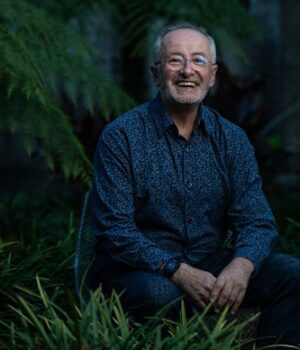
Source : the age
Seven years after stepping away from regular television, former Enough Rope host Andrew Denton is contentedly settled into the second act of his life. Acknowledging the high points of his career, the 66-year-old broadcaster says he doesn’t miss his former life. “Not in the slightest,” Denton says.
“Of course, there were beautiful moments and exciting moments when something really flew or worked, but all the nervous energy of it, I didn’t like. I was happy to go. I’d done everything I wanted to do. I also had a sense, and I do believe this strongly, that people should get off the stage and let someone else on.”
But television has a strange way of finding its way back to your door, and on Sunday night, Denton was inducted into the TV Week Logie Hall of Fame. It’s an unexpected honour, but not an insignificant one. Since its inception in 1984, there have been just 41 inductees, including television pioneers Hector Crawford and Reg Grundy, actor Ruth Cracknell and journalists Laurie Oakes and Kerry O’Brien.
When the organisers of the awards contacted Denton to advise him of the honour, Denton assumed they wanted him to present an award during Sunday night’s telecast. As he called them back, he confesses he was framing the words to politely decline.
“I had my reasons for not going all worked out,” Denton says. “Perhaps ungraciously, my first response was ‘oh, no’. Because as you would remember, I’ve had a very bountiful harvest of shit-canning the Logies down the years. But then it was explained it was a jury of peers, and I liked the thought that the late Sam Neill was addressing that jury of peers.
“I remembered whenever I’ve seen people [who have received the honour], like Magda Szubanski and John Clarke, I always think, ‘well, I’m really glad they’ve been recognised’. So I came around to the feeling it would be churlish to say no. I’m happy to take a bow, and I’m happy to share a couple of things and acknowledge a few people.”
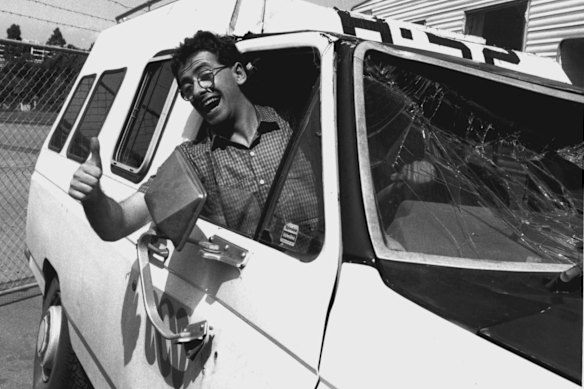
Denton’s media career is almost unrivalled. He began at Triple M in Sydney, moved to the ABC, where he presented Blah Blah Blah (1988), The Money or the Gun (1989-90) and Live and Sweaty (1991-1995), and to Seven, where he hosted Denton (1994–95). From 2003 to 2008, he hosted Enough Rope with Andrew Denton, and he was executive producer of the ABC’s The Election Chaser and CNNNN.
It’s an unsurprising life, perhaps, when you consider his father, Kit Denton, was a broadcaster, a writer and an author. Andrew Denton, the son of a storyteller, naturally became a storyteller himself. “Dad was a brilliant communicator and writer,” Denton says. “Wordplay and exploring ideas and being able to contest the point of view, that was all part of our life. That was the water in which we swam.
“I didn’t intend to have a career in the media. Whoever sits down and plans that? Probably some do, but I didn’t.
“I was confident in my ability to express myself and probably overly forceful in my confidence with some of my ideas, but that’s what young people do. Dad was also very encouraging of me as an interviewer; he thought that was my strength more than comedy.”
When Denton came to television from radio, he was a transformational presence. Not just in his ability to upend the medium and find fresh takes on established ideas, but also because he brought fearlessness to the form, and he balanced it with integrity and humanity. He took no prisoners, but he never lost an innate sense of kindness.
The ABC, where his skills were fostered, was an extraordinary toy box for emerging talent at the time. “It was a magnificent space I stepped into,” Denton says. “I was really lucky to be surrounded by people who had real intellectual curiosity, but were playful.”
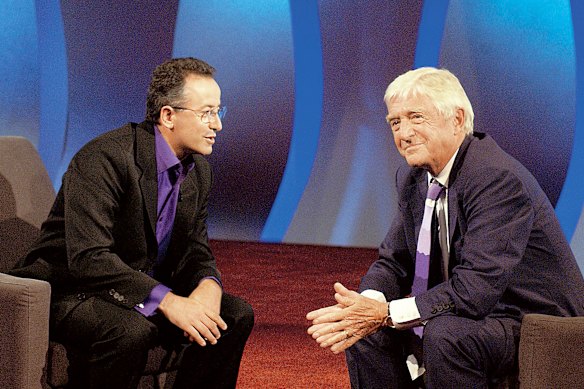
Denton’s legacy in television is perhaps that he preserved and platformed the art of conversation. Enough Rope was an ambitious idea that contradicted the trend to shorter programming, simpler soundbites and less in-depth detail. It was a reaction to losing “the stuff we really talk about. I didn’t matter who was on, I pretty much asked the same question of everyone, which is, ‘life’s tough, how are you going?’. I’m very proud of it.”
Denton’s post-television life has been relatively quiet in media terms, though he has become a powerful advocate for voluntary assisted dying, founding the charity, Go Gentle Australia, in 2016 to campaign for legal reform. He sums up his post-TV focus in a single word: “Injustice. I discovered, and then discovered further, a deep injustice happening to people who were vulnerable and dying. So this is the particular hill on which I’ve planted my flag.”
It has been, he says, “an extraordinary rich second act. I’ve just met an entire community of people who have absolutely nothing to do with my previous community, who I still have lots of connections with and fun with and joy with. But I just cannot believe that I found this entire new world, which is in its own way extraordinary and sustaining, and I feel very fortunate”.
Having a conversation with Denton is a joy. It is why, perhaps, the famous and the infamous were so easily drawn to Enough Rope. He’s older than I remember from our last meeting, more than a decade ago, but only by a fraction. The un-manufactured smile, and the twinkle in his eye, are undiminished. Long after the interview has ended, we have to forcibly end our chat because work and the world beckon us both.
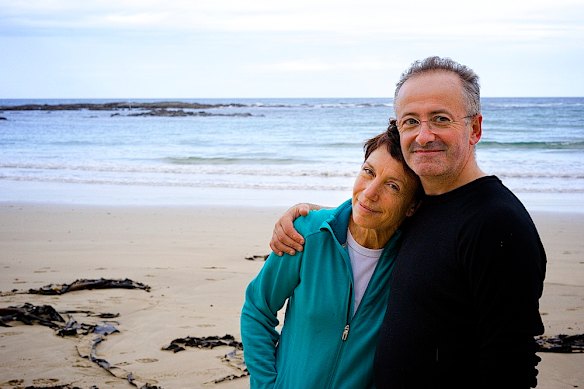
To finish, I ask him about his real life, with partner, journalist Jennifer Byrne, and son Connor, and in what ways the people in his life make him joyful. “That’s a lovely question,” he says. “Jennifer and I, I doubt there’s a day when one of us doesn’t say to the other, and perhaps more than once, ‘how lucky are we? How good is life?’.
“Yes, we have challenges and issues, like every family, but we feel so fortunate,” Denton says. “We certainly feel, both of us, deeply fortunate for the media careers we had. It was a very rich time. My son is going to get married. He’s doing really well in his chosen career. We have great friends. I’m engaged in a super interesting moral ethical issue with my advocacy work.
“What I’ve learned is the more generous I become, the happier I get,” Denton says. “And generous doesn’t mean giving a gift. It means sending a message. It means acknowledging somebody’s done well. It means reaching out to people and taking the time to do that. I’ve discovered a key to a happy life is generosity of spirit.”