source : the age
To submit a letter to The Age, email letters@theage.com.au. Please include your home address and telephone number below your letter. No attachments. See here for our rules and tips on getting your letter published.
STATE ELECTION
The Victorian Coalition has now committed to spending $90 million a year to save some of us (predominantly in marginal seats) toll charges (“Road tolls to be capped at $50 weekly under Coalition commuter plan”, 16/7). Rural voters must be ecstatic about paying more taxes to subsidise Melbourne.
It would help if they could now explain how they’ll keep their commitment to reduce the state debt (by an albeit minuscule 1 per cent per annum) by doing that, when they are also spending $250 million extra per year on potholes, cancelling the ESL, lowering payroll tax, getting rid of land tax and employing thousands more police and PSOs (if they can get them) – without cutting services or sacking public servants.
Maybe it explains why their social media posts now talk about “stabilising” debt rather than reducing it, as they have until recently.
Richard Jamonts, Williamstown
Pledge gives help to those who don’t need it
Jess Wilson’s cap on toll fees considers, like so much policy, that the cost-of-living crisis is experienced by everyone equally.
Why give a motorist on $800,000 a year the same help as someone on $80,000? Such general applications assist those who don’t need it while reducing the pool of what might be made to those in real need of financial assistance.
Jenny Herbert, Metung
Wilson gives low priority to sustainability
Victorian Opposition Leader Jess Wilson has made a number of announcements which focus on the the cost of living but indicate the low priority her Coalition give to sustainability.
Bringing back weekly bin collections ignores the benefits of lowering the amount of waste going into landfill and increases costs to councils. The opposition say they will “end the gas ban” but helping switch Victorian households to more efficient electric technology will have economy wide benefits, reduce harmful pollution and increase energy security.
They say they will run coal plants for as long as possible, locking in more pollution and climate harm for our communities and raising insurance costs.
Nature is under increasing pressure and climate risk is rising. Hip-pocket announcements may be popular, but I don’t think these policies will make Victoria “safer or more affordable” in the long run.
David Hudspeth, Burwood
Grid costs are a major part of power bills
The good news is that “record-breaking renewable energy generation” has helped many customers, with lower bills. The bad news is that the grid will continue to require major investment (″Energy giants warn big test still to come for power grid″, 17/8).
The Australian Energy Market Operator (AEMO) confirms that the cheapest way to maintain grid reliability is with wind and solar, backed up by batteries, hydroelectric and some gas.
LNP energy policy includes building more rooftop solar and battery installations in urban areas. There would be major impacts of Jess Wilson’s promise to protect farmers by “pausing major transmission projects”. Whatever the chosen energy mix, grid costs are a major part of power bills.
John Hughes, Mentone
Why does all the money go to one firm?
In the same edition, The Age reports that a private-sector consortium is circling to get the inside running on building the airport rail link (″Private sector weighs bid to help Melbourne’s airport rail link finally take off″, 16/8). We also read that the Coalition will use our taxes to subsidise Transurban tolls. One may have hoped the Coalition would offer a government that would rein in such cosy deals. If cost-of-living pressures are such that commuters require assistance, why should all the money be directed to one firm? .
Eric Keys, retired transport planner, Flemington
Tawdry vote grab
What a ridiculous idea of the state Coalition to reimburse tolls of up to $3000 per year. It makes one wonder if the Coalition would be any better at government than the current lot. This is nothing more than a tawdry attempt at vote grabbing, something that we are more than used to in Australia. It means all Victorians will pay, instead of the toll road users.
This considered action has nothing to do with Transurban, and it does not deserve criticism as it only operates the roads and will receive normal payments due. Keep in mind, Melbourne would not have the freeway network we currently have if it was not for the toll operator.
Mike Weiss, Vermont South
THE FORUM
Small business lament
The proposed changes to the tax system, especially the changes to trusts will decimate small business. However, this is hardly mentioned in the media or by politicians. Small business accounts for half of all business output in Australia.
Farmers have a strong voice in the National Farmers’ Federation and the Nationals, and have successfully argued for a carve-out from the tax changes. But why do these 400,000 small businesses that operate through trusts not receive the same consideration? Because they don’t have a voice. (When was the last time anyone saw a headline from the Council of Small Business Organisations Australia or even know who COSBOA is?)
And so, democracy fails. The single vote of a coffee shop owner is valued the same as a public servant who wants to retain “work from home” privileges, or a uni student who votes for HECS fee relief, or the salary worker who demands childcare rebates.
None of these voters care about the changes to the tax system. And so the crucial engine of economic growth in our community will pack up and leave. And we will, as a nation, be all the poorer for it.
Wayne Alexander, Eltham
COVID not the problem
Neil Mitchell’s article (″There’s a nasty mood festering in this state″, 16/8) describes the negative society in which we live. Various reasons for the anger and resentment are postulated, such as a hangover from the pandemic. The pandemic privations – there were many– finished almost five years ago.
Blaming the pandemic cannot continue: we can and should be over this. Those who lived through WWII, especially those survivors of Japanese POW horrors who came home and got on with it, worked to rebuild their lives without the anger and appalling behaviour demonstrated now.
The negativity of the press – eg. describing Victoria as a ″rust bucket″ – contributes to disaffection, as does the focus on trivia: ″melongate″. General ignorance is a problem – in an age where the wisdom of the world is available with a click of a few buttons, far too many people look to lies and false ″information″, forming opinions which are simply wrong.
Louise Kloot, Doncaster
Rich and poor divide
As we approach our state election in November, columnist Neil Mitchell seems to skip over the fact that this anger is not just in our state, or our country, but a mood expressed throughout the “free” world.
Among a list of possible reasons, he leans heavily on the aftereffects of Victoria’s onerous COVID lockdowns. This doesn’t explain why populists whipping up anger are rising in most Western nations. How about the huge wealth gap that has opened in these countries?
The Australian Institute of Health and Welfare cites several studies showing wealth inequality significantly reduces happiness in a society. We watch as the “so-called” leader of the free world uses his position of power to enrich himself and his cronies and cuts aid to desperate people on or below the breadline.
Closer to home, who wouldn’t be angry to see our taxpayer dollars fed to already wealthy private schools while the schools their children attend are unable to cover even the most basic necessities?
There are many struggling families in Australia, and it is hard to imagine that this anger won’t continue while they see their “well-off” neighbours enjoying many advantages not available to themselves, not to mention the billionaires able to consistently multiply their wealth every year.
The Albanese government’s recent changes to tax breaks for the wealthy and those with investment properties are steps in the right direction to address the wealth gap. Much more needs to be done at state and federal levels, however. Let us start looking for solutions, rather than blame.
Jan Downing, Hawthorn East
Elephant in room
I would suggest that Neil Mitchell’s article (16/8) misses the elephant in the room. Is Victoria much different to the US or UK? What do these places have in common? The failed and selfish economic agenda called neo-liberalism. Oh, and then the columnist’s irony to quote the Centre for Independent Studies, a bastion of free-market individualism.
Phil Labrum, Trentham
Saw it coming
On reading “The Emerald Isle has turned yellow as food supply fears rise across Europe” (16/8), I’m reminded of an ABC Radio National report 20 years ago in which Philip Adams interviewed a British climate scientist who said the British Isles and Europe would face a semi-arid climate within a century.
He said people can live in semi-arid climates but that the population supported would be substantially less that at present and that if carbon emissions were stopped immediately, it would take at least a century for the atmosphere to repair. I think that this summer in Europe is illustrating that the prophesies made are coming to pass.
Christopher Jarvis, Point Lonsdale
Living in hotboxes
Many years ago, during an intense heatwave, my late mother-in-law came perilously close to death. She was in her post-war weatherboard house with poor insulation, and, by the third day of heat, with her air conditioner malfunctioning, her house was an inferno.
Hearing her weak voice on the phone we rushed to her side with a fan, wet towels and ice cubes and were able to cool her before the excellent ambulance members came. They were surprised she was alive.
There are thousands of homes of the type she lived in still being used in Melbourne today. They are hotboxes in summer and freezing in the winter. There are also a remarkable number of later built houses and units with no trees or eaves for shading.
To hear Coalition shadow ministers suggest we build lower quality houses is madness. Heat waves are raging in Europe and people are dying in their apartments that were designed for a totally different climate.
Houses built now will still be there in 40 years when the climate will be hotter still.
Helen Hook, Black Rock
Yielding to idiom
“The reason why” used in journalist Nikki Barrowclough’s first sentence (″There’s no getting around it: We need to talk about this irksome word″, 15/8) is a tautology but nonetheless has become somewhat idiomatic. At what point does prescriptive grammar yield to idiom?
There are many phrases in English whose origins are obscure and which are not capable of grammatical deconstruction. The writer’s use of ″reticent″ rather than ″reluctant″ is indicative of the way in which words whose meaning once clearly delineated are now becoming interchangeable. The word none can mean no-one or not any as one wishes.
Justin Mackenzie, Sassafras
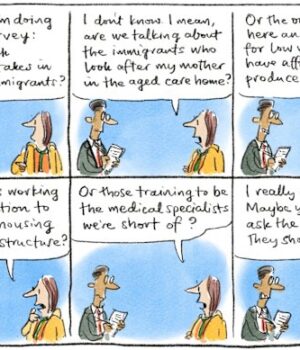
Immigration question
Has federal Labor left its run too late on immigration? (“Labor marked down on migration as delayed visa shake-up approaches”, 17/8). In the last stages of Joe Biden’s presidency, it finally dawned that his open door immigration policy was failing, and he rushed in measures to change it, but too late. In the US public’s mind, Biden was soft on immigration and he and the Democrats suffered as a result.
Perceptions in politics take a while to develop, but once they do, they are hard to eradicate. Labor needs a bold, plain statement signalling to the electorate that it is taking charge of this mismanaged system with a new policy framework: sustainable, transparent and catering to the interests of all Australians – not just the business class, whose interests in a high immigration intake are clearly self-serving.
Greg Gardiner, Brunswick
Punching the ball
Sports journalist Michael Gleeson’s explanation that you can’t punch your own ball through for a score after the siren has not always been upheld by the league (″The AFL’s quirky rule exposed amid frenzy of Saturday night’s draw″, 17/8).
At round 1, 1982, Carlton v Fitzroy at Princes Park, Mario Bortolotto punched the ball through for a score to Carlton and the match resulted in a draw.
The technical ruling was that the trajectory of the ball would have taken it through even if Mario hadn’t punched it, and as such the goal umpire adjudicated the punch had not assisted the score. Goal umpires back then must have had a type of ESP.
Stephen Turner, Quarry Hill
Denton a class act
Thank you to the Logies awards for recognising the extraordinary talent of Andrew Denton whose strength was guiding guests to step away from their protective public personas and being authentic. It made for extraordinary viewing on Denton Unplugged.
It was a masterclass of extensive research to see what others say about them, including many celebrities who hide behind their PR machines and don’t usually go off script. His shows never insulted the intelligence of his TV audience, and for that I am extremely grateful, providing us with so many memorable moments.
Sally Walcock, Toorak
AND ANOTHER THING
Accolades
My faith is restored. Muster Dogs won a Logie.
Heather Barker, Albert Park
Andrew Denton’s acceptance speech for his Logie Hall of Fame award was full of grace, humour and humility. Politicians of every ilk should be forced to watch it!
Peter Venn, East Bentleigh
Will Pauline Hanson now request an official enquiry into Shane Jacobson’s joke about her at The Logies? If Gina Rinehart gets offended at jokes at her expense, will Pauline follow in the same manner, or do commercial networks get a free pass ?
Jenny Smith, East Melbourne
Can I kindly remind Dave Hughes of the infamous speech by Ricky Gervais at the Golden Globes where he called out the hypocrisy of privileged celebrities: ″You’re in no position to lecture the public about anything as you don’t live in the real world … you’ve spent less time in school than Greta Thunberg″.
Pamela Papadopoulos, South Yarra
Cricket
Good to see only whole numbers used on the report card for Australia’s Test cricketers. Food critics and others, please take note (“Australia player ratings after shock Test loss to Bangladesh”, 17/8).
The use of half marks is pretentious and unnecessary when the mark is already out of 5, 10 or 20.
Lindsay Zoch, Mildura
Surely, it’s no coincidence that Australia’s capitulation to Bangladesh occurred in Darwin, whereby Bangladesh best adapted to an old-fashioned notion of preparing for a five-day Test match.
The folly of the Aussies was to rely upon hubris, the downfall of many who have come before.
Tim Goddard, Barwon Heads