

SOURCE :- THE AGE NEWS
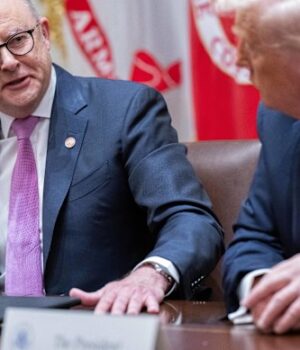
Prime Minister Anthony Albanese has had a tough five weeks in trying to manage “melongate”. He may well heed the advice of James Massola, chief political commentator of this masthead, to forge a “strategic retreat” when a nasty issue undercuts the PM’s standing and authority. But that is not the case when it comes to how the PM deals with President Donald Trump. Albanese has deliberately decided that it is in Australia’s interests to pursue and lock in granular transactional engagements that will not only continue 100 years of mateship (coined by Joe Hockey, a former ambassador to the US) and the 74-year-old ANZUS alliance, but will also keep Australia out of harm’s way on Trump’s chessboard.
Trump has inflicted significant pain on Australia with his vicious wielding of punitive tariffs with virtually every nation the United States does business with. Trump has shredded the US-Australia Free Trade Agreement – a pact that spurred economic growth in both countries. Trump’s Iran war compounds the damage to Australia’s economy.
As Trump has exercised his America First agenda across the globe, he has alienated the leaders of America’s strongest allies. They have hit back directly at Trump, both rhetorically and with aggressive policies designed to blunt the Trump tariffs and remain economically competitive.
Canada’s Mark Carney (US trade talks are “nasty”), France’s Emmanuel Macron (Trump does not have a “serious” approach on Iran), Italy’s Giorgia Meloni (Trump’s “constant, unprovoked attacks”), Japan’s Sanae Takaichi (“rolled her eyes” at Trump’s remarks on Pearl Harbour), Denmark’s Mette Frederiksen (stop “threatening” Greenland), Germany’s Friedrich Merz (Iran had “humiliated” the US), and many other leaders have bridled at Trump’s mean language towards them.
Hostility flares on all fronts. This is not Australia’s posture.
When Trump starts trade wars, the PM firmly declares Australia is innocent and floods the policy and political channels in Washington, from the White House to the Congress, with rock solid evidence that the tariffs are unjustified and must be wound back. There is no threat of retaliation. Instead, Australia keeps grinding away.
In the war with Iran, when Trump asked if Australia would join a European armada to clear the Strait of Hormuz, the answer was a low-decibel decline, with no judgments publicly expressed about how Trump is prosecuting the war. Trump has twice said he is “not happy” that Australia would not participate. But Trump did not make it a defining moment in the alliance.
With continuing speculation that AUKUS could sink of its own weight, according to Albanese, Trump has expressed “full steam ahead” on the partnership. If there are make-or-break issues such as the production schedule, they are not at the Oval Office level.
The secret of the PM’s success is in how the relationship is conducted. It is not a relationship dependent on meetings in the White House, but on calls embroidered with friendship. Last week’s call was a classic. There was no advance word it was scheduled. It was reportedly a long conversation. They exchanged views on the key issues of the moment, from Iran to tariffs. The PM supports Trump’s insistence that Iran not possess a nuclear weapon. Albanese flagged China’s aggressive posture towards Australia. They discussed critical minerals and new Australian boom towns to supply them.
The PM said they even discussed a few personal issues. This offers a new level of insight into the relationship.
The call reflected solid work by ambassador Greg Moriarty, and a warm reception for incoming US ambassador David Brat.
Albanese’s transactional posture trumps the dynamics that European and Asian allies are pursuing with this president.
There will be further tension points. The Big Tech bros are coming down hard on the News Bargaining Incentive. They have more power and reach into the Oval Office than Australia has. But even if the outcome is adverse to Australia, it will not, under this government, be a make-or-break issue for the alliance.
After November’s US midterm elections, the countdown on Trump’s limited tenure as president accelerates. On the PM’s watch, the landscape will tilt more towards Australia’s favour.
The PM’s frame for engagement with Trump is transactional, not existential. That is the ballgame of his choosing with the US. Relative to the rest of the Western democracies, Australia is winning.
Bruce Wolpe is a senior fellow at the University of Sydney’s United States Studies Centre. He has served on the Democratic staff in the US Congress and as chief of staff to former prime minister Julia Gillard.
The Opinion newsletter is a weekly wrap of views that will challenge, champion and inform your own. Sign up here.
 Bruce Wolpe is a senior fellow at the University of Sydney’s United States Studies Centre. He has served on the Democratic staff in the US Congress and as chief of staff to former prime minister Julia Gillard.

