Source : THE AGE NEWS
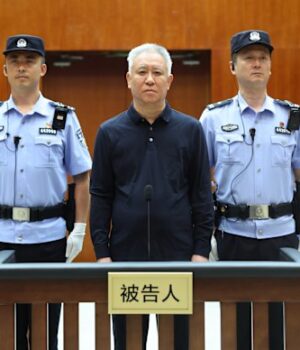
China Evergrande Group’s founder Hui Ka Yan has been sentenced to life in prison, bringing an end to one of the most dramatic rise and fall stories in China’s corporate history.
The disgraced property tycoon, once Asia’s second-richest man, had turned Evergrande into a poster child of corporate excess during China’s long real estate boom. But after his empire came crashing down following a 2021 default, he was caught in a dragnet of official investigations that ultimately caused his downfall.
Hui, who appeared visibly aged in court with greying hair, was sentenced alongside 56 others involved in Evergrande, including his sons Xu Zhijian and Xu Tenghe. His assets will be confiscated, and his companies were fined a combined 15.82 billion yuan ($3.3 billion).
The move draws a curtain on what for years was one of China’s great success stories. Hui had binged on debt during Evergrande’s expansion, turning it into the world’s most indebted developer as he transformed the property giant into a sprawling conglomerate.
But Chinese authorities concluded that his rise was built on deception. They said Hui had perpetrated a massive financial fraud that included inflating assets and concealing liabilities.
In 2017, Hui had a net worth of $US45.3 billion ($63.3 billiion), the highest in Asia, according to Forbes. By 2023, it had shrunk to an estimated $US3 billion. On Thursday, the court in Shenzhen ordered the confiscation of all his personal property.
In April, Hui had pleaded guilty in a Chinese court to charges including illegally taking public deposits and fundraising fraud.
“The amount involved in the crime is exceptionally large, the circumstances are particularly heinous, exceptionally heavy economic losses have been caused, and the harm to society is extremely grave,” a report from state media outlet Xinhua wrote, adding that Evergrande and Hui “must be severely punished in accordance with the law.”
Evergrande and Hui were also found guilty of fraudulently issuing securities, violating information disclosure rules as well as bribery. Meanwhile, the founder was accused of embezzling company assets through dividend mechanisms.
The sentence doesn’t bring an end to the numerous legal fights surrounding Evergrande. The company is now in liquidation, with an army of creditors inside and outside of China poring over its assets in the hopes of recovering some of their heavy losses.
Rags to riches
Hui, also known as Xu Jiayin in Mandarin, was born in Henan province in 1958 and grew up in poverty. Encouraged by the prospect of Deng Xiaoping’s economic reform plan, the son of a wood cutter quit his job at a steel firm in 1992 and later began developing property in Guangzhou, the provincial capital of Guangdong. He then founded Evergrande in 1996 and rode the wave of China’s unprecedented real estate boom.
Evergrande, which means “permanence and greatness” in Chinese, relied on heavy borrowing to fuel its growth, becoming the largest dollar-debt borrower among its peers and for a time the country’s biggest developer by sales. During its prime, the firm built more than 1300 projects across 280 cities. Supercharged by real estate riches, it also expanded its reach into industries ranging from bottled water to professional soccer and electric vehicles.
For a long time, Evergrande skirted liquidity scares by tapping tycoons in China and Hong Kong to buy the firm’s stock and bonds. Hui also turned to his own suppliers and retail investors for financial backing. But Beijing’s crackdown on the property sector since 2020 capped its borrowing capacity, effectively cutting Hui off from credit markets.
Hui’s charges follow a long list of harsh actions by Chinese authorities against corporate magnates.
The sentence doesn’t bring an end to the numerous legal fights surrounding Evergrande. The company is now in liquidation, with an army of creditors inside and outside of China poring over its assets in the hopes of recovering some of their heavy losses.
Anbang Group’s former chairman, Wu Xiaohui, was sentenced to 18 years in prison for fraud and embezzlement in 2018. That same year, China Huarong Asset Management Co. Chairman Lai Xiaomin was arrested amid a corruption scandal before being executed in 2021 on charges including bribery. HNA Group chairman Chen Feng was detained a few months later along with chief executive officer Tan Xiangdong for unspecified crimes.
Evergrande defaulted on its debt in late 2021. Following failed restructuring attempts, it was given a winding up order in Hong Kong in 2024, marking a significant escalation in the unravelling of the sector. Later that year, a mainland Chinese court accepted a liquidation application filed against one of its major onshore units.
Hui was taken away by Chinese police in 2023 and held under so-called residential surveillance — a type of police action that falls short of formal detention or arrest. Apart from a company filing confirming Hui being put under control, Chinese authorities had remained tight-lipped about his status since then.
In 2024, Chinese regulators accused Evergrande’s main onshore unit of inflating more than 560 billion yuan of revenue by recognising sales in advance, an alleged fraud that dwarfs that of Luckin Coffee and Enron. China then suspended the operations of PricewaterhouseCoopers, Evergrande’s long-time auditor, for six months and imposed fines.
Much of Hui’s known wealth was derived from his controlling stake in Evergrande and the cash dividends he’s received from the company since its 2009 listing in Hong Kong. Hui had pocketed more than $US7 billion over the past decade, thanks to the firm’s generous payouts, according to Bloomberg calculations.