Source : INDIA TODAY NEWS
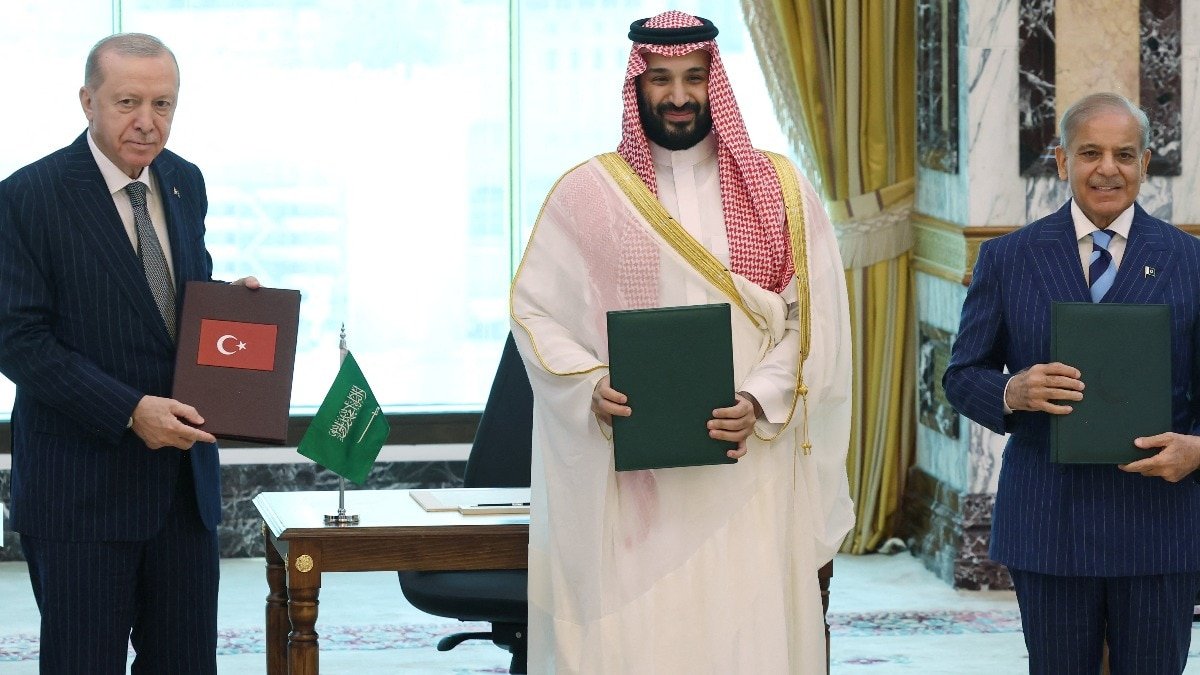
A new defence partnership signed between Saudi Arabia, Pakistan and Turkey is opening the door to a potentially more expansive alliance in Asia. Their Makkah Joint Defence Agreement commits the three countries to treating an armed attack on one as an attack on all. Against this backdrop, Bangladesh has said it is open to joining the framework while carefully assessing its strategic and economic interests.
advertisement
Foreign Affairs Adviser to Bangladesh Prime Minister, Humayun Kabir,said Bangladesh is open to participating in an economic or defence arrangement involving the three countries, but only after weighing its own interests.
“Bangladesh maintains a positive approach towards the possibility of joining an economic or defence framework involving Saudi Arabia, Pakistan and Turkey, taking into account its own interests and the changing dynamics of the global economy and trade,” Kabir told Bangladeshi outlet BSS News.
This is pivotal because Bangladesh’s relationship with its all-weather friend, India, has soured following the fall of the Sheikh Hasina government in 2024. Dhaka is simultaneously deepening engagement with Pakistan and China while keeping a possible visit by Prime Minister Tarique Rahman to New Delhi on hold.
The result is a foreign policy picture in which Bangladesh appears increasingly willing to widen its strategic options rather than rely heavily on any single regional relationship.
DHAKA LOOKS TOWARDS THE MECCA PACT
Saudi Arabia, Pakistan and Turkey signed the Makkah Joint Defence Agreement on August 7. The pact says an armed attack against one of the three countries will be regarded as an attack against all three, while also calling for closer defence cooperation and collective deterrence.
The agreement has already prompted speculation about whether it could eventually grow into a bigger security grouping.
Pakistan has said the arrangement is defensive and open to other countries. Egypt has also signalled that it is considering joining the pact. Cairo is reviewing the constitutional and legal implications of the defence commitments. Turkey has backed Egypt’s potential entry, describing it as a “natural partner”. That makes the latest comments particularly notable.
However, Kabir specifically linked the possibility to economic and trade interests. That approach would also fit Bangladesh’s growing engagement with Pakistan. He said Dhaka was strengthening ties with Islamabad, particularly in trade and people-to-people connectivity, and described the engagement as normal diplomacy.
ISLAMIC NATO OR A BIG BLUFF?
The Mecca Pact has been described by some analysts as a possible first step towards an “Islamic Nato”. But that comparison may be premature. The agreement creates a collective-defence principle and promises stronger cooperation, but it does not establish a Nato-style military command structure or automatically require members to enter a war on behalf of another member.
Its three founding members also have very different priorities.
Saudi Arabia brings enormous financial and energy resources and remains a core power in the Gulf. Turkey brings a large military, a growing defence industry and perks of Nato membership. Pakistan brings extensive military experience and is the only nuclear-armed member.
That combination gives the pact considerable strategic weight. But the same differences could make deeper integration difficult.
Saudi Arabia has important economic relationships with India and is closely connected to the United States. Turkey has its own relationship with Iran and its responsibilities as a NATO member. Pakistan has security concerns and economic interests that do not always align with those of Riyadh or Ankara.
The pact has therefore created a new platform for cooperation, but whether it develops into a fully fledged military alliance is yet to be tested.
DHAKA HESITATES ON INDIA
The biggest immediate test of Dhaka’s foreign policy may still be its relationship with India. Kabir said there was “no justification for rushing into a top-level visit” if doing so meant going beyond Bangladesh’s national interests. The comments come amid uncertainty over whether Bangladesh Prime Minister Tarique Rahman will travel to New Delhi ahead of the BRICS Summit.
“The possibility of the prime minister visiting India ahead of the upcoming BRICS Summit remains slim unless an appropriate environment is created based on consensus between the two countries on specific issues and a dignified invitation,” he said.
Earlier reports had suggested that a visit could take place in August. But Dhaka has since signalled that it does not want to rush the engagement without the right diplomatic conditions.
The disagreement is rooted partly in the fallout from Bangladesh’s 2024 uprising, after former Prime Minister Sheikh Hasina fled to India. Dhaka has since pressed New Delhi for her extradition, while India has said it is examining the request under its legal framework.
Kabir said New Delhi needed to better understand the reality created by the uprising.
“The neighbouring country must properly understand the reality of Bangladesh’s July mass uprising, which took place through the sacrifices of more than 1,500 people,” he said.
He also criticised New Delhi for allowing Sheikh Hasina media space after her departure from Bangladesh.
“After the fall of autocratic rule through the July mass uprising, in which more than 1,500 people sacrificed their lives in Bangladesh, providing political or media space in India to fascist Sheikh Hasina, who fled there and took shelter as a criminal, is contrary to India’s democratic etiquette.”
DHAKA-BEIJING TIES ENTER NEW PHASE
While relations with India remain unsettled, Bangladesh is also moving closer to China. Kabir said relations between Dhaka and Beijing had reached “a new height”. Bangladesh, he said, was seeking deeper engagement with China while trying to avoid becoming trapped in wider geopolitical competition. He pointed to the countries’ “Two Plus Two” mechanism and their comprehensive partnership as examples of the expanding relationship.
That balancing act may become increasingly important if Bangladesh decides to engage with the Mecca framework.
A closer relationship with Saudi Arabia, Pakistan and Turkey would give Dhaka additional diplomatic and economic options. At the same time, it could add another layer to India’s concerns about the direction of Bangladesh’s intentions.
However, Dhaka is unlikely to view the move simply through the prism of India.
BANGLADESH’S CALCULUS
For Dhaka, the question is ultimately less about joining an “Islamic Nato” than about how much strategic room Bangladesh wants to create for itself.
The country is simultaneously seeking stronger ties with China, rebuilding relations with Pakistan and negotiating a difficult relationship with India.
Kabir’s comments clearly indicate that Dhaka does not want to close any of those doors. A possible role in the Mecca framework could give Bangladesh another channel for defence cooperation, trade and diplomatic engagement. It could also strengthen ties with countries that have growing economic and political influence across the Middle East and South Asia.
Bangladesh has yet to decide whether to join the pact. But Dhaka has made clear that it is seriously considering the possibility.
– Ends
SOURCE :- TIMES OF INDIA