Source : the age
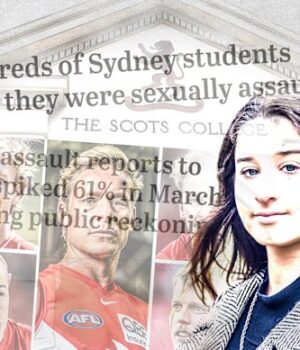
Every few years a sexual assault story catalyses a moment of public reckoning about how we treat women and girls in society. This week, the conversation arrived when sexual assault allegations were levelled against students of Scots College, and days later, a player from the Sydney Swans.
These events are not the same, nor are the alleged perpetrators. The accused are underage boys in one case, and a high-profile sportsman in the other. Their different roles in society come with different expectations of public scrutiny.
But they are bound by their attachment to institutions that our society holds in prestige: high-fee private schools and prominent sports clubs, for which reputation is currency. Some scoff at the special status attributed to these places, but they capture our curiosity because of the insights they shed into cultures of power, or privilege.
It has brought me back to my reporting from five years ago, when I was writing about sexual assault and consent education as an online petition by Sydney woman Chanel Contos prompted hundreds of young women to share graphic stories about being violated by their male peers at private schools. A natural question follows: has anything changed?
When we look at the alleged behaviour, clearly not enough. When we consider the way these powerful bodies respond, it’s more complicated.
One of the many things that struck me while reporting in 2021 was how the schools responded. A couple, mainly heads of girls’ schools, offered to speak straight away. Others were deeply reluctant. I was most surprised, perhaps naively, by the schools that brought in crisis communications firms, otherwise held on retainer by big companies for the most serious of corporate scandals, and the tactics they used to stop the story spreading into a deeper probe of their own environment.
Leaders of high-profile institutions walk a tightrope at times like these. Few facts are known, guilt is not proven, there are risks of jeopardising a trial. Yet it is during these early days that feelings and fury are most fresh. It’s the window of time that we turn to these institutions for moral authority, a signal of social standards.
So we can take the reaction this week as a barometer of broader change. The Swans and AFL have been largely commended for taking a strong stance, suspending players, apologising and affirming women’s right to safety. Scots, meanwhile, faces criticism over allegations it is protecting the boys and the school’s reputation for financial reasons, claims the headmaster rejects.
They may be united by prestige, but the Swans and Scots are dealing with different stakes.
The Swans need to show their corporate partners and 75,000 members, many of whom are families, they take these issues seriously. Their brand is built on community trust. Scots, on the other hand, needs to maintain confidence among a much smaller circle, of both current and prospective fee-paying parents.
The Swans’ response suggests that social expectations have shifted, particularly post #MeToo, and there is no longer widespread public tolerance for silence or excuses. The moral and commercial imperative for the club is to take action when a player crosses the line – no matter how high-profile – rather than tolerate disrespectful or potentially criminal behaviour. The speed and scale of the club’s response so far feels different to scandals years earlier.
The way the Scots story is unfolding, however, feels more familiar. Perhaps that’s because the closer these cases come to communities, households and families, the more challenging they are to confront. More than one woman in five has experienced sexual violence, but far fewer men ever identify as perpetrators. This equation is deeply uncomfortable when it implies these boys or men could be your friends, brothers or sons.
It’s one thing to point a finger at a famous sports star. It’s another to point it at a teenager you know.
Yet once again, this is the uncomfortable reality we are dealing with.
That’s the second reflection: this week makes it sadly clear that women’s sexual boundaries continue to be crossed in our society. This is despite increased awareness, more consent education and the strengthening of sexual assault laws in many jurisdictions. On Thursday, three Sydney teens were charged with raping a girl at a home.
I was prompted to swap notes with my email inbox from 2021. It was the greatest volume of feedback I had ever received from Herald readers on a story, and that was the case until now. Teachers said they were “so desperately upset for the young teen girls who are assaulted each weekend by our students”. Mothers described their horror at learning their daughters and several friends had been raped. “The saddest part is that she told me all of this in a matter-of-fact way while eating dinner,” one said. A handful of male students wrote about feeling shamed and unsettled about what they felt was cover-up culture in their schools.
Why are we still here? Is it the rise of the manosphere, the proliferation of violent porn, the likes of Andrew Tate? Or is it an extension of male power and indifference to women that has been there all along? Would any of these situations been prevented by better consent education? Or will men equipped with those lessons push boundaries anyway?
Weeks such as this raise often raise more questions than answers.
To help me work through them five years ago, I wound the clock back another seven years and read Anna Krien’s 2014 book Night Games. It follows the case of an AFL player accused of rape to explore the workings of the legal system, male peer pressure and institutional self-preservation.
Between schools and sports codes, the dynamics then were the same and they remain so today. Young men whose actions fall in a spectrum between naive and malicious, young women who are traumatised or violated either way, a justice system often unequipped to deliver it, institutions that put reputation above repair.
The testimonies Contos shared brought to life these complexities and their consequences: cover-ups, social fallout, shame and denial, fractured friendships. Most important, they gave voice to thousands of women with sexual experiences that weren’t reported but nonetheless felt wrong, and sometimes took years to understand as a violation.
But we still haven’t made enough progress in dealing with them. Scant few of these cases are ever escalated to the legal system, given the process takes such a toll on alleged victims. This week, though, several allegations have crossed that threshhold and again burst into public view.
The debates and conversations will resume in friendship groups, families and workplaces. They remind us that we are yet to fully grapple with this as a community, and behaviour is yet to change.
Natassia Chrysanthos is the federal political correspondent. She was a Walkley finalist and won a Kennedy award for her reporting on the Contos petition in 2021. Her Good Weekend feature written with David Leser, Sex, schoolkids and where it all goes wrong, was a finalist in the Our Watch Award for Excellence in Reporting on Violence Against Women in 2022.
 Natassia Chrysanthos is Federal Political Correspondent. She has previously reported on immigration, health, social issues and the NDIS from Parliament House in Canberra.Connect via X or email.