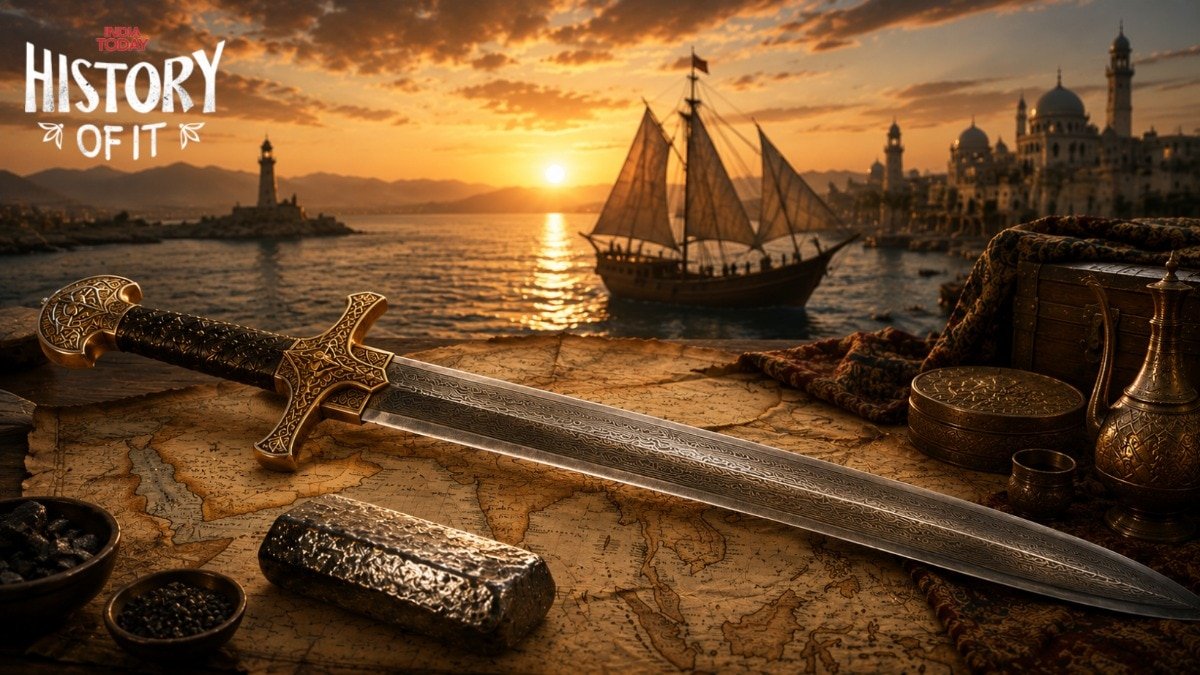
Source : INDIA TODAY NEWS
“Inna’r Rasula lasaifun yustadaau bihi, Muhannadun min Suyufillahi maslulu.”
These words, according to Islamic tradition, belong to 7th century Arabian poet Ka’b bin Zuhair in his celebrated Bnat Su’d, a 58-verse Lmiyyah composed after his conversion to Islam. It meant, “Indeed, the Messenger is a sword by which illumination is sought, an Indian sword, drawn forth from the swords of God.”
advertisement
Zuhair compared Prophet Muhammad to Muhannad — an Indian sword. Tradition holds that, moved by the poem, the Prophet placed his cloak over Zuhair’s shoulders. One may wonder: why, among the many images available to a poet praising the Prophet, invoke an Indian sword? And what did “Indian” signify when it became a mark of a blade of exceptional quality?
The question is not merely literary. It opens a much larger story about technology, trade and power.
Perhaps the clue lies in something PM Narendra Modi said from the Red Fort this Independence Day. He asked India to think about something that rarely stirs the imagination: critical minerals. Beneath that dry vocabulary lies one of the oldest truths of power: nations that control the materials needed to build the future possess an extraordinary strategic advantage.
Listening to Modi, history enthusiasts cannot help but wonder: has India lived this story before? The answer lies not in some distant technological future, but in a forgotten chapter of India’s own past — when mastery over a critical material could shape the fortunes of civilisations.
Now return to those opening verses. Beneath the poetic imagery of Ka’b bin Zuhair lies a striking historical clue: long before critical minerals became the language of modern geopolitics, iron was already a strategic resource.
The civilisation that could wrest iron from the earth, command the furnace and turn metal into steel possessed far more than a material. It possessed technology, and technology has always been a currency of power.
Bharat understood this thousands of years ago.
The story of Indian steel does not begin in Jamshedpur or with 20th-century industry. It begins beside clay furnaces, tended by craftsmen whose names are lost to history, even as their knowledge travelled far beyond India’s shores.
Archaeological sites across the Middle Ganga Valley, including Malhar, Dadupur and Raja Nala-ka-tila, reveal an early tradition of ironworking. Some evidence has been dated to the second millennium BCE, though the chronology remains debated. By the first millennium BCE, iron was everywhere: knives, arrowheads, axes, chisels, tongs, agricultural implements and weapons.
Iron was no longer a curiosity. It was transforming everyday life.
But making iron was one achievement. Making exceptional steel was another.
Indian craftsmen learnt to control ore, charcoal, heat and air with remarkable precision. A small error could mean a blade that shattered; mastery produced one worth carrying across continents.
Then, in southern India, metallurgy took an extraordinary leap.
THE STEEL CALLED WOOTZ
The men who made it did not call it wootz. In southern India, it was simply ukku — steel. Arab merchants knew it as Hinduwani; Persian writers called it pulad (faulad). The word wootz came much later, probably from a British rendering of ukku, entering scientific vocabulary in the 18th century after George Pearson of the Royal Society examined Indian samples sent by Scottish doctor-author Helenus Scott.
By then, Indian steel had already travelled across Asia for centuries.
Wootz was crucible steel: iron and carbon-rich material were sealed inside a crucible and heated until carbon entered the metal, producing a high-carbon steel unlike ordinary wrought iron.
Its exact beginnings remain debated. But India undoubtedly became a major centre of crucible-steel production, particularly in the peninsula, centuries before the Common Era.
The smiths knew nothing of carbon percentages, cementite or metallography. They had no instruments to measure furnace temperatures. Yet generations of observation had taught them what no textbook could: which ore, how much charcoal, what heat and when to strike.
Modern metallography later revealed the secret behind wootz’s famed patterns: networks of cementite within the steel.
Production flourished across peninsular India. The area that is now Telangana, Karnataka and Tamil Nadu became important centres. At Konasamudram (now in Telangana), archaeologists found 60 crucible-steel ingots; a reminder that this was no isolated village craft, but an industry.
THE INDIAN STYLE THAT TRAVELLED ABROAD
This Indian metal was already moving through the great commercial arteries of the ancient world, travelling with merchants, envoys and armies.
Roman historian Quintus Curtius Rufus, in Historiae Alexandri Magni, Book IX, 8.1, records Indian envoys bringing Alexander 100 talents of “bright iron” — ferri candidi — along with Indian shields, chariots, cavalry and exotic animals. Whatever the precise nature of this metal, the scale of the gift is striking. Indian iron was not a curiosity to be admired and forgotten. It was valuable enough to be carried into a royal diplomatic exchange.
Then comes Roman author-naturalist Pliny the Elder. In Natural History, Book XXXIV, he writes, “But of all the different kinds of iron, the palm of excellence is awarded to that which is made by the Seres, who send it to us with their tissues and skins; next to which is the Parthian iron.”
The identity of the Seres is connected with the Chera of southern India.
More explicit is the Periplus of the Erythraean Sea, a first-century CE account of Indian Ocean commerce, which records Indian steel among the goods moving through the trade linking India with the Red Sea and West Asia.
Indian steel would leave its homeland as metal and travel thousands of kilometres before becoming a weapon in a distant kingdom.
Eventually, Indian crucible steel — wootz — became closely associated with the legendary blades known in the West as Damascus steel. The terms, however, should not be confused: pattern-welding was a different technology, and not every Damascus blade was made from Indian steel.
Yet the larger truth survives the technical distinctions: India did not have to forge every famous Damascus blade for Indian steel to shape their legend. It only had to produce a metal worth carrying across continents.
THE SWORD THAT CARRIED INDIA’S REPUTATION
There was a time when the quality of a sword could tell you where the finest steel was being made. Indian steel had earned precisely that reputation. Long before modern branding, “Indian” itself could serve as a mark of quality.
The pre-Islamic Arabian poet Zuhayr ibn Abi Sulma wrote of the Saif Hindi, the Indian sword, “The Hindi sword will not let you down, even if fighting an armed battalion.”
Tarafa ibn al-Abd, one of the seven poets of the Mu’allaqat, likewise invoked the Muhannad, the Indian sword.
“A wound inflicted by someone close to us is way deeper and hurtful than one sustained through Muhannad [Indian sword],” he said.
These fragments of an older literary memory clearly tell us that Hind (India) had already become associated with the finest weapons.
Ibn Hisham records another intriguing tradition. When the Jurhum fled Mecca after their defeat by Khuza’a, they are said to have buried treasures in the Zamzam well. When Abd al-Muttalib later rediscovered it, the objects recovered reportedly included swords and armour, among them Qala’i swords; a term associated with Indian swords.
Later tradition even connected Jabal Hindi in Mecca with Indian swords.
Whether every detail of these traditions can be independently established is another matter. What matters is the persistence of the association: Hind and the superior sword had become intertwined in the Arabic imagination.
Then return to the opening verse of this story, and have a relook at what those metaphors reveal. The Indian sword (steel) carried an idea of sharpness, strength and reliability. Indian steel had travelled far enough to enter the language of poetry, warfare and prestige.
Centuries later, the 12th-century geographer Muhammad al-Idrisi offered an even more explicit testimony in his Nuzhat al-Mushtaq. Describing Indian iron and sword-making, he praised the skill of Indian craftsmen in smelting and treating iron.
“There are no sharper and better-slashing iron than that of India, and there is no doubt about it,” Muhammad al-Idrisi wrote.
By then, Indian steel had earned something more enduring than a reputation: a place in the technological memory of the world.
THE PILLAR THAT SURVIVED THE EMPIRES
India’s metallurgical story was not confined to weapons.
In Delhi stands an iron pillar more than 1,600 years old. It has survived monsoon, heat, dust and centuries of exposure with remarkably little corrosion above ground.
The pillar is made of forge-welded wrought iron, and scientists have studied its unusual resistance for decades. Its composition and the formation of a protective phosphate-rich corrosion layer are important parts of the explanation.
It would be wrong to call it “rust-proof”. It is not. Its buried portion has suffered corrosion. But that qualification only makes the surviving achievement more impressive. The pillar tells us something a written boast never could. Indian ironworkers of the Gupta age had mastered the production, forging and joining of enormous quantities of iron with a degree of control that continues to interest modern corrosion scientists.
The empire that erected it disappeared, but the pillar has remained.
EUROPE DISCOVERS INDIAN STEEL
Centuries later, Indian steelmakers encountered a radically changing world.
European travellers began recording steel production in southern India. By the late eighteenth century, European scientists were examining Indian wootz, fascinated by a high-carbon steel whose properties seemed almost impossible to reproduce. Samples travelled to Britain, where metallurgists and circles associated with the Royal Society examined them.
For Europe, entering the age of modern science, Indian steel posed a tantalising question:
How did Indian craftsmen achieve this?
The irony is hard to miss. European scientists were beginning to explain through chemistry and microscopy what Indian craftsmen had perfected through generations of observation, experiment and inherited knowledge. Their furnaces were modest. Their understanding was not.
The Industrial Revolution would eventually transform steel making to a scale the old crucible furnaces could never match. Yet Indian steel had already travelled much farther than the furnaces that produced it. It moved along ancient trade routes, entered Arab poetry, found a place in Persian vocabulary, shaped West Asian sword-making and ultimately reached European laboratories.
And suddenly, PM Modi’s words from the Red Fort acquire a different resonance.
He was speaking about the future, not history. Yet the future he described carries an unmistakably old Indian echo.
Critical minerals. Secure supply chains. Control over the materials that will power the next age.
The names have changed. The contest has not.
Yesterday, it was iron. Today, it is lithium, cobalt and rare earths. Tomorrow, it will be whatever material becomes indispensable to the technology of its age.
India once understood this instinctively. Its craftsmen took something buried beneath the earth and transformed it into a material sought by kings, merchants and warriors thousands of kilometres away. Indian steel did not conquer the world with armies. It travelled because the world wanted it.
That is the real lesson.
A mineral buried in the ground is only a resource. Knowledge turns it into technology. Technology turns it into an advantage. And an advantage, at scale, becomes power.
The ancient Indian smith understood the first part of that equation long before modern science gave it a name.
He took ore, mastered fire and made steel. Then he sent something forged in an Indian furnace across the world.
The world once came looking for Indian steel.
Modi’s call from the Red Fort is, in many ways, a call to ensure that when the world comes looking for the critical materials and technologies of the next century, India is ready to forge what the future cannot do without.
(Aabhas Maldahiyar is the author of Babur: The Quest for Hindustan.)
– Ends
SOURCE :- TIMES OF INDIA