Source : INDIA TODAY NEWS
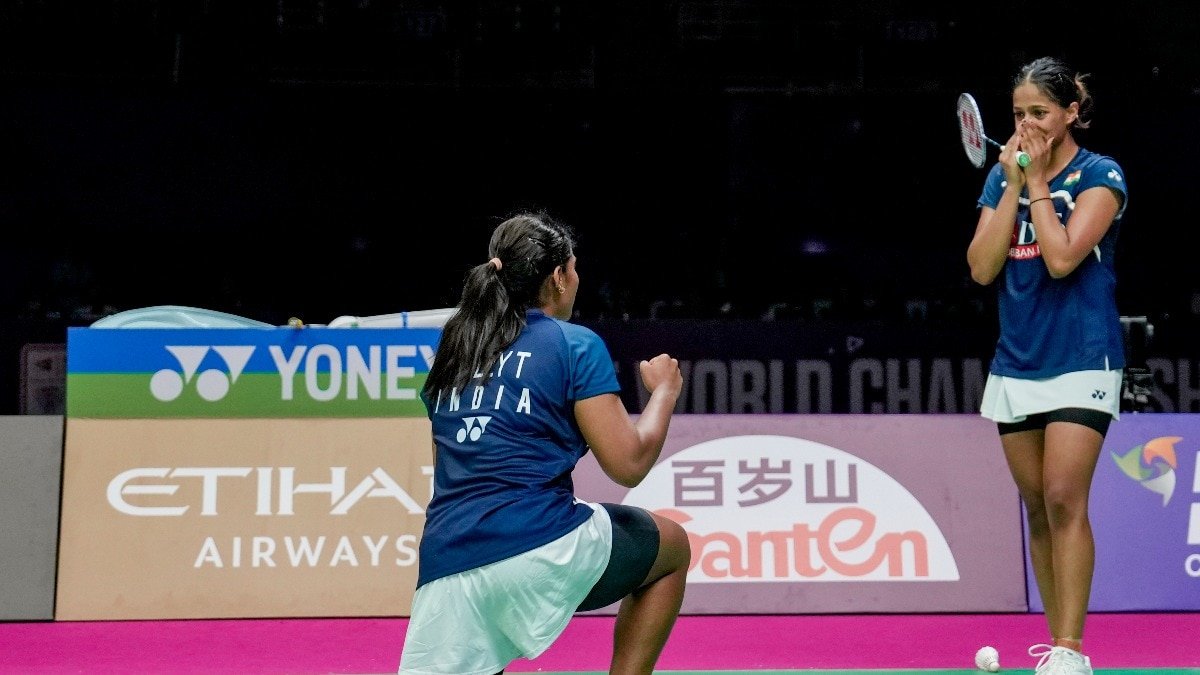
Neither of them could hold it together. They walked off the court to a thunderous ovation from a packed crowd at the Indira Gandhi Indoor Stadium in New Delhi, and the moment they got backstage, they broke down in tears. It was release: years of pressure, of knowing they belonged, of showing they belonged, finally arriving at the one result that settled the argument for good.
advertisement
They had just beaten the World No. 4 pairing of Jia Yifan and Zhang Shuxian of China, a team they had never beaten before. They went 0-6 down inside the opening exchanges, much to the dismay of a crowd that had turned up to cheer them on, and lost the first game 16-21. But by the end of an hour and 10 minutes, Treesa and Gayatri had done the improbable, winning the next two games 21-15, 21-13 to guarantee India a medal at the BWF World Championships on home soil.
They became the first Indian women’s doubles pair in fifteen years to reach a Worlds semi-final, continuing the country’s streak of a medal at every edition since 2011.
The emotions were understandable.
Treesa reached national chief coach Pullela Gopichand first, in the coaching box, and gave him a warm hug. Gayatri followed, and her father kissed the top of her head. Their coach, B. Sumeeth Reddy, stood beside Gopichand, watching on with pride. The team had won India another medal.
Gayatri and Treesa did not want to speak to the media straight away. They took a break, cooled down, and then came to stand in front of the cameras that were waiting to mark their historic win. But the emotions were still visible. As the questions from a curious press pack kept coming, the pair began to tire of them.
At one point Gayatri turned to Treesa and said, “you take it,” and Treesa obliged, much the way they leave a shot for one another with a clear call on court.
THE WEIGHT OF A SURNAME
It had not been easy for either of them.
Gayatri and Treesa made the top 10 of women’s doubles last year, beaten top 10 players nearly a dozen times, have reached the semi-finals of the All England Open twice, and won Commonwealth Games bronze in 2022. But the consistency that separates the elite of the women’s doubles circuit from the rest had eluded them. Injuries played their part, but the questions always followed. Doubts came with them.
Gayatri, in particular, has not always had it easy. She is the daughter of one of the most accomplished players Indian badminton has produced, and, more pointedly, of one of the most decorated coaches in the world, a man who has produced Olympic medallists in Saina Nehwal and PV Sindhu.
Why could he not do it for his own daughter? Was she not good enough?
Sumeeth Reddy, who has coached the pair since 2025, says the baggage was, at times, too heavy for a 23-year-old to carry.
Indian media can be unforgiving. Social media more so.
“Starting with Gayatri, obviously Gopi Sir’s daughter, it’s a big baggage and everyone would say, ‘Oh, silver spoon’ and all of that, but I think it’s very big baggage. I think with this she would be relieved that she’s also a World Championship medallist. I think that would be a huge medal in her career,” he told the media on Friday.
THE GIRL FROM CHERUPUZHA
Treesa had her own story to write. She came from a modest background, training on makeshift mud courts her father, a physical education teacher and the family’s sole earner at the time, had built for her and her elder sister, in Cherupuzha, Kerala. In households like hers, sport is rarely a given, and once chosen, failure is rarely an option either. At 12, she left home to chase it further. She was as feisty a child as she is now, and every bit as determined.
S.R. Arun Vishnu, who was instrumental in pairing Gayatri and Treesa when the latter joined the Pullela Gopichand Badminton Academy in 2020, remembers the fire in her belly.
“She has come from a, like, her family background was not great when she started and she, you know, so she knows that she has to do well for the family. So that is there, that’s also pushing her,” he told IndiaToday.in.
WHEN GOPI SIR WAS HESITANT
Even Gopichand, for all he has meant to Indian badminton, was not willing to risk the scrutiny that would follow if he made the call himself. When he and Arun sat down to work out two pairings from four players at the academy, he did not put his daughter with the more experienced, rising talent among them.
“It was in 2021, just after Covid, that they started playing together. So at that time we had four players: Treesa, Tanisha and Rutaparna. So we had to make pairs among the four,” Arun explained.
“So then, actually, it was Gopi Sir. The intention of pairing like this was, Rutaparna was already established at that time. So if Gopi Sir made Treesa play against Rutaparna, then it would become a controversy. He didn’t want that controversy. That’s why he put Tanisha with Rutaparna and Treesa with Gayatri.
“In the end, it worked out as well. Treesa was good from the backcourt. Gayatri was proficient from the frontcourt.”
From her earliest days, Gayatri has been scrutiny’s favourite child. She began her career playing singles. Why wouldn’t she? She was Gopichand’s daughter. But injuries kept interrupting her progress, and deep down, Gayatri wanted doubles.
Gopichand did not need much convincing once she made it clear to him. Years in the sport had taught him that fame and money come more easily to singles players than to doubles specialists, especially in a country with no real legacy in the discipline.
“So I remember how she shifted from singles to doubles, where she was getting injured because of injuries. And when we asked her, she said she enjoys playing doubles more than singles.
“At that time, she was playing really well in the junior circuit, singles. Still, Gopi Sir, in spite of being a singles All England champion and having achieved so much, he was okay with that.
“So that’s how they were. She is all about, whatever Gayatri is happy, she’s ready to do that, and she’s now proving her vision is right,” Arun said.
COMPLEMENTARY, NOT COMPETING
If you scrolled through X on the day the Arjuna Award was announced for Gayatri and Treesa, you would know what we are talking about. Questions were asked over whether they deserved it. Some called it the Gopichand effect. Over the years, many have questioned whether Gayatri was ever the right partner for an aggressive player like Treesa.
But Ashwini Ponnappa, who knows a thing or two about doubles badminton, says Gayatri’s value was never in the power game, but in her ability to read a rally and set up the point for Treesa to finish, which is exactly what she did all week in Delhi.
“Gayatri is the calmer one of the two on court. She is the player who holds the partnership together. Treesa is incredibly fast, incredibly strong. But there are times she can get erratic with her shots, but that’s where a player like Gayatri, level-headed and calm, she reads the game very well which is why she places her smashes very well. That’s very important. They complement each other.
“It’s not about getting two players together who have done well in events, it’s about complementary style, and it’s important to have one player a little more consistent in the partnership and a little calmer, which is what Gayatri brings to the partnership,” she told the Badminton Association of India on Friday.
A SONG OF FIRE AND ICE
Jia Yifan, who won the first of her two Olympic medals in 2020, before Gayatri and Treesa had even become a pair, was left mightily impressed by the Indian duo. Graceful in defeat, Jia, one of the most accomplished doubles players China has produced, had two words for each of them.
“Gayatri, sharp-minded.”
“Treesa, fierce and powerful.”
It has been a striking combination of fire and ice. But the fire and the ice have come from both of them, at different moments, all week.
Their improved rotation has been a delight to watch at these World Championships. Treesa’s smashes still sting, and Gayatri is still the calming presence at the front. But they have not been afraid to flip the script when it suits them.
Two days earlier, they had demolished the world number seven pairing of Rin Iwanaga and Kie Nakanishi of Japan 21-16, 21-12, a ruthless pre-quarter-final performance that took the Japanese pair by surprise. Rin and Kie themselves admitted afterwards that the improved rotation from Treesa and Gayatri had caught them off guard.
Treesa, more comfortable at the back of the court, was willing to move in and control the net, and did so with ease. Gayatri, more at home dictating play from the front, was willing to drop back and show off her improved power game. Against the Chinese on Friday, it was her cross-court smashes that won India the crucial points.
“Over the last 30-40 days, the rotation has got better. Gayatri has been rotating a lot more. I mean, if you remember, most of them would say that she would always stay back, but I think this tournament, that’s not the case,” Sumeeth said.
“Both of them shared their load equally. I think that was worked upon, and I think you can see the output.”
There is a touch of Serena Williams about Treesa on court: fierce, expressive and relentless. Off it, she is remarkably calm.
Arun Vishnu says that is not the case. Where Gayatri is the same shy, mellow presence off the court as she appears to be, Treesa’s fire belongs entirely to the court.
“Absolutely. Off the court, both of them are really calm. Treesa’s aggression is only on the court. Off the court, she’s really calm, and she’s very focused, hardworking,” he said.
Treesa tends to supply the headlines in the mixed zone too. Asked when they believed they could beat the Chinese pair, she answered without missing a beat: “Only after the last point was won.” Gayatri agreed she had been thinking the very same thing, but it was Treesa who got there first with the line.
The chemistry between the two goes back to their earliest days together.
“They know, off the court, it’s almost like Treesa is taking care of her stuff and Gayatri is taking care of her stuff. But whenever they need help from each other, they’re there for each other. They know that they’re there for each other,” said Arun, who has watched them since 2021.
NO.1 IN THE MAKING?
Sumeeth made sure the senior Gopichand got his due. It was a special moment for the former All England champion, a man who has coached talent from across India to global medals, but this time the talent had grown up under his own roof.
“And once the match finished, I just congratulated him, saying that, ‘You have done it.’ He is a father as well. He is the chief national coach and he has been, since the last forty-five days, doing two or three sessions each day,” Sumeeth said.
The medal itself is the full stop, the one argument no one can relitigate. What comes after, Arun believes, is the interesting part: a pair with nothing left to prove and a genuine shot at world number one. He reckons the rest of the circuit already senses it, that Gayatri and Treesa have stopped being opponents you fancy your chances against and started being ones you fear.
“Definitely they can be No. 1. They can beat anybody in the world. I think most of the players are afraid of this Indian pair. I have seen that from behind the Koreans, Chinese, Japanese, Indonesians, everyone.
“I’ve seen they have become more mature now. They have become calmer now, so they can handle pressure better now,” he said.
Backstage, away from the cameras and the questions, there were no doubters, no expectations, no surnames to live up to. Just Gayatri and Treesa, together, finally crying for the right reasons.
– Ends
SOURCE :- TIMES OF INDIA