SOURCE :- THE AGE NEWS
What in the World, a free weekly newsletter from our foreign correspondents, is sent every Thursday. Below is an excerpt. Sign up to get the whole newsletter delivered to your inbox.
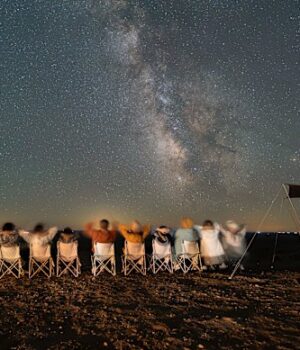
Dahongshan, China: A sparkling night sky deep in the red dirt desert of Inner Mongolia is one of the more spectacular, if unexpected, backdrops to an invocation of Immanuel Kant.
On a stretch of untamed escarpment dotted with camping tents and hand-dug toilets near China’s northern border, the German philosopher’s musings on the “starry heavens above and the moral law within” have been dropped into casual conversation.
“There are only two things in the world that truly move people – one is the lofty moral standard in our hearts, and the other is the brilliant starry sky above our heads,” a camper tells me, paraphrasing Kant’s famous line from his 1788 Critique of Practical Reason.
“Ever since I was a child, I’ve heard that saying,” she adds. “It has always deeply moved me.”
Our quoter works in the education bureau of central China’s Hebei province and has used the cover of the school holidays to slip away for a long weekend, unbeknownst to her bosses, so she declines to give her name.
The chance to see the Perseid meteor shower rain down over the Inner Mongolian sky was too good to miss, so she persuaded six friends and their four children to accompany her. They took three cars, packed them with camping gear, and drove 900 kilometres north.
“When we were kids growing up in the countryside, we used to see the stars clearly. Children today basically have almost no chance to experience that,” the stargazer says.
“That’s why I believe that besides Chinese language, maths and other academic subjects, they also need some education about nature in their lives.”
For the same reason, accountant Li Dan and her husband loaded their two children into their electric four-wheel-drive and set out for the desert from Wuhan in Hubei province, a multi-day drive.
“Living in the city, we rarely get to see stars. This year, it’s a rare opportunity because it’s a new moon,” Li says, adding that previous years were spoiled by bad weather.
I, too, have come to see the Perseid show and to chat with the stargazers who have trekked across the country to watch. It is an annual cosmic event best seen in the northern hemisphere around August, when Earth passes through the dust trail left by the comet Swift-Tuttle.
What look like shooting stars streaking across the night sky are actually rock particles burning up as they smash into Earth’s atmosphere.
“I find work so exhausting in recent years. Getting out once in a while to stroll around and gaze at this vast, open starry sky just makes me feel so much more at ease,” says Wang Chunxu, a 25-year-old teacher from Beijing. “I feel like all my worries are melting away.”
This year, the confluence of a new moon (minimal light) and a near-perfect weather forecast conspired to make Dahongshan – literally, “big red mountain” – in Inner Mongolia, a region in northern China bordering the country of Mongolia, one of the best places in the world to watch the Perseid shower.
To get there from Beijing, it’s an eight-hour drive north, a journey I made with a Chinese friend and his family.
We cut through the mountain ranges that frame the capital, before gradually climbing 1000 metres above sea level along a road that winds through the yurt-studded grasslands, home to ethnic Mongolian herders. From there, it’s onwards to the fringe of the Gobi Desert.
After pausing for a herd of camels to cross the road, we reached the clifftop of Dahongshan in time to see the sun set over a sweeping escarpment of chiselled rocky hills and red clay plateau as far as the eye can see.
Chalk it up to a touch of homesickness, but I’m reminded of the hot ochre of central Australia – more Dorothea Mackellar than Kant in my mind.
By the time we arrived, dozens of campers had already claimed their spots on the clifftop and were setting up tripods and cameras, or cooking over electric stoves rigged up to their EVs.
Among them was a gaggle of 12 strangers aged in their 20s to 40s from Beijing and Tianjin, who were wrangled by Zhang Yang, a calligraphy tutor when he is not hitting the open roads.
Zhang put a call-out on Douyin (the Chinese TikTok) to anyone who wanted to join him on a road trip to watch the meteor shower, so long as they split the cost of petrol, tolls and food.
He says he got the bug for the great outdoors after watching Australian outback documentaries as a boy.
“Australians drove utes and travelled around. I found those documentaries quite fascinating. Now, I travel all over the country but prefer places with fewer tourists,” Zhang says.
“This is my first time observing a meteor shower under such good weather conditions.”
We wait until about 9pm for the sky to become dark enough for the first stars to appear, and then suddenly it’s radiant. A shimmering Milky Way from horizon to horizon.
Necks craned skywards, gasps and squeals erupt across the campsite as the first meteors blitz across the sky. The dedicated will stay up past 2am to catch as many as 90 luminous streaks.
The ideal setting to contemplate the humbling vastness of the universe, and humanity’s moral imperative to try to make sense of it.
Get a note directly from our foreign correspondents on what’s making headlines around the world. Sign up for our weekly What in the World newsletter.
 Lisa Visentin is the North Asia correspondent for The Sydney Morning Herald and The Age based in Beijing. She was previously a federal political correspondent based in Canberra.Connect via X or email.