Source :- THE AGE NEWS
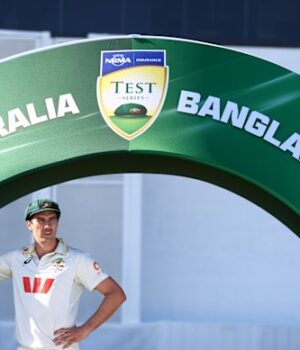
Mackay: ”OK then, we can go to the pub early.” The voice from below the makeshift press box rather summed up the sense of anti-climax as Nathan Lyon pouched two wickets to end the second Test only three balls into its fifth session.
Ten minutes before the scheduled close of play on day two, the only cricket being played in Mackay was by the Harrup Park general manager and his staff, who enjoyed a lighthearted game on a surface that had reaped 30 wickets in 750 total balls: the fourth shortest completed Test match in history.
For Australia, this was a pleasingly clinical display with the ball and in the field. Mitchell Starc, captain Pat Cummins and Lyon bowled with speed, venom and guile respectively to snuff out Bangladesh. Josh Hazlewood was also useful, lacking only a more generous helping in the wickets column.
Of course there are still multiple question marks over an Australian batting line-up that cobbled first innings tallies of 198 and 210 across these two games. In particular, Marnus Labuschagne will be nervously awaiting the make-up of the Test squad soon to be named for South Africa.
In parallel, there will be discussions about the batting order in general. Cameron Green has prospered at No.5, much as Usman Khawaja and Travis Head had before him, but the rest of the top seven has been nowhere near productive enough. Labuschagne may be due a try in another position, and Head’s place at the top of the order is also open to some debate.
“If we want to stay No.1 in the world and really win every Test match and be as good as we think we can be, I think we were a little bit below par both Test matches,” Cummins said. “Greeny had an awesome series. Every time he batted he looked really solid.
“But we probably could have extended that lead yesterday, taken the game away from them and put on a 250-plus lead. When they had that little run of wickets last night, how do we weather that storm, a couple of top order wickets that maybe they’d like another crack at.”
But the biggest issue with Mackay was not one limited to the shortcomings of either team. When Australia beat South Africa inside two days at the Gabba in December 2022, the game was memorable because it was such a breathless outlier.
Australia’s previous two-day Test had been in the UAE against Pakistan in 2002. There had been just three other instances in the 20th century. Over the vast sweep of history, Test cricket had allowed for plenty of ebb as well as flow, allowing spectators to settle in, players to adapt, and stories to develop.
Now, however, Australia have hosted three such matches in their past seven Tests, and the rush of wickets is becoming rather humdrum. Spectators in Mackay were actually cheering any not out verdict from the umpires on Sunday, not through any lack of patriotism, but simply because they wanted to see more cricket.
Cummins defended the pitch prepared in Mackay, pointing more to poor batting than the presence of too much grass on a hard surface.
“I think if every Test was like this, then perhaps [I would be worried],” Cummins said. “But the two Test matches here, the results were not what we thought, which is what Test cricket is about.
“There’s still so many unknowns going into day one. You’re still tossing up ‘do I bat or bowl, what’s the pitch going to do’. That still holds true. You wouldn’t want every Test to be two days, but as long as there’s still that intrigue, I think that’s good.”
More telling were the comments of the stadium curator, Peter Kazakoff, who said his turf-tending fraternity was battling to strike a balance in keeping with the way that Test cricket was increasingly being played.
“Definitely the game has changed the way the batsmen approach it,” he told ABC Radio. “It’s so much more aggressive now. No doubt as curators, we’ve got to adapt to that. It’s not an 18-wicket pitch, by far. These things happen.
“Test cricket’s changed; cricket’s changed. We’ve got to try to work with that as well. We probably have to tone it down a fraction than we would’ve in previous years, just to keep up with the modern trend of international cricket. T20 cricket has made a huge mark on Test cricket now. I think everyone is just adapting to it.”
Games like Mackay are problematic for the future. Because if players, coaches and curators don’t strike a better balance to provide for contests that do at least stretch into days three and four on a consistent basis, then cricket’s financial models will be strained even more than Cricket Australia’s was when the Perth and Melbourne Tests flamed out last summer.
Certainly, there will be more instances of the other shout that could be heard from behind the grass banks on Sunday afternoon.
“Free burgers! Free hot chips!” came the cry, as a caterer tried to offload excess stock to departing spectators. You could almost picture Todd Greenberg wincing.
 Daniel Brettig is The Age’s chief cricket writer and the author of several books on cricket.Connect via X.