source : the age
To submit a letter to The Age, email letters@theage.com.au. Please include your home address and telephone number below your letter. No attachments. See here for our rules and tips on getting your letter published.
MEGACITY
The same old bureaucratic words are trotted out in an attempt to reassure us about the plan to make Melbourne a megacity: environmental sustainability, equity, access and so on (“Labor pledges to halt Melbourne’s urban sprawl, but planners ask if we’re heading to a megacity mess”, 24/8).
Yet, we can’t even manage a small area such as Footscray to ensure safety for all (“The pain ripping my home apart”, 24/8). Let’s face it, modern life is very complex, profit-based
vested interests are entrenched and immovable, public resources can’t meet needs, and nothing is going to improve through unfettered growth.
Fiona White, Alfredton
Jess Wilson’s report card on environment
As a local who cares about our environment, as most Victorians do, I was pleased to see state Opposition Leader Jess Wilson commit to turning the privately owned Box Hill Brickworks site into a public park and promise $20 million to ensure that outcome.
Well done, Jess Wilson and the Liberals, for supporting a campaign for public green space which has significant
community support.
Such opportunities to add to green space are rare and often opposed by developers. People need green space to thrive, and
our unique insects, birds and animals species also need space in urban environments.
With our environment facing increasing challenges from invasive species, land clearing and climate change, it would be beneficial for our community if Wilson also acknowledged the biodiversity crisis we are facing and backed a comprehensive climate policy to help preserve our unique natural history for the future. Everything is connected, and our economy ultimately relies on our environment.
We know those unique species and ecological systems will struggle to adapt to the speed of climate change. More and more species are already being added to the threatened species list.
Threats like the South Australian algal bloom which devastated marine ecosystems are becoming more likely.
David Hudspeth, Burwood
State opposition on a losing gamble
Jess Wilson’s Coalition wants to scrap clean energy transmission projects and rely on expensive, polluting gas instead (“Bill fears in power line pledge″, 23/8). Where will the Victorian Coalition source that gas, how will they build the infrastructure needed to deliver it to households, and how will they cover the cost? We have just two years before the ageing Yallourn coal-fired power station closes.
Abandoning transmission projects like VNI West puts Victoria’s energy security at risk. In 2026, doubling down on gas is a gamble our state doesn’t need.
Karen Lamb, North Geelong
No to more dirty, expensive gas
It’s 2026 and we’re still talking about dirty, expensive gas as if it were some kind of cure-all (“Domestic gas policy sparks industrial revival hopes”, 24/8).
A gas-led industrial revival? A Victorian Coalition plan to replace coal with gas (“Bill fears in power line pledge”, 23/8)? No, thank you.
Larni Dibben, Glen Iris
Streets of our town
I’ve enjoyed reading the series of personal stories of the places people live in our wonderful city for many years. It reminds me of the special, lovely and colourful nature of our life here in Melbourne.
However, I was particularly struck and appreciative of the honest and moving story of my neighbouring suburb of Footscray by Ceridwen Spark (″My suburb gentrified decades ago. Now its residents are afraid to walk the streets″, 23/8).
Thank you, Ceridwen, for sharing the joys and struggles your community faces every day. I hope the government and others may invest and do whatever is necessary to ensure that your place thrives and grows into the future. Tim Hoffmann, Brunswick
THE FORUM
Moving right ahead
Imagine 10 years ago – even five – that the federal president and leader of one of Australia’s two major political parties had accepted hospitality at a public event from an organisation whose elders ″paid neo-Nazi affiliates and far-right figures to bully and intimidate politicians″ (24/8).
Ask yourself what would have happened then if this president and leader had uttered words to the effect of ″nothing to see here″; and if their own members had described any inquiry into these neo-Nazi supporters as ″persecution″, ″madness″ and a “hyperpartisan witch hunt”.
Ask yourself how far to the right Australian political discourse has moved in the past few years. Then ask yourself what has changed, and what darkness lies ahead.
Nick Eckstein, Kangaroo Ground
Charity status review
News of the ongoing political connections of the Plymouth (Exclusive) Brethren fosters thoughts that the community is actually paying for their practices via the Australian Charities Non-for-Profit Commission whereby they buy their lifestyle tax-free.
There needs to be a clean out of the Australian Charities Non-for-Profit Commission register which has more than 60,000 listed charities. This will be a monumental challenge.
But rather than penny-pinching from pensioners, reach out to
the big money.
Margaret Raffle, Keilor East
Politicians not listening
Prime Minister Albanese had every reason to respond to the majority who want strong laws to control gambling advertising, but for his own reasons, he hedged. After much wrangling, laws were passed in parliament that were a long way short of what was needed. The PM’s comment was that ″we listened, and I think we got the right balance”.
To me, that response is far from accurate. Maybe he has silenced dissent, but the public’s reaction will probably cost Labor the next election.
David Lamb, Kew East
Losing faith in leaders
Is it any wonder the public is losing faith in our politicians?
From Anthony Albanese receiving questionable advice about appearing on the appalling Bush Talk podcast, to the government failing to act on gambling advertising despite widespread public support for reform, and now Angus Taylor and Tony Abbott accepting hospitality from the Exclusive Brethren during a bicycle ride, questions about political judgment and accountability continue to arise.
The allegations surrounding links between some Brethren figures and far-right or neo-Nazi affiliates make the decision to accept such hospitality all the more concerning.
Australians deserve better political leadership, greater accountability and a stronger commitment to the public interest. But one thing is certain: the answer cannot be One Nation.
Nathan Feld, Glen Iris
Start your own church
It was perhaps a suitable metaphor when Angus Taylor fell off his bike at the Pollie Pedal bike ride under the sponsorship of the Plymouth Brethren (24/8).
The brethren’s selective principle of reportedly providing financial support on the one hand to nobble Labor, while eschewing members from being involved in the political process, is an interesting contradistinction.
I think I might start my own church.
Peter Russo, West Brunswick
Winner takes all era
The Plymouth Brethren may not vote, but are ready to hand out material at election time spruiking for the Liberals.
Politics is becoming so underhanded and corrupted with a win-at-all-costs approach. No wonder a lot of us have lost confidence in politics.
It would be good to see an election without those who provide support for parties and waiting for favours in return.
Nola Cormick, Albert Park
Not happy, Jeff
Re your correspondents on “former premiers” (Letters, 24/8): Economic rationalism brought about the destruction of so much that gave real and sustained meaning to “community” with
the devastation of highly functioning rural communities a tragic result.
I am reminded of this every time my rural-based grandchildren are transported anything from one to 2 hours for weekend sport participation.
The size of the leagues demands extreme dedication from parents who have often already travelled distances to their workplaces daily during the week.
One can argue that we all make choices but the erosion of “home time” and the current cost of fuel plus the state of the roads make the accessing of sporting competitions arduous and probably prohibitive for some.
With the centralising of educational facilities and local governments, many highly functioning rural communities have been diminished in a way that was immediately devastating.
Those small communities no longer have a general store, a post office, a pub or school; therefore people relocated or bore the brunt of travelling significant distances to access services.
The cost to the small communities of rural Victorian people – social, financial and historical – has been destructive in a way that is immeasurable.
Still not happy, Jeff.
Mary-Louise Tehan, Queenscliff
When is fair, fair?
It seems unlikely Australia will increase unemployment benefits in the ways Sean Kelly suggests (“Harm done now can be harm forever; how government delay can derail lives”, 24/8).
For example, the idea that unemployment payments should be tied to previous income so that a newly unemployed person is not “effectively removed, instantly, from the life you lived before” would be quickly dismissed as being unfair.
People would ask why some unemployed people should receive a higher benefit than others.
Principles of fairness underpin Australia’s system of social welfare payments.
In 1975, the Whitlam government removed means testing for the age pension for everyone aged 70 or older.
Of course, subsequent governments rolled back that universal eligibility so that payments are better targeted at those who reaĺly need them. That’s the Australian way.
In the event that mass unemployment caused by
artificial intelligence generates calls for a universal basic income in Australia, get ready for howls of protest: “That’s not fair! They don’t need it!“
Rod Wise, Surrey Hills
Business AI absence
When will big business step up and show some leadership in the great AI debate?
What do they see as the impact on entry-level jobs?
What do they envisage the longer-term impact will be on overall employee numbers?
How will the widespread usage of AI change employee roles,
and what will this mean for educating, training and job security for workers?
The announcement of a parliamentary bipartisan committee to examine these issues is welcome (“Labor, Coalition unite to ring-fence AI”, 22/8) but based on the gambling advertising legislation passed by the government and opposition, it will probably produce only pusillanimous recommendations.
The onus lies with business to propose how AI can be used to enhance societal, employment
and profitability, and then work with government to achieve
these objectives.
Peter Thomson, Brunswick
Stop gas expansion
It seems incredible that the gas industry is looking for opportunities to scale up production (“Domestic gas policy sparks industrial revival hopes” 24/8) when we have witnessed a devastating summer in Europe and North America, and 2026 is set to be the hottest year on record.
Yes, we need to protect Australia from economic shocks such as the spike in fuel prices, but we also need to phase out fossil fuel use as soon as possible to have any chance of arresting the climb in global temperatures and incidents of extreme weather.
Wind and solar are not finite resources and, once infrastructure is in place, not subject to wildly fluctuating world prices.
In addition, they do not contribute to an increase in carbon in the atmosphere.
By all means, reduce exports of gas to ensure local supply, but we shouldn’t use this as a chance to expand and profit from an
industry that will exacerbate our climate crisis.
Graeme Lechte, Pascoe Vale
Keep gas supply local
Good to see our gas may gradually seep through to local users (24/8). Australia should not be selling to overseas nations who make a fortune reselling the gas.
The focus should be on making gas usage more climate-friendly instead of selling it off.
Doris LeRoy, Altona
Nature trumps market
Debates about carbon accounting systems distract from the fact that iconic native animals, plants and ecosystems are endangered and need urgent protection (“New forest proposal to dwarf Koala Park”, 23/8).
NSW Premier Chris Minns promised to create the Great Koala National Park, but after election added the condition that its forests generate carbon offsets.
His ″solution″ to threats from “logging, climate change, species decline and huge bushfires” is to make it cheaper for companies
to keep polluting rather than reduce emissions.
The ″market″ doesn’t always produce the best outcomes. What have we lost when we can recognise the value of something only after putting a price on it?
Protecting nature is a responsibility of governments, not a legitimate function of ″the market″.
Julia Croatto, Kew
AND ANOTHER THING
Plymouth Brethren
The LNP is in bed with the Plymouth Brethren, who have a record of supporting the LNP during elections. The Brethren should be stripped of their charity status and sent packing from Australia.
Paul Chivers, Box Hill North
I’m comforted that the Brethren Christian Church maintains its tax-free status by providing breakfast to the participants in the annual pollie pedal bike ride.
Peter Randles, Pascoe Vale South
Give the lobbyists a permit and a set of rules. If you break the rules, your permit is cancelled. It’s not too hard, is it?
John Marks, Werribee
AFL
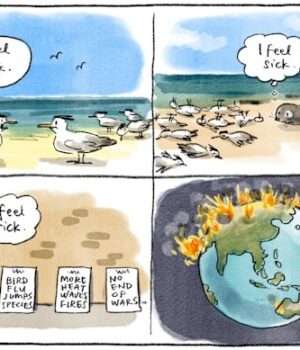
If the Swans’ problem is bird flu, as your correspondent suggests (Letters, 24/8), then there’s surely a message in that for the Hawks, Pies, Eagles and any other teams on the wing.
Jenifer Nicholls, Windsor
Well done, Sydney Swans! In the big picture, and as a unit, you have responded well to the slurs and vilification.
Paul Murchison, Kingsbury
Wildcard Weekend: the excitement of seeing if your team is eliminated this week or next.
Matthew Gilbert, Mont Albert
Essendone! If it wasn’t for hope, I’d be drowning in my tears.
Graham Cadd, Dromana
Furthermore
Trump is at war with Iran, now he is at war with Canada. Has he still got his eyes on a Nobel Peace Prize?
John Walsh, Watsonia
Barely a day passes without the television news not reporting a catastrophe involving a stolen car.
Is it not possible to encourage the motor vehicle industry to make car theft a near impossibility?
Bruce Love, East Melbourne
Thank you, Richard Glover (″The worst part of ageing? Nobody knows what I’m talking about any more″, 22/8).
At the risk of sounding like a broken record, my carbon copy conversational experiences mean that I can sometimes feel like a shag on a rock!
Jennifer Ferneyhough, Melbourne
The opinion newsletter is a weekly wrap of views that will challenge, champion and inform your own. Sign up here.