

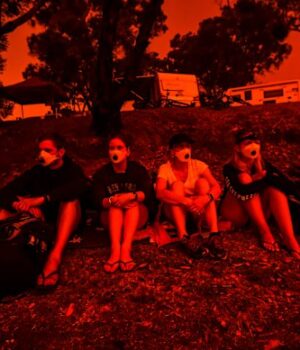
Source : the age
For many people in the climate movement the Black Summer bushfires are seen as catastrophe that changed the world, revealing with horrifying clarity how serious the threat of climate change has become and ending the climate debate.
New research reveals that it did no such thing.
In fact, in the weeks after the peak of the fires more Australians came to question the science of climate change, many echoing claims made in conservative media that the fires were the result of arson rather than climate.
Researchers analysed three national surveys conducted before, during and after the 2019/20 fires that burnt 24 million hectares, directly killed at least 33 people, destroyed more than 3000 homes and killed or displaced nearly three billion animals.
They grouped the 1061 subjects of the study into three groups, which they called climate change acceptors, fence-sitters and sceptics, and asked them to rank opinion statements about climate change by degree of endorsement.
They found that before the fires began, 64.6 per cent accepted climate science, but after the fires this had fallen to 54.46 per cent, while the number of fence-sitters grew from 27.13 per cent to 37.09 per cent. The number of sceptics remained relatively stable, growing only from 8.28 per cent to 8.45 per cent.
“Our results suggest the Black Summer bushfires did not elicit greater acceptance of anthropogenic climate change or heightened concern. Instead, misinformation, particularly conservative media narratives attributing the fires to mass arson, may have influenced beliefs about the fires’ causes, especially among undecided and sceptical individuals,” says the paper.
The research, published today by the Royal Society, indicates that misinformation may have dampened the fires’ impact on the public’s perception of climate risk, as evidenced by the widespread endorsement of the false claim that arsonists caused the bushfires – a belief held by 88.89 per cent of sceptics, 56.96 per cent of fence-sitters, and 38.79 per cent of acceptors.
This contrasted sharply with the attribution of the fires to climate change, which was endorsed by 87.07 per cent of acceptors but rejected by most other participants, suggesting that competing narratives and the simultaneous onset of the COVID-19 pandemic may have diverted public attention, it says.
“Online misinformation spread under the #ArsonEmergency hashtag, notably the claim that arsonists were a major cause of the fires, subsequently influenced conservative mass media reporting of the bushfires,” says the paper, written in collaboration with the CSIRO, The University of Western Australia, The University of Melbourne and Lancaster University in the UK.
“A prominent example was an article published in The Australian under the title ‘Bushfires: firebugs fuelling crisis as national arson toll hits 183’, claiming that ‘more than 180 alleged arson cases have been recorded since the start of the bushfire season’.
“The article played a prominent role in fuelling online climate change denial narratives and was shared by prominent conservatives, such as Donald Trump Jr, to his audience of four million followers on Twitter, thus propelling the misinformation to a much larger online audience. The arson claims were grossly exaggerated, calculated based on a range of fire-related offences other than arson and relied on annual figures rather than the Black Summer bushfire season.”
A spokesman for News Corp Australia rejected the assertion.
“Claims that our publications blamed this disaster on arson are false and do not hold up to scrutiny. Nor did our mastheads overstate the role of arson, as some critics claimed, to downplay focus on climate change,” he said.
“Nor did our publications ignore climate change issues in their bushfire coverage. Our four state-based mastheads and The Australian published 3335 stories about the bushfires between September 1, 2019, and January 23, 2020. Only 3.4 per cent mentioned arson or arsonists.
“One hundred and sixty of our employees covered the fires for months, reporting events in real time as a live, breaking emergency, often placing their own wellbeing in danger to tell the stories that mattered to our communities.”
The researchers write that by providing competing narratives like the mass-arson claim, misinformation facilitated what they called motivated reasoning, “the tendency for individuals to interpret information in ways that protect or reinforce their prior beliefs,” allowing some people to interpret the causes of bushfires in ways that protected or reinforced their pre-existing climate change beliefs, and others to shift from being acceptors to fence-sitters.
Bad actors seeking to seed disinformation harness reports of arson as the cause of fires due to the public’s misunderstanding of wildfires and climate change, said one of the paper’s co-authors, the University of Lancaster’s Dr Mark Hurlstone, a senior lecturer in psychology who researches attitudes to climate change.
He said many people did not understand that, however fires are ignited, hotter and drier conditions caused by climate change made them far more destructive.
“Climate change isn’t causing these fires; it’s priming the landscape for these fires to burn intensely and to spread widely.”
A CSIRO study published in the journal Nature in 2021 showed the annual area burnt in Australian forests had increased by 800 per cent in the previous 32 years, primarily due to climate change. A previous study by World Weather Attribution said that compared with the climate of 1900, the probability of Fire Weather Index as high as in 2019/20 has increased by more than a factor of four.
Another World Weather Attribution study published in July found that climate “whiplash” driven by climate change had exacerbated the fire threat before wildfires devastated parts of France, Spain and the UK this northern summer.
Whiplash describes how climate change has intensified winter rains, which boost forest fuel loads, as well as summer heat and drought, which dries out the landscape, accelerating fire risk.
According to Hurlstone, studies like these tend to be published after fires, and after reports of arson in social and mass media have already caused misunderstanding of how climate change makes fires worse.
He said climate scientists and communicators must better prepare the public to understand climate crises before they begin.
Get to the heart of what’s happening with climate change and the environment. Sign up for our fortnightly Environment newsletter.
 Nick O’Malley is National Environment and Climate Editor for The Sydney Morning Herald and The Age. He is also a senior writer and a former US correspondent.Connect via email.

