source : the age
If you ever find yourself buried beneath the rubble of an earthquake’s aftermath or expiring in a remote cave, salvation may not arrive in the form of a dashing rescuer or detection dog, but of a hulking, hissing, spiky-legged cockroach.
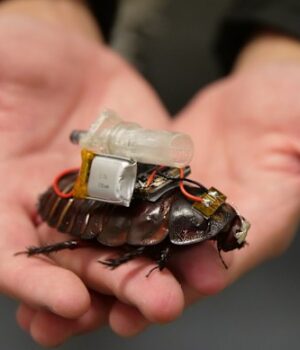
Scientists are developing cyborg paramedic cockroaches designed to find people trapped in places human rescuers can’t reach, with the latest recruits capable of delivering medicine by firing syringes from a harpoon system on their backs.
The “paraborg” (a portmanteau of paramedic and cyborg) insects are made from giant burrowing cockroaches, which are the world’s heaviest cockroach species and native to north Queensland.
“It’s not for everyone,” biorobotics specialist and cyborg creator Dr T. Thang Vo-Doan, from the University of Queensland, said of working with the cockroaches. “But we have very good relationship with them in the lab.”
The glossy arthropods are fashioned into cyborgs by the insertion of electrodes into their antennae, so the cockroaches can be remote-controlled with a joystick.
Antennae detect obstacles, so when the left one is stimulated, the cockroaches bear right, and vice versa.
Other electrodes in the “cerci” – sensory appendages at the back of the insect – allow researchers to accelerate or stop the cyborg roaches.
Scientists eventually want to make fully robotic, insect-inspired rescue devices but Vo-Doan said robots aren’t small, agile or efficient enough yet to operate in disaster zones. Cockroaches, however, are ready to rumble.
“The insect can climb and run, even carry heavy loads in different orientations in a complex environment,” Vo-Doan said. “You already have everything from nature. It simplifies our system a lot in terms of design and engineering.”
He believes more lives can be saved now by harnessing the insects, with agility and efficiency honed by evolution, to carry devices including cameras and sensors into collapsed buildings.
While small robots are restricted by limited battery life, cockroaches can go for days, powered simply by gum leaves and apple slices.
There’s no requirement for scientists to obtain ethical approval for research with insects. But the cockroaches are anaesthetised for the insertion of electrodes, and electronic systems are carefully removed after experiments.
Vo-Doan said the cyborg recruits seem to live as long and well as their civilian counterparts.
The latest study, published in Advanced Science, focused on the “rescue” part of search and rescue. If a swarm of cyborg cockroaches discovered a victim buried beneath rubble who was suffering from sepsis, what happens next?
Enter the medic class. The researchers created and tested needle-firing cyborgs and showed they could successfully navigate to a target and deliver a jab in 72 per cent of proof-of-concept trials.
When cockroaches came within 15 centimetres of a mock target, the hit rate was 95 per cent.
“A lot of people might not like the sight of a giant cockroach scurrying towards them,” said PhD candidate and first author of the research Hai Nhan Le.
“But if you’re trapped in rubble or stuck in a cave and need help, it could make a real difference between life and death.”
The idea, eventually, is to create a “fully autonomous paramedic team composed of terrestrial cyborg insects” that can independently search for victims, relay information and deliver medication, the researchers write.
The concept might seem far-fetched but other international teams are taking the same approach and have been trialling it in the field.
Ten cyborg Madagascan hissing cockroaches fitted with infrared cameras and sensors were deployed alongside Singapore’s Operation Lionheart rescue team in the aftermath of a 2025 earthquake in Myanmar that killed at least 3600 people. (The cockroach squad didn’t detect any survivors but researchers said the mission yielded valuable lessons to improve the cyborgs.)
Meanwhile, in June, another team of researchers introduced the aquatic class.
They designed flexible cockroach diving suits 3D-printed from resin. Cockroaches wearing the suits could operate underwater for three hours despite being a terrestrial species, the researchers reported in Nature.
The amphibious cyborgs could one day carry out missions in flooded areas or help explore the deep ocean – or other planets. “The ultimate goal is to [take this technology to] space,” lead author Professor Hirotaka Sato told New Scientist. “Exploration over the Mars surface, for example.”
So when might we see cyborg cockroaches rolled out to disaster zones? Perhaps five years, perhaps 20, depending on the level of support the idea gains, Vo-Doan said.
Experts such as Superintendent Tim Hassiotis, from Fire & Rescue NSW, are open to the concept if the cyborgs prove effective in real emergencies.
“If cyborg insects can safely enter spaces we can’t, locate casualties and ultimately help deliver emergency care, they could become another valuable tool in the future of urban search and rescue,” Hassiotis said.
Examine, a free newsletter covering science, is sent every Tuesday. Sign up to get the whole newsletter in your inbox.
 Angus Dalton is the science reporter for The Sydney Morning Herald.Connect via X or email.