Source :- THE AGE NEWS
To an outsider, the email read like a threat. If you don’t deliver on your promises, you will lose the Cox Plate.
The correspondence, sent by Racing Victoria chair Tim Eddy to the bosses of the Moonee Valley Racing Club, made one thing clear: without a race-ready grandstand, RV could not guarantee the return of the club’s signature Group 1 event in 2027.
The formal nature of Eddy’s email surprised Moonee Valley chairman Adam Lennen and CEO Michael Browell.
But perhaps they shouldn’t have been surprised, given that only three months earlier they had received an audacious merger proposal from a rival club that would have wiped Moonee Valley Racing Club from the country’s racing landscape entirely.
That proposal didn’t come from RV, but from the Valley’s rival, the Melbourne Racing Club.
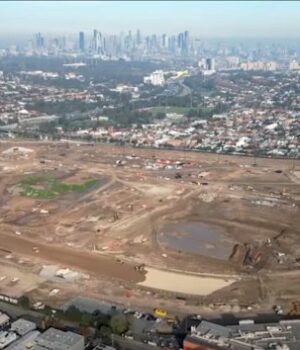
Both issues landed in the club’s saddlebags while in the midst of a long-planned $220 million redevelopment that began when punters enthusiastically began tearing the venue to pieces at the conclusion of the 2025 instalment of Australia’s best weight-for-age horse race. The track has been ripped up; the old grandstands torn down.
The Cox Plate will be run at Flemington in 2026 – the home of the Melbourne Cup. It is the first time the race will be held outside the Valley since it began in 1922. It was relocated to give the club time to complete the redevelopment of its famously narrow and short-straighted track and the accompanying facilities, including the grandstand.
It wasn’t long after the Racing Victoria email that Moonee Valley publicly revealed it would not be able to complete its grandstand in time for the 2027 race; perhaps not even 2028. Its plan for those years is to boost capacity with temporary infrastructure to accommodate the large crowds that attend the race.
Valley CEO Michael Browell said delaying construction of the grandstand was the fiscally responsible thing to do. “We’re rolling with the market changes as they happen,” he told this masthead.
For its part, Racing Victoria was unapologetic about asking Moonee Valley to prove it could host 15,000 spectators on race day and issuing a set of draft guidelines that had the potential to deny the new-look Valley one of the crown jewels of Australian racing. It would also have to prove its new track was fit for racing and its facilities, such as new jockey rooms and a new mounting yard, were fit for purpose.
“Whilst we are supportive of the club’s redevelopment, we will make our decisions on meeting allocations in the best interests of Victorian racing,” an RV spokesperson said.
An audacious proposal
The Valley board calmly discussed the RV letter, just as they had done three months earlier when they received an audacious “merger proposal” from the Melbourne Racing Club.
To the layperson, it looked more like a takeover than a merger.
The MRC proposal came on the back of growing speculation within the industry that the Valley project was running out of money in challenging economic conditions and the club would wind up insolvent. The club vehemently denies that is the case.
Among those with concerns is Jonathan Munz.
The billionaire powerbroker and chairman of the Thoroughbred Racehorse Owners Association has long been opposed to the Moonee Valley rebuild. Widely considered one of the most influential voices in Victorian racing, Munz would prefer the entire precinct be sold, and the potential $500 million in proceeds ploughed back into the industry.
Munz, who owns a private jet and is a fan of The Godfather films, is also the vice-chairman of Melbourne Racing Club, which governs Caulfield and Sandown. He was the driving force behind the MRC’s May 4 merger bid – an offer approved by the MRC board.
The proposal called for the clubs to come together and for Moonee Valley to immediately abandon its mega rebuild, despite having already spent close to $50 million demolishing its grandstands and rebuilding its track.
Another key component of the MRC’s merger plan was to cease racing at Moonee Valley altogether and instead build a new $70 million third track at Sandown Racecourse to service the industry’s demands.
It was an interesting twist. The future of Sandown – one of four metropolitan Melbourne racetracks, including Flemington, Caulfield and Moonee Valley – was in doubt until September 2024 because the MRC was considering selling off the precinct for housing as part of the creation of a new suburb.
The Sandown sale would have paid for upgrades at Caulfield, but those plans were abandoned when John Kanga took control of the MRC board. When he resigned on the eve of last year’s Caulfield Cup, he was replaced by Munz.
Another pointed demand in the MRC’s merger proposal was that all Moonee Valley staff would be sacked, including Browell.
But the clubs would provide five board members each, and Lennen would be offered the chairmanship of the new entity. Moonee Valley members would be given free membership for life.
The MRC and Munz declined to comment when contacted by this masthead.
There is no evidence of a direct link between the MRC’s merger bid and RV’s return-to-racing guidelines.
Lennen told this masthead the Valley’s full board rejected the merger offer because they were committed to rebuilding their course.
“It was not an offer capable of acceptance,” he said.
“There’s no way we could entertain a proper merger discussion until we understood where MRC’s balance sheet is at.”
‘The Achilles heel’
Lennen acknowledged there was a nervousness within the industry about clubs blowing millions of dollars following the 2024 mounting yard debacle at Caulfield.
The former MRC committee spent $160 million at Caulfield on a new inner track, subterranean stalls, mounting yard and race-day facilities, which were opened in 2024. The mounting yard was decommissioned soon after, amid complaints from the industry, and returned to its original location.
“We sat down with [RV CEO] Aaron [Morrison] and said, ‘we get where you’re coming from, and we have nothing to hide, no issues with it, but we actually don’t think it [a raft of guidelines] is necessarily the best way to do it’,” Lennen said.
“So we sat down with them, and then we responded in writing, and effectively created an MOU [memorandum of understanding] with a working group structure that is basically the path forward.
“We’re 13 months away from hosting a race meeting, and we’ve got a whole program of works that we’re going to step them through.”
The MRC has its own mountain of debt – listed at $178 million in last year’s annual report – which is dependent on the sale of a $195 million slice of land at Caulfield Racecourse to Mount Scopus College. The Valley claims it will have a large cash surplus by the time its redevelopment is completed, due partly to the sale of apartments.
It is not the first time Munz has attempted to oversee a merger. The Age revealed in June last year that he hosted a secret meeting in his Toorak mansion to discuss a potential coming together of the Victoria and Melbourne racing clubs.
Browell said Racing Victoria and the club’s major sponsor, Ladbrokes, were told more than two years ago that a new grandstand “would not be built when we came back” in 2027.
He said this message was also conveyed to club members at the 2025 annual general meeting.
“But there’s a pocket of discontent within the industry that thinks, ‘Ah, that’s the Achilles heel here’, let’s home in on that and drum this point through,” he said.
‘Shared delivery’
Browell agreed that Racing Victoria should “play a part in a project of this scale”, considering the recent mistakes at Caulfield, but said he was confused by the timing of their guidelines.
“If I had that [return-to-racing] document 12 months before we started, I wouldn’t have thought twice about it,” Browell said.
“I would have thought, ‘this is standard operating procedure: Here’s a three-year club-funding agreement to help you get through your redevelopment, and by the way, here is the role Racing Victoria will play every step of the way’.”
An RV spokesperson said the sport’s governing body would “work through the proposed plans” with Moonee Valley over the coming months.
“We’re yet to see detailed plans from the club around how they would accommodate a crowd of at least 15,000 people so we’re not yet in a position to make a decision, noting that we still have a bit of time given our race dates for 2027-28 won’t typically be finalised until next autumn,” the spokesperson said.
“The absence of a completed permanent grandstand doesn’t automatically mean the Valley couldn’t be allocated premier meetings from next season.
“However, we’ll need to be fully satisfied that their alternative plans for a combination of fixed and temporary infrastructure is both suitable and capable of meeting operational requirements; the expectations of customers, owners and participants; and for delivering an event experience befitting the occasion.”
Both Browell and Lennen said they had no doubt they could work with Racing Victoria to ensure the club raced into the future.
“We are actually taking them on the journey,” Lennen said. “So it’s actually a shared delivery.”
News, results and expert analysis from the weekend of sport sent every Monday. Sign up for our Sport newsletter.