Source : INDIA TODAY NEWS
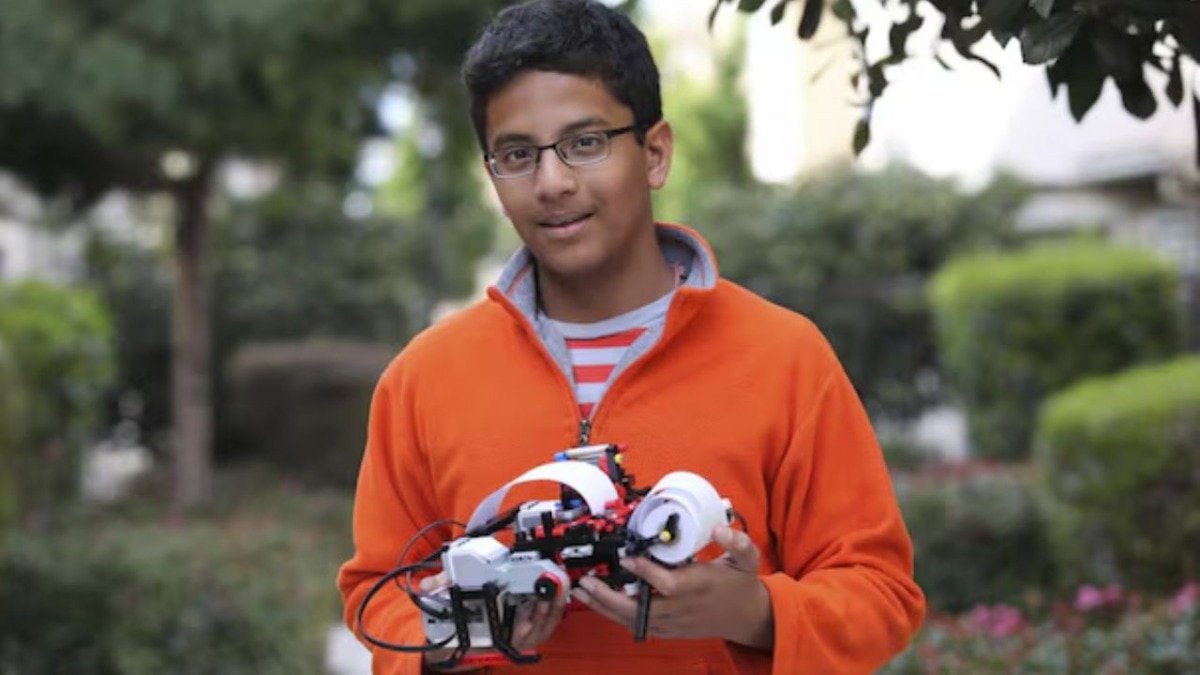
How do blind people read? It was a simple question 13-year-old Shubham Banerjee asked his parents in 2014. They told him to look it up online, and what he found really surprised him: Braille printers, also called embossers, could cost $2,000 or more. So Banerjee decided to see if he could build one for less. Banerjee was an eighth-grader in Santa Clara, California in 2014, and he already had the material he needed for the first experiment, which was a Lego Mindstorms EV3 robotics kit. The result was Braigo, a working Braille printer that was made largely from Lego components and a few additional electrical parts.
advertisement
SO, HOW DID A LEGO KIT PRINT BRAILLE?
Braille is made up of raised dots that can be read by touch, and a Braille embosser creates those dots on paper instead of printing ordinary ink. Banerjee’s first prototype used three motors to move the paper and printer head and create the raised-dot patterns, and it eventually took him seven attempts to get a working version, according to Smithsonian.
The project was initially meant for a school science fair. The teen spent several weeks working on it at the kitchen table, often late into the night, with his father, Niloy, helping him. A conventional Braille printer could cost at least $2,000 at the time, while Banerjee’s prototype was built for about $350, including the Lego Mindstorms kit and additional components. That did not make it a direct replacement for commercial Braille embossers, but it showed that a basic working machine could be built using relatively inexpensive, widely available components.
WHY WAS THE COST SUCH A BIG DEAL?
Braille enables blind and visually impaired people to read and write through raised dots, but access to Braille materials has declined as other technologies, including screen readers and text-to-speech software, have become more common. The problem is that those technologies do not make Braille unnecessary for everyone.
Banerjee’s project focused on a simple question: could the hardware used to produce Braille be made more affordable? That was also what caught the attention of Henry Wedler, who was a blind doctoral student at the University of California, Davis, and learned about the project and contacted Banerjee.
Wedler tested the printer and helped Banerjee understand how a blind user might actually use such a device. One limitation of the original Lego version was that it required a sighted person to operate it, so the prototype was not finished simply because it could produce raised dots; it had to become useful too.
FROM SCHOOL PROJECT TO BRAIGO
Banerjee entered the printer in the 2014 Synopsys Santa Clara County Science Fair and won the Outreach Foundation n+1 Prize for a science or engineering breakthrough. He later launched Braigo Labs to continue developing the idea. He combined “Braille” and “Lego”, and the name stayed even as the technology evolved beyond the original Lego-based prototype. By then, Banerjee was working on a purpose-built version that was intended to be quieter and easier to use.
In 2014, Intel Capital invested in Braigo Labs as part of a broader investment in 16 companies. The investment made Banerjee the youngest entrepreneur to receive venture capital funding from Intel at the time, according to contemporary reports. By then, the project had also moved beyond Lego, and Banerjee was working on a more conventional version of the printer that was intended to be quieter, faster and easier to use. The goal was still the same: make Braille printing equipment smaller and less expensive.
WHAT HAPPENED TO THE LEGO PRINTER?
The original Lego machine was never meant to be the final commercial product, since its importance was that it allowed Banerjee to test the idea cheaply and demonstrate that the basic mechanism could work. Braigo Labs then moved towards developing a purpose-built printer rather than relying on Lego parts.
At the time, the project showed how a relatively inexpensive robotics kit could be used to test an idea that would otherwise require far more specialised hardware. Banerjee’s project teaches us that sometimes the first step is not creating a completely new technology, but finding a cheaper way to build something that already exists. A question from a school science project had turned into a working prototype, a company and finally, investment from Intel. The Lego printer had done what a prototype is supposed to do: it proved the idea was worth developing further.
– Ends
SOURCE :- TIMES OF INDIA