SOURCE :- THE AGE NEWS
Follow our live coverage of the Nepal floods here.
Warning: This story contains graphic content.
Trishuli, Nepal/Beijing: A wall of mud and rock collapsing into a river on the Himalayan border of Nepal and China triggered catastrophic flooding on the Nepali side, killing at least 160 people with hundreds more missing.
It’s the worst natural disaster to hit Nepal since the 2015 earthquake that killed 9000 and as the situation unfolds, videos of homes, roads and power projects being swept away on both sides of the border point to the number of casualties rising.
As authorities continue the grim task of recovering and trying to identify bodies, survivors are coming to terms with the tragedy.
“It was a huge gush of mud coming straight towards us. As it got closer, it kept rising higher and higher,” said Keshav Prasad Baral, a 68-year-old survivor, who was being treated at a small hospital.
“When I saw it enter our home, I tried to grab my wife’s hand and take her to the terrace. But she was swept away by the mud,” said Keshav Prasad Baral, a 68-year-old survivor, who was being treated at a small hospital.
“Four or five hours later, a helicopter came to rescue me. My wife is still somewhere beneath the mud. She’s gone.”
It’s an experience shared by many survivors. Kalpana Malla, who saw her father, mother, sister and sister’s children caught up in the floodwaters, told the BBC her family didn’t stand a chance against the fury of the flood.
“They could not escape, there was no chance at all. This flood took everything, but my son and I climbed the rooftop of a house and survived somehow,” she said.
Another survivor described being saved by clinging to a mango tree as he watched the house where he had been working disappear.
Twelve British tourists had just crossed through Gyirong – a border land crossing between the two countries – on a tour when a mud-filled wave more than 20 metres high hit, London’s Telegraph reported. They glanced over their shoulders – then began to run for their lives as the wall of water surged towards them down the narrow valley.
The tour was led by Alpine Eco Trek, a local service that arranges regular 10-day trips from the Nepalese capital of Kathmandu to the Tibetan mountain of Kailash.
“Both guides went offline at 8.42am,” said Ram Kumar Adhikari, the manager of the tour company. “The whole area was swept away by the flood. Even the Tibet immigration office,” he said.
The fate of the 12, which included “young girls”, remains unknown. They were among the hundreds of tourists who remain unaccounted for, according to Nepalese authorities.
A 61-year-old British woman and her 60-year-old sister were following the same route as the Alpine group when the mudslide struck. Leaf Holidays, the organiser of their trip, said it had lost contact with all 54 of its pilgrims and staff.
“My brother is the guide. He is missing. I rented a helicopter myself and went out for an hour looking for them,” Gopal Thapa, one of the company’s trek leaders, told The Telegraph.
Thousands of people live in Nepali riverside settlements downstream from the flooding, including along the Bhote Koshi and Trishuli rivers. The authorities have not estimated the number of people missing and the extent of damage.
Locals from the affected areas of Nuwakot and Dhading were seen gathering outside a Nepali army training centre – the base for helicopter rescue operations – seeking information about missing family members.
Police were recording the names of the missing just outside the barracks gate, using mobile phone flashlights as their only source of light as the area remained without electricity due to damaged hydropower infrastructure.
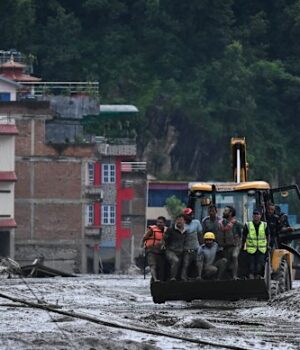
In the affected areas, houses, trees and vehicles were submerged or buried in mudslides. Helicopters hovered overhead all day in the area bringing in survivors.
“There is devastation everywhere we look,” Tula Bahadur BK, a health worker in Rasuwa, told Reuters. “The settlements next to the river have been completely swept away. Five of my own relatives are missing.”
Security footage captured on the Chinese side of the Nepal-Tibet border showed many people fleeing before a torrent of rock, mud and water destroyed buildings and vehicles and took many lives.
China’s state broadcaster said three people were killed and 265 missing in Gyirong. It said the toll was still being verified and rescue efforts were ongoing.
A rescuer interviewed by Chinese state broadcaster CCTV said they had been trying to establish contact with the Gyirong border port but “so far there haven’t been any results”.
All roads leading to the border crossing had been “completely destroyed” after a preliminary inspection with a drone, the rescuer added.
With the deluge of muddy water sweeping down from an estimated nearly 2000 metres above sea level, flood alerts were issued in the populous northern Indian states of Uttar Pradesh and Bihar, which border Nepal and where several rivers flow down the mountains into the plains.
Authorities in Bihar said they had evacuated about 5000 people from six districts and planned to evacuate a total of 10,000 to 12,000 people.
Reuters, staff reporter
Read more on the Nepal flood disaster:
Get a note directly from our foreign correspondents on what’s making headlines around the world. Sign up for our weekly What in the World newsletter.