
Source : the age
At least twice a week, Nat Thaipun – winner of MasterChef 2024, cookbook author and new Good Food columnist – pulls a 12-hour shift as a chef at three-hatted Melbourne fine diner Vue de Monde. She flops, exhausted, through her front door after 10pm. But it’s her kitchen, not the couch, that calls.
“I cook after work to relax; I play with ideas for new recipes. I call it procrasti-cooking,” Thaipun says.
She also runs to relax – turning a brain wired for overwork into a state of calm. This is no casual jog, though; she is training for a 50-to-100-kilometre ultra-marathon.
“I’m hoping to do the 100ks in 20 hours. It might be more like 22 with the elevation,” she says.
Shopping to fuel this frenetic pace is a crucial part of her week. She hits Melbourne’s beloved Queen Victoria Market for fresh produce, choosing Sunday or Tuesday – when stallholders slash prices by lunchtime before the market closes the following day.
‘I let prices dictate what I buy. If vegetables are cheap, it usually means they are in season, which means they will taste their best.’Nat Thaipun
We drop by on a Tuesday lunchtime and, sure enough, the bargain tables are out – turning up $1 plates of chillies, $1 bags of cucumbers and four avocados for just $2.
Clever, thrifty shopping is the essence of Thaipun’s approach, and her mind instantly transforms the slightly limp fiery peppers into a dried chilli supply.

“Making dried chillies is so easy: just roast fresh ones in the oven at 70 degrees for four to eight hours, depending on size. Oh, and these cucumbers I’d throw into my morning juice.”
The trained barista’s first stop is always Market Lane for a coffee, before hitting the famous Borek Shop for a spicy potato pastry – she devours it while weaving through the 148-year-old market.

Fruit and vegetables
Thaipun’s parents – who migrated from Thailand to Australia in the 1980s – ran the Thai Hut restaurant in Sunbury in outer Melbourne for 30 years. Her grandmother was both regular carer and diligent conduit of Thai culinary expertise, passing down practical wisdom on using whatever ingredients were available, rather than chasing anything hard to source.
Cruising the market’s heaving veg section, Thaipun isn’t hunting down specialist Thai produce. Instead, her focus is strictly on value.
“I let prices dictate what I buy. If vegetables are cheap, it usually means they are in season, which means they will taste their best.”
But there are non-negotiables: garlic, ginger and onion form the core foundation of her cooking. She also keeps a stash of lemongrass (halved lengthways and frozen), along with makrut lime leaves and pandan leaves, which she uses to scent rice or craft desserts.
She is never without a bunch of coriander, which she can make last for two weeks. “First, chop the roots off; wash and store them in a small ziplock bag (these are great for curries). Then wash the leaves and stems well, and use a salad spinner to dry them. Wrap in paper towel and keep in a lidded container. You can do this with most herbs.”
From there she grabs whatever greens are cheapest – sometimes broccoli or cauliflower but usually Asian stalwarts like choy sum and gai laan – to toss into stir-fries.
Thaipun’s morning health habit is to drink a shot of juice, which she blends up after each market visit and stores in a two-litre container.
“I think it’s the chef in me that likes to get nutrients in very efficiently. I always juice carrots, apple, orange, ginger and then whatever other fruit is in season. And I add a pinch of salt. It rounds the flavour and my mum says it boosts the body’s absorption of vitamin C.”
Meat
Thaipun keeps her weekly shop under $100 for two people – including meat. Navigating the overwhelming butcher section, price is once again her guide. She eyes a large tray of lamb chops for $28 (far cheaper than the supermarket), alongside a favourite cut – wagyu topside – and chicken Marylands. “I never use chicken breasts. They’re so much more expensive and have way less flavour than bone-in meat.”
She always picks up pork mince for Thai stir-fries, rating pork – especially shoulder and belly – as top-value meat. Her advice is simple: buy whatever is on special and freeze it. She’s invested in a vacuum sealer (picked up cheaply from Kmart) – “or use ziplock bags, making sure you label and date everything”.
She also picks up chicken carcasses and necks to make stock – roasting them at 200C for 30 minutes until golden brown. From there she transfers them into a big pot of water with aromatics such as bay leaves and onion. Four hours of gentle simmering delivers the “best bone broth, loaded with collagen”.

Bread
Away from the late-night kitchen shift, Thaipun leans into the “girl dinner”. Central to this is simply an olive (or plain) baguette, which she cuts into generous wedges and serves with pickles (see her quick pickle recipe below), home-made jams, cured meats and cheese – “essentially, a charcuterie board”.
Cheese
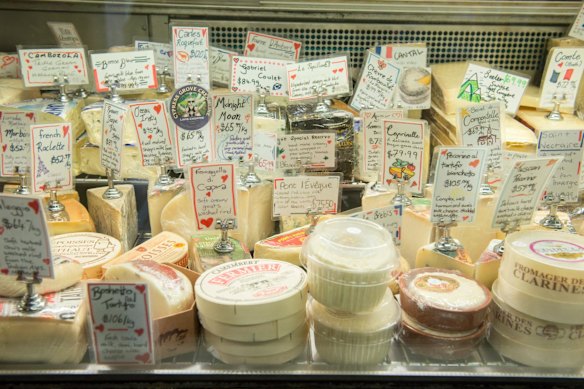
Cheese is a weekly staple – starting with an aged parmesan for pasta night, then a blue and a goat’s cheese. She hunts out Australian producers like Grandvewe Cheeses (especially the Sapphire Blue) and Tongola goat’s cheese (the Curdy and Zoe styles), both from Tasmania. A wedge of Long Paddock Banksia – a semi-hard, gouda-style cheese – usually rounds out the board.

Coffee
A barista for more than 10 years, Thaipun loves a pour-over – hot water slowly poured over fresh ground coffee. But she prefers buying beans at the market to brew at home – naming Market Lane and Inglewood as regulars – because, obviously, it’s much cheaper.
She’s done the maths to prove it.
“Roughly speaking, a 250g bag of good beans costs around $20 to $25 (even cheaper if you buy a 1kg bag). At 16 grams of coffee per cup, that’s about 15 cups a bag – call it $1.50 a cup once you add a filter paper. Compare that to $6 at a cafe and you’re saving around $4.50. Do that daily and you’re up almost $32 a week, which is more than $1600 a year.”
Nat Thaipun’s quick pickle
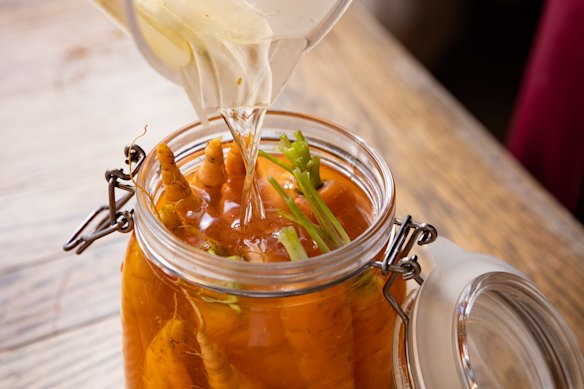
Always just remember the 3:2:1 rule – 3 parts vinegar and 2 parts water to 1 part sugar, plus salt to taste. This brine is great for cucumber, carrot, radish, red onion, shallots and chilli.
INGREDIENTS
- 3 tbsp rice vinegar (or white vinegar)
- 2 tbsp water
- 1 tbsp sugar
- ½ tsp salt
- 2 cups vegetables, thinly sliced (cucumber, carrot, red onion, radish, chilli)
METHOD
- Stir together the vinegar, water, sugar and salt until the sugar and salt fully dissolve.
- Pack the thinly sliced vegetables into a jar or bowl and pour the brine straight over them, ensuring everything’s submerged.
- Eat once it’s turned tangy-sweet with a bit of crunch left – usually 20 minutes is enough.
Keeps in the fridge for up to a week.