Source : INDIA TODAY NEWS
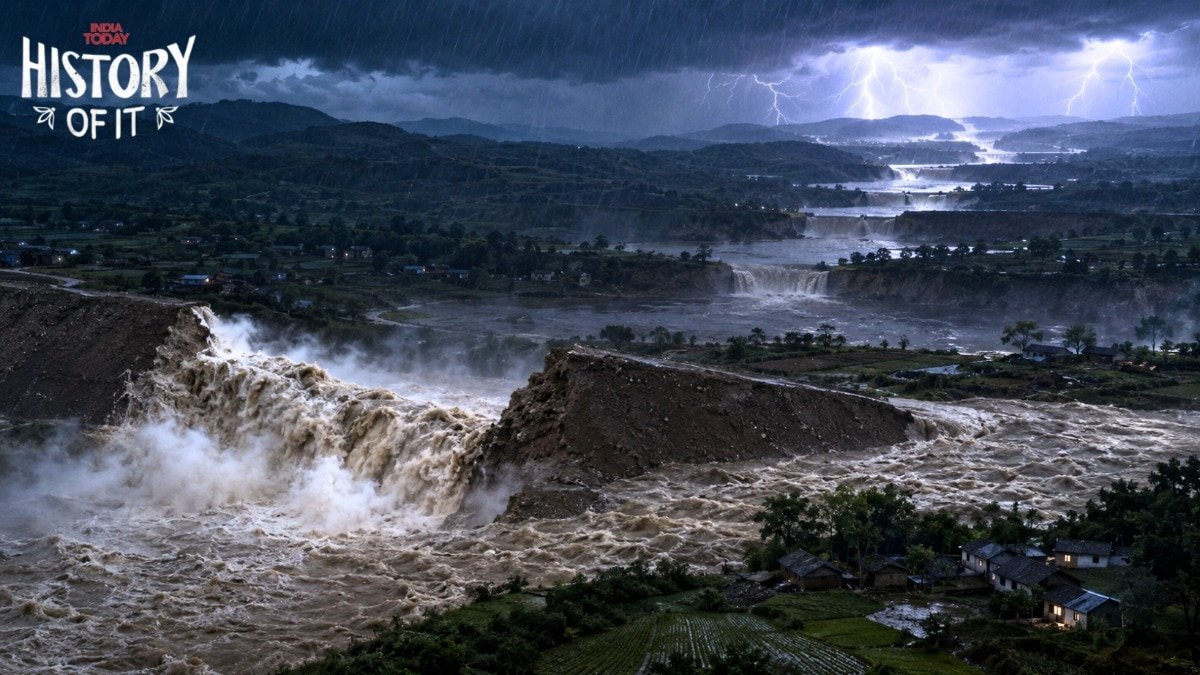
“Then came a tremendous crash, as if the heavens were collapsing and the earth splitting apart,” recalled witness Chen Bin of the moment just after midnight on August 8, 1975, when China’s supposedly indestructible “Iron Dam” gave way.
The Banqiao Dam was built during the nascent years of Communist China and Mao Zedong’s early years in power, and it was later reinforced with Soviet assistance. It was a showpiece of the Communist Party’s campaign to tame China’s mighty rivers. It was a campaign that accelerated during the Great Leap Forward. But as Banqiao broke, a wall of water up to 10 kilometres wide raced across the valleys and plains of Henan province, catching downstream villages in their sleep. By morning, the major dams of Banqiao and Shimantan, and dozens of smaller dams had failed, unleashing China’s deadliest dam disaster, which is ranked as the world’s third-deadliest flood in recorded history.
advertisement
The trigger was Typhoon Nina, which dumped more than a year’s worth of rain over parts of Henan in just three days.
Typhoon Nina, which had formed in the eastern Pacific Ocean, brought extreme rain to the region, but poor dam design, official inaction and failed warnings made the disaster far worse. China’s state-controlled media barely reported the dam collapse. The scale of the tragedy emerged about 20 years later, while some official records reportedly remained secret for nearly 30 years.
The flood directly killed around 26,000 people, according to a 2017 study by researchers from Princeton and Tsinghua universities. The study estimated that famine and disease subsequently caused approximately one lakh additional deaths. A much higher estimate of about 2.3 lakh deaths was produced by eight senior Chinese experts, cited by Human Rights Watch in 1995. The exact toll, however, remains contested. Around 10 million people were affected or left without adequate shelter, while entire villages and towns, roads, railway lines and vast stretches of farmland disappeared underwater.
The 1975 disaster has acquired fresh relevance after the latest flash flood along Nepal’s Bhote Koshi-Trishuli river system, close to the Tibet border. While preliminary scientific assessments suggest that an ice-rock or glacier collapse triggered the destructive surge, several Nepali journalists and experts have alleged that China’s little-known infrastructure construction along the border might have contributed to the disaster.
Similar concerns about secrecy, environmental damage and inadequate disclosure have also been raised by experts in connection with China’s Three Gorges Dam. After the disaster unfolded on Thursday, several Indian experts again raised a red flag over the 60,000-MW dam that China is building in the high seismic zone in Medog county, close to the border with Arunachal Pradesh.
The disaster has underscored how timely information about landslides, natural river blockages, glacial lakes, rainfall and reservoirs are essential for countries and communities downstream of the Himalayas. It also revives an old question associated with Banqiao and later with the Three Gorges debate. What happens when information about a fast-developing water disaster is buried by a secretive state?
THE MAKING OF CHINA’S IRON DAM AND MAO’S GREAT LEAP
Banqiao was constructed on the Ru River in Henan province between 1951 and 1952 as part of the “Harness the Huai River” programme. Its purposes included flood control, irrigation and electricity generation. Just years after it was built, cracks had appeared in the structure and its sluice gates. It was repaired and reinforced in 1955-56 with advice from Soviet engineers, acquiring a reputation as the tie ke, or “Iron Dam”. It was a structure considered virtually unbreakable.
The dam was among numerous reservoirs created as Mao Zedong’s newly established People’s Republic of China sought to demonstrate that political power could conquer nature. The construction drive intensified during Mao’s Great Leap Forward from 1958, when more than 100 reservoirs were reportedly built around Zhumadian alone.
Zhumadian in southern Henan was the epicentre of the disaster, home to Banqiao, Shimantan and dozens of smaller reservoirs that failed during the catastrophic flood.
Mao-led China’s policy emphasised storing water and building numerous small dams. Chen Xing, then a senior Henan water-conservancy engineer, warned that prioritising storage while neglecting drainage on the plains could disrupt the natural water system and increase flood danger.
“If I hadn’t spoken up about these incorrect and erroneous propositions and measures, who would dare to?” Chen told Phoenix TV, a Hong Kong-based Chinese-language television network, in 2012. His objections were rejected, and he was accused of making “right-leaning errors.”
While the excessive focus on water storage worsened the disaster, its immediate trigger was brewing over the Pacific a month ago.
A PACIFIC TYPHOON BROUGHT MORE THAN A YEAR’S RAIN IN THREE DAYS
Typhoon Nina formed over the Philippine Sea at the end of July 1975, intensified rapidly and crossed Taiwan before making another landfall in China’s Fujian province.
The storm weakened as it moved inland, but its remnants became trapped over central China by a blocking weather system. An interaction with another tropical depression channelled exceptional moisture into Henan. The result was rainfall of a magnitude rarely recorded anywhere.
The 2017 Journal of Hydrometeorology study by scholars, Long Yang, Maofeng Liu, James A Smith and Fuqiang Tian, found that maximum one-day rainfall exceeded 1,000 mm near the storm’s centre. The highest three-day accumulation reached 1,605 mm at Linzhuang between August 5 and 7, 1975.
Banqiao itself received 1,422 mm over the three days, including 784 mm on August 7. At Linzhuang, 830 mm fell within just six hours. That was close to the recognised world record.
Water poured into Banqiao reservoir at an estimated peak rate of 13,000 cubic metres per second. Its spillways could release only around 1,700 cubic metres per second, according to the Princeton-Tsinghua study.
The reservoir was gaining water almost eight times faster than it could discharge it.
WARNINGS LOST IN STORM, MESSENGERS SWALLOWED BY FLOOD
The situation was worsened by indecision and failed communications after the first dam failed. Technician Hu Defeng later recalled that operating rules required water to be released, but staff had received no clear order from above. “Who dared to make the decision?” he asked in an account published by China Energy News in 2012.
Even when an engineer agreed that the gates should be opened, there was no firm instruction on whether to open them fully. Hu said the safe release capacity was around 450 cubic metres per second, but only about 300 cubic metres per second was discharged at one stage.
“Many people felt the seriousness of the problem and believed that the gates had to be fully opened, but no one explicitly said so,” he recalled.
Telephones and radio links had been disrupted already. Messages had to be carried by people moving along the dam in torrential rain. A warning sent by a military unit failed to produce a comprehensive evacuation. Signal flares were misunderstood, phones were scarce, and some messengers were themselves swallowed by the flood.
Shahedian, located several kilometres below Banqiao, was reportedly the only downstream town to receive a warning more than an hour before the dam breach. According to the US Bureau of Reclamation’s 2015 case-history compilation, 827 of its roughly 6,000 residents died.
Wencheng and its surrounding villages received no warning before the flood arrived at night. In Weiwan village, 929 of 1,976 people were killed. In Qianhu, 1,397 of 2,200 died.
THE NIGHT WHEN OVER 60 CHINESE DAMS FELL
By late August 7, water had reached Banqiao’s protective wall. Shortly after midnight, it overtopped the structure, stripped away its earthen shell and opened a breach across the dam.
Chen Bin, a local flood-control official, described lightning flashing over “a world of rain” immediately before the collapse. Then came the tremendous crash that he compared with heaven and earth breaking apart.
Approximately 701 million cubic metres of water escaped from Banqiao within six hours, according to post-flood research cited in the Journal of Hydrometeorology. The resulting flood broadened to between 10 and 15 kilometres and moved at an estimated 30-50 kilometres per hour.
Shimantan Dam, 32 kilometres from Banqiao, had already failed after being overtopped. The two major breaches initiated a cascade across the hydrological system.
The exact count varies by source. The US Bureau of Reclamation and several subsequent accounts describe 62 dams failing in total, including Banqiao and Shimantan. The Princeton-Tsinghua paper refers to the two major dams and “62 smaller reservoirs”, while a Chinese account speaks of nearly 60 reservoirs. The number 62 remains the most widely cited total.
Some dams were later deliberately breached to redirect floodwater and protect other reservoirs, further complicating the count.
CHINESE FLOOD SURVIVORS FACED FAMINE AND DISEASE
The first torrent was only the beginning. At least 26,000 people were initially killed due to the floods.
The Beijing-Guangzhou railway was severed, roads vanished and communication with the disaster zone collapsed. Nine days after Banqiao failed, millions of people reportedly remained surrounded by water.
Phoenix TV’s reconstruction cited telephone records showing desperate conditions. On August 13, around two million people were still trapped. In one village, thousands had consumed the available leaves. Some clung to the trees for days. Medical teams reached areas where encephalitis and other diseases were spreading, but sometimes they arrived without medicine.
By August 18, hundreds of thousands remained stranded in Pingyu, Shangcai and Xincai. Survivors reportedly ate insects and leaves while contaminated water, extreme heat and decomposing bodies created conditions for epidemics.
This situation made way for an enormous death toll. The Princeton-Tsinghua study reported approximately one lakh additional fatalities from famine and disease. A Xinhua journalist who investigated the affected districts estimated between 30,000 and 40,000 deaths. An early Henan Communist Party assessment reportedly put the toll at 85,600.
The figure of 2.3 lakh deaths came later from eight senior Chinese critics of the Three Gorges project — Qiao Peixin, Sun Yueqi, Lin Hua, Qian Jiaju, Wang Xingrang, Lei Tianjue, Xu Chi and Lu Qinkan. The Human Rights Watch said that the higher total appeared to include people who died later from hunger and epidemics.
HOW CHINA BURIED THE DAM FAILURE DISASTER
Communist China was then in the final phase of the Cultural Revolution. Information was tightly regulated. Newspapers presented flood-relief propaganda while omitting the dam failures and their human cost.
A former official, Chen Zhikai, later told Phoenix TV that no explicit secrecy instruction was necessary. “Usually, when a reservoir collapses and people die, we don’t disclose it to the public,” he said, describing the prevailing system as one of “reporting good news and not bad news”.
The Human Rights Watch’s 1995 report brought the Banqiao-Shimantan disaster to wider international attention while it examined Beijing’s obsession with large dams. It described the 1975 catastrophe as having been “almost entirely unreported” beyond the top party leadership and specialist hydrological circles.
The silence of Communist China mattered a great deal. If failures remain hidden, engineers and communities elsewhere cannot learn from them. If death figures were suppressed (as they were), the human cost of bad engineering design and delayed warnings could not be properly assessed.
Banqiao was eventually rebuilt between 1986 and 1993. But its enduring lesson is that an extreme natural event can become a mass tragedy when poor planning, official inaction and secrecy come in a bunch. The Banqiao disaster showed, while the typhoon supplied water, poor planning, official paralysis and secrecy turned it into a catastrophe. Half a century later, its warnings are as urgent as ever. If governments hide risks and delays in the supply of information, downstream communities pay the price.
– Ends
SOURCE :- TIMES OF INDIA