Source : PERTHNOW NEWS
For three decades, Australian Story has told the tales that define us as a nation.
It has detailed triumphs and tragedies, big and small.
Shone light on tremendous miscarriages of justice.
Helped push legislative change.
Cleared the name of wronged people.
And invited us into the lives of ordinary Australians, many of whom have extraordinary stories to tell.
Thirty years on, the show still resonates.
“I think because people see themselves in it,” Wendy Page, a founding producer of the program, told The Sunday Times from her home in Tasmania.
Page worked on the long-running news and current affairs program for 25 of its 30 years, winning two Walkley Awards for episodes she produced.

A few days after speaking to The Sunday Times, Page travelled to Sydney for Australian Story Live, an event which took place at the Opera House, recorded to air as an extended episode of the show this Monday.
It was Page’s way of honouring a program that has been a huge part of her life.
“I think people see their own lives in it, one way or another,” she said of the show’s impact.
“These are not programs about the reporter — if you watch 60 Minutes, for example, the reporter is there all the way through, front and centre almost — but you don’t see or hear the reporters from Australian Story at all.
“It’s just people (telling) their story.
“And the audience is incredibly discerning.”

Page has been instrumental in bringing many of the program’s most memorable stories to the small screen.
Known for her exploration of miscarriages of justice, she won one Walkley for an episode about the wrongful conviction of Perth man John Button, accused of killing his girlfriend in the 1960s.
She also produced a double episode titled “The Wronged Man”, which looked at the 1994 murder of a Perth jeweller Pamela Lawrence and the case of another wrongly convicted Western Australian, Andrew Mallard.
In 2004, she turned her attention to the then-unsolved Claremont murders, producing an Australian Story program about the case.

“I did that (original) program back in 2004, and so I got to know the parents of two of the girls very well,” Page explains.
“Because I did all the interviews, I still had relationships with various people who had been in my original story, so I went back.
“You keep in contact with people like that — I still touch base with them now and again — because they become an important part of your career, but also of your life.
“You can’t not get close to people who entrust you with such deep, personal and emotional stories.”
Page was also behind a story in 2003 about Lynette Dawson, later pursued in detail via the globally-popular Teacher’s Pet podcast.

“The podcast was subsequent to that, and when (that) went crazy around the world, I had retired at that point, but they brought me back for that as well,” Page explains.
“Actually, a lot of my stories rear up again — when there’s some dramatic new development they’ll bring me back for an update.”
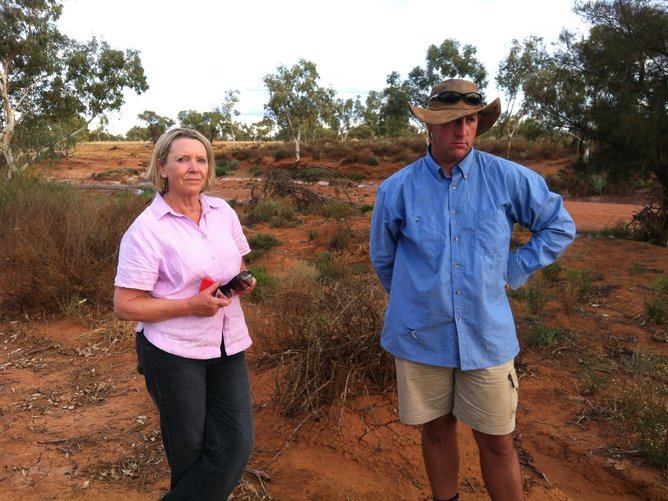
At the Opera House, some of the show’s most notable past subjects took to the stage, including actor and producer Claudia Karvan, Olympic swimming champion Michael Klim, First Nations advocate and community leader Mechelle Turvey, maths educator Eddie Woo, and Queensland graziers, Gayle and Mac Shann. Tim Minchin and Alex Lloyd performed as well.
The show’s founding executive producer, Deborah Fleming, and current presenter Leigh Sales were also involved.
At the show, Karvan opened up about her decision to share her story with the program for an episode which aired in 2023, saying she trusted Australian Story to tell her story faithfully.
Page says this sense of trust ensured Australian Story’s longevity and relevance.
“We used to say we got the stories that money couldn’t buy,” she explains.

“We often got the stories (others) had brandished the cheque book for, but they said they wanted to go with us, because Australian Story has a great reputation for its integrity.
“A lot of people will say, ‘it’s such a soft program, it’s so easy if you go on Australian Story’, but it’s not soft — we require a lot from the people who surrender themselves to us.
“It is not easy, and they have to answer the hard questions — even though you don’t hear our questions, we do ask them — and sometimes they are not comfortable.
“But if you are on a journey with them, you tell them in the beginning that you will treat them with integrity, but that you want them to answer the questions.”
“They are not given a free ride.”
WA STORIES TO REMEMBER
The Claremont Murders: He Who Waits (2004) & To His Door (2020)
Page’s 2004 episode dealt with the stalled investigation, featuring interviews with forensic experts, police, and the victim’s families, including the parents of Jane Rimmer and Sarah Spiers.
In the episode, experts called for a complete whole case review of all evidence, something that eventually happened, leading to the discovery of DNA evidence that led to the arrest of convicted murderer, Bradley Robert Edwards.
Page returned to cover Edwards’ guilty verdict 16 years later, reconnecting with many of those who had spoken years earlier.
Diana Bliss: The Parson’s Daughter (1997) & Her Hour Upon The Stage (2012)

Best known for her fraught marriage to disgraced businessman Alan Bond, Diana Bliss appeared on the program twice, first in 1997, when her famous husband was in jail on fraud charges.
“I felt very strongly that she had been conned by him as much as everyone else had,” Page says.
Tragically, in 2012, Bliss took her own life and Page revisited her story in a double episode.
“I still had archive tapes with my original interviews, much of which hadn’t seen the light of day,” she explains.
“I was assigned to do a story about her life leading up to her death, which was quite challenging, but quite extraordinary.”
Wooleen Station: Half a Million Acres (2012), Return to Wooleen (2012) & Splendour in the Grass (2017)

These episodes detailed a couple’s fight to rehabilitate their severely degraded 375,000 acre cattle property in WA’s Murchison region.
“It was classic ‘Aus Story’ material,” Page says.
“David Pollock had been chosen over his older brother Richard to take over the family’s pastoral lease.
“It was an extremely painful decision for their father, but the two sons had radically different ideas about its future management.
“David’s plan was to totally de-stock the land (despite a condition of WA pastoral leases that you must run stock), and nurture it back to good health.
“But no stock means no income.”
Australian Story later followed the station’s fascinating turn-around.
John Button: Dancing With Strangers (1998) & Murder He Wrote (2002)
Journalist Estelle Blackburn was writing a book about notorious WA serial killer Eric Edger Cooke, on a quest to prove that he was behind the murder of a woman in 1963, a murder that John Button was convicted of carrying out on his girlfriend 40 years prior.
Page connected with Blackburn and followed the fascinating story for an hour-long special.
“The book led to the reopening of the case, but I think Australian Story substantially helped with that, because it lifted the profile,” Page says.
“I followed (the story) for the next four years, and managed to have the confidence of all three families involved: the family of Eric Cooke, the parents of the murdered girl, and John Button’s family.”
Andrew Mallard: The Wronged Man (2010 & 2019)

In May 1994, Perth jeweller Pamela Lawrence was murdered inside her Mosman Park jewellery shop — police wrongly charged a local man, Andrew Mallard, who was living in the area at the time.
“It wasn’t Australian Story’s story that proved his innocence — that was all Colleen Egan and John Quigley’s work — but we had the exclusive television story about Mallard, after he was released,” Page says.
In April 2019, while living in LA, Mallard was tragically killed — Australian Story honoured his memory with an episode later that year.