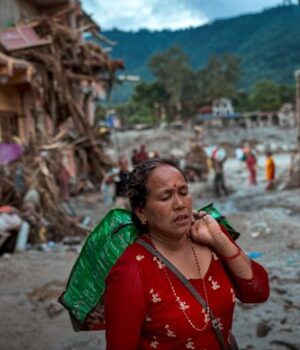
Source : the age
Wednesday was just another day at Adara, the global humanitarian group I founded 28 years ago. The team in our Sydney-based “for purpose” corporate advisory firm, generating revenue for our work with people in poverty, was producing financial and commercial advice to significant Australian organisations. Our development teams in Sydney, Uganda and Nepal were working on maternal newborn health and remote education services. Then our phones began pinging.
Messages came from Pralhad Dhakal, director of our Nepal operations. He had just landed back in Kathmandu from our most remote project sites in the country’s far west. His family lives in Nuwakot, the worst-hit region of the sudden floods, where we have been working for many years. He was just off a call from his sister as she fled to the mountains. He was worried about his elderly father, who lives near the Trishuli River. Yet still doing his job – checking in on his staff, their families and the communities we work with. Risk assessment. Staff assessment. Damage assessment. Leadership.
As we now know, a giant chunk of Himalayan glacier had broken off and plummeted thousands of feet, triggering a wall of water, mud and ice that swept into the Bhote Koshi and Trishuli rivers, which rose by up to nine metres in 30 minutes and poured into Nepal. Flooding ripped into the Nuwakot region, where we have been working for many years – a place massively damaged in the 2015 earthquake that took almost 9000 lives.
Here it was again. Unfolding catastrophe in a region of desperately vulnerable people. The glaciers, which tower over the breadth of northern Nepal, are recast in an instant – from nature we gaze at in awe, to nature we fear.
Researchers at the Kathmandu-based International Centre for Integrated Mountain Development say the region’s ice loss has doubled since 2000. Even under the Paris Agreement’s best-case 1.5-degree pathway, roughly a third of these glaciers will vanish this century. On current trajectories, the Hindu Kush Himalaya could lose up to 75 per cent of its ice volume by 2100, drying up the rivers that feed a quarter of humanity.
This is the ugly face of climate change. In rich countries, we are living with it. In low-income countries, the poor are bearing its deadliest consequences.
What happened in Nepal should not be viewed as simply a distant tragedy. The dots connect. In Australia, our retreat from climate action continues. Executives returned to Australia from holidays in Europe, many talking about “how hot it was over there”. And then, seemingly without a moment of reflection, they returned to business as usual – financial metrics, competitive pressures and reporting season. The very definition of missed opportunity as our world warms to the point of crisis.
Having worked for decades as a director and adviser to large companies as well as in the humanitarian sector, I am used to head-snapping changes in approaches and views. That cognitive conflict has been more evident than ever in the past few days.
Woodside Energy – Australia’s largest oil and gas producer – used its half-year results to scrap its $5 billion clean-energy investment target and abandon its scope 3 emissions-abatement goal altogether. It is not alone. The world’s biggest asset manager, BlackRock, withdrew last year from the Net Zero Asset Managers, a global group of financial services firms that pledged to support net zero greenhouse gas emissions by 2050. Four days later, the group suspended operations entirely. It relaunched a year later with a weakened commitment and reduced membership, and BlackRock has not rejoined. Major banks continue to support the carbon-fuel sector, despite commitments to reduce exposure.
At the other end of the spectrum, last week some in the green movement pushed against climate abatement offsets, perhaps because they are tools of capital, a power system they decry and, as a starting point, may not be effective enough. Arguably, this is the same ideology that cost Australia a chance to price carbon, not so many years ago.
And in Canberra, net zero has again become a political football.
This is the cognitive dissonance at the heart of Australian public life: our own climate authority warns we are missing our targets, some in our green movement block progress because they feel it falls short of the ideal, our biggest oil and gas company just walked back its decarbonisation promises in favour of shareholder returns, and some in our political class treat “net zero” as an insult rather than a critical obligation. Meanwhile, glaciers on the other side of the world collapse in real time, killing people who had nothing to do with causing that to happen.
Each one of us who has the privilege of leadership has an extraordinary opportunity to limit climate warming, to leave a positive legacy and to build a more sustainable economy and society. To do that, we need to lead, not look away.
Change will happen when we decide to lay down our ideological and political swords, when we make decisions within the parameters of long-established data and science.
Another phone call with our CEO. She and Pralhad are mapping likely impact. Discussing how many kids will be unaccompanied, orphaned and in the crosshairs of child traffickers who will already be marshalling to take advantage. I flash back to 20 years ago and the first time I stepped into a dark, cold basement to find 37 children on their way into the sex trade in India, the youngest only three years old. I know this is coming for so many more innocent kids, now and into our future.
I put down the phone. And then, I weep.
Audette Exel is the founder of the Adara Group. She is a former director and chair of the risk committee of Westpac and a former director of the Suncorp Group. In 2013, she was awarded an honorary Order of Australia for her service to humanity.
 Audette Exel is the founder of the Adara Group. She is a former director and chair of the risk committee of Westpac and a former director of the Suncorp Group. In 2013, she was awarded an honorary Order of Australia for her service to humanity.