

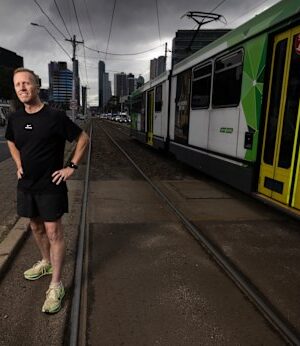
source : the age
Minutes after Ben Turner was hit by a tram, all indications were that he had died.
Ambulance officers who arrived at the scene that Friday night, in South Melbourne, in 2005, found that the 29-year-old’s heart had stopped and he wasn’t breathing.
Paramedic Mick Stephenson says Turner was lying face-down between the tram tracks in Kings Way, his face smashed, and with one leg flung over his head.
Stephenson says Turner’s chances of successful resuscitation were next to none.
“If your heart stops and you stop breathing, from trauma, you rarely survive,” Stephenson says. “He was in a terrible state.”
But Stephenson and his partner, John Taplin, refused to give up. Their cool, deft work, beside eight lanes of traffic on Kings Way, saved Turner’s life.
They cut into Turner’s chest and inserted a tube to release air from the lung lining. It relieved the pressure that had stopped the heart. They re-inflated the lung and his heart started beating.
Turner regained consciousness in The Alfred hospital in Prahran, three weeks later.
In 2026, the words “grateful” and “lucky” remain with Turner, given he survived a punctured lung, a head injury, 10 broken ribs, a broken leg, and fractured vertebrae.
He has made, says Stephenson, a remarkable recovery.
In October, Turner will run the Melbourne Marathon, to pay tribute to the people who saved him.
He says he feels grateful every day.
“Just being here, being able to breathe and run. Being able to be a full participant in life, with my kids, my wife and work, being able to do any of these things, they’re all privileges that we all take for granted. I’m very lucky.”
Turner today has five titanium plates inside his face, and a rod inside his left leg. He has a crooked little finger and a small scar on his face.
Turner remembers nothing about the accident.
Friends told him he was at a South Melbourne pub. At about midnight he headed towards his St Kilda Road apartment.
News reports said he was talking on his phone when he was hit by the tram. After four weeks in hospital, Turner moved to the Epworth rehabilitation centre in Richmond.
Turner remembers feeling amazed that other people could walk up stairs, because he felt so weak.
An attitude of “one step at a time” helped, as did girlfriend Anabela Correia, “who wouldn’t let me wallow”.
The couple married in 2007 and have two children, Max, 16, and Audrey, 12.
Turner, a technology director in Cloud, Data & AI, started running in 2010 and now trains for about 60km per week.
In 2023, he ran a 44-kilometre race on the Great Ocean Road. On October 11, Turner will run the Melbourne Marathon, to raise money for Ambulance Victoria and The Alfred Foundation but also to recognise and assure emergency service and rehabilitation workers that they make a difference.
Stephenson, who is now Turner’s friend, says Turner “made a miraculous recovery, compared to where we thought he was”.
“Every time I see him, I marvel at how well he is, how well he’s done,” he said.
“To think a bloke lying on the tram tracks, for all intents and purposes dead, is 20-odd years later running a marathon, it’s a pretty impressive story. Good luck to him. He’s a fighter, there’s no doubt about it.”
Start the day with a summary of the day’s most important and interesting stories, analysis and insights. Sign up for our Morning Edition newsletter.


