

source : the age
It’s just after 8.30am on an August Friday morning outside Reddam House North Shore. At the school gate, a mother chats with a staff member about anxiety.
Do students have a reason to be anxious? Friday at Reddam is cycle test day, where every pupil from year 3 upwards sits a 50-minute test on a range of subjects including English, mathematics and science.
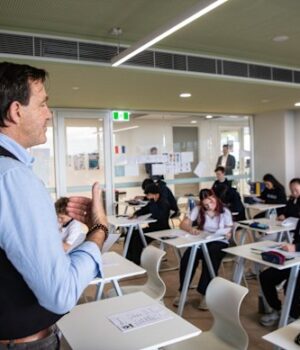
After 8.50am, in a classroom on the upper floors of the school’s North Sydney building, year 9 science students sit at separate desks in rows.
Teacher Steve Centra has soothing background music playing. He appears to be reading from a script. Inhale for four counts, exhale for six counts, he says. There’s also a message for the students.
“This test measures your performance today,” he says. “It does not measure your worth. Your result doesn’t define your intelligence, does not define your potential, and certainly, it doesn’t define who you are.”
In the 18 months since the North Sydney school opened, student numbers have grown from 498 to 875. Next year’s expected enrolment is 1100 students, with capacity of 1350 to be reached in 2028. The school’s first cohort of HSC students will start year 12 studies later this term.
Reddam North Shore is part of the Inspired Education group, a for-profit company that runs 125 schools in 30 countries.
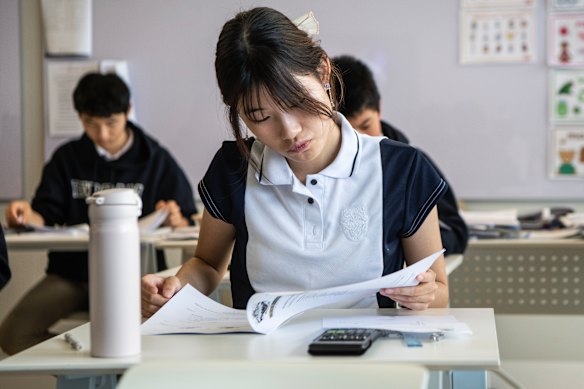
Some in the education sector are critical of high-stakes tests, which they regard as narrowing the focus of education and stressing students unnecessarily. At Reddam, cycle testing is the school’s main pillar. The school mantra could be: It’s cool to be clever. It’s cool to be kind.
Kylie Chacon, head of primary, says tests go beyond academic benefits. “The main thing is that we’re teaching them to push themselves to be their personal best,” she says.
Every teacher tutors before and after school to help underperforming students improve. Chacon says testing helps provide teachers with data so they can reflect on how they have taught the content.
It is also an enrolment drawcard. “Parents are choosing our school for our systems, and especially the cycle test,” she says.
Where other schools have sprawling campuses, Reddam North Shore is a converted Harry Seidler building, once six-storey office block. There are specialised mathematics, science and English teachers in years 5 and 6.
Melissa Coombes, head of K-6 mathematics, says students get a strong foundation before entering year 7, where the curriculum steps up to more challenging concepts such as algebra. Mathematics is “not everyone’s cup of tea” and a subject some primary teachers might shy away from, she says.
Having taught at another independent school, for girls, she regards Reddam North Shore as having a distinct academic culture.
“I think the difference here is that students are quite motivated,” she says. “They do get excited about tricky maths problems and new topics.”
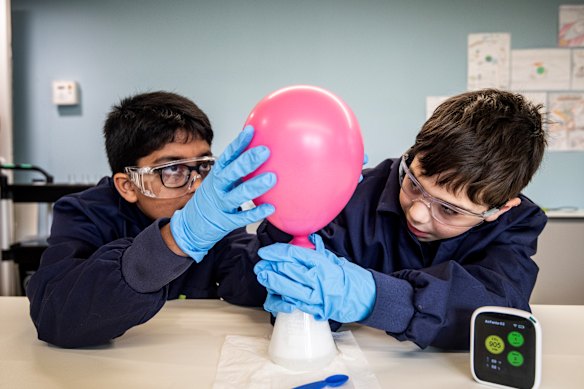
Midmorning in a science laboratory, year 5 student Jordan Ma is keen to tell the Herald about a science experiment he’s poised to conduct. “Back in my old school, I didn’t really get to do any experiments. I only just sat in class and just listened.”
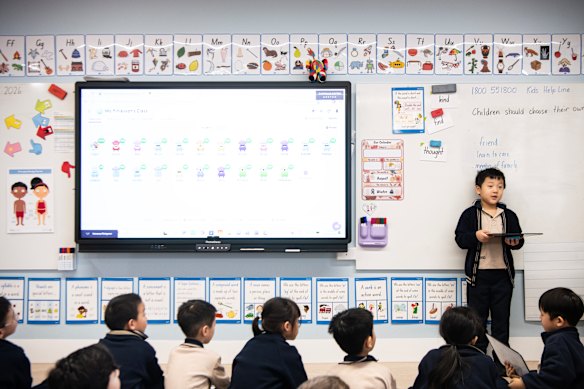
Nearby, English teacher Sarah Burnham-King sits with a year 6 class in a public speaking lesson. A boy tells a story about the world’s ugliest fish, his arms by his side, steadily scanning classmates to make eye contact with everyone, and doing it without notes.
Students then give him feedback on his performance, noting two things he did well. They also note one weakness he could improve – one boy says he could make better use of his hands while speaking.
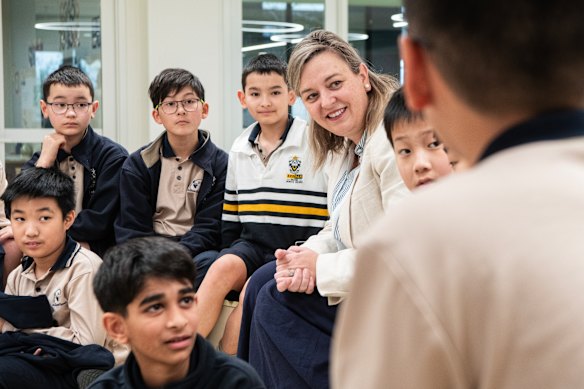
Public speaking is a central part of Reddam’s high school curriculum, with a one-hour public speaking class every week for students in years 7 to 9.
Actor Rose Chachko, who now also teaches public speaking at Reddam North Shore, said she was mortified at the prospect of talking in front of her peers when she attended the high school’s eastern suburbs campus.
“We were all frightened, scared, going up in front of an audience, in front of teenagers that we don’t know,” she says.
Years later, it paid dividends into job interviews, including on one particular occasion at Channel Seven.
“I remember the interviewer saying to me: ‘I actually noticed that you don’t say ‘um’ and ‘like’ a lot like I do.’
“I said to him: ‘It’s so interesting because for three years back in high school, I was trained to eliminate those words as much as possible in my public speaking class.’
“When you go out in the real world, when you communicate with your teachers, when you communicate with your friends, with your parents, later on in life when you’re going to be applying for jobs and things like that, it’s an absolute life skill to be able to communicate properly.”
Annual fees for Reddam range from $30,000 for kindergarten to $49,000 for year 12, placing it among long-established high-fee independent schools.
For deputy principal Nick Jolly, previously at Cranbrook, Reddam breaks the Sydney private school mould.
As other schools might focus on ties and blazers, Reddam is simpler with plenty of room for individuality. Blue hair is fine. As others play on tradition, Reddam sees itself as outward-looking.
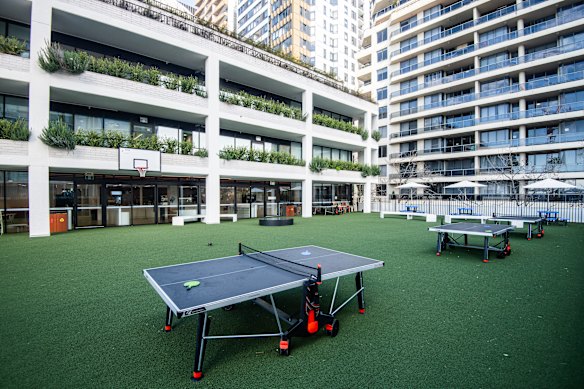
“For us, school is preparation for life, and we do our best to prepare kids for entry into that world,” he says.
It is just after 10am and Reddam North Shore principal Dave Pittcairn has an interview with a prospective new student. He asks incoming pupils two questions before they secure a spot at the school: Do you want to come to the school to take your academics seriously and be a positive contributor in class? And, do you believe it’s important to be a good friend, a kind person and be respectful of those who you might not like?
“If you don’t want to buy into what we’re doing here, it’s not the right school for you,” he says.
Students who aren’t academically inclined might feel Reddam is not for them, but according to Pittcairn, academic excellence “means you’ve got to try your best” and students must value their education.
High school students are expected to maintain a cross-subject average of 60 per cent, but marks alone do not determine a student’s place at Reddam. Of greater importance to the school is to have students doing their best, behaving well and contributing positively.
Reddam being a for-profit school, Pittcairn says, has not yet proved an issue with parents who “see this is how the world works”.
Pittcairn says he has spoken with the current crop of year 10 students, who have ambitions to be the No.1 school in HSC league tables. James Ruse held that top spot for decades, yielding to North Sydney Boys.
Does he think they will? Probably not. “We’re not selective in any shape or form,” he says. “I’m not going to burst the bubble and tell them how hard that actually is to come first in the state.”
Reddam House in Woollahra regularly places in the top 10 – in part due to the cycle test.
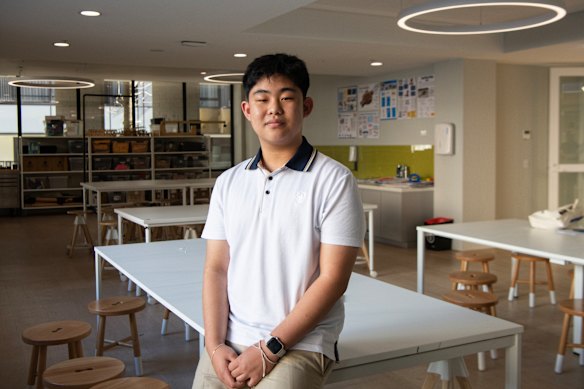
For year 10 student Jeffrey Li, who had finished a cycle test earlier in the morning, the routine has helped change his approach to schoolwork. At his previous school, he said, he needed only to study for the final weeks of term to do well on the assessment.
“It’s structured really well for students to kind of be on top of everything,” he says. “These cycle tests really maintain consistency of studying every single week, changing it up, and you’re really on your toes … for the whole term.”


