Source : Perth Now news
Young Aussies raised on streaming and downloads are going back to the future, rediscovering physical DC, DVDs, and vinyl records their parents once took for granted.
As tech companies increasingly move away from “physical media”, a wave of younger consumers is increasingly seeking it out before it is lost forever.
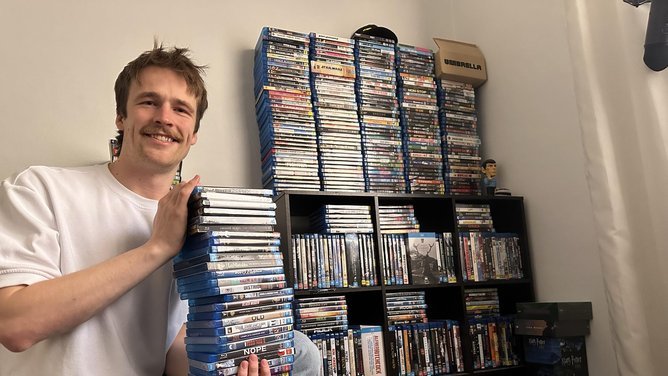
Online content creator Robert Hess is helping with that rediscovery by using his social media platform to document his own collection of 476 Blu-rays and 122 DVDs.
“I feel like having the vessel of something physical just feels like a more healthy way to consume media,” the-27-year-old from Melbourne told NewsWire.
“Once you’ve got a more personalised connection to a film like that, it feels like the ultimate to be able to actually own it and have it.”
Mr Hess said his collection “forces you to spend more time” with the media and immerse yourself with the body of work, even if it’s bad.
“I don’t think it’s a disposable sort of medium. I think it’s something that you have and cherish,” he said.
“I think it’s meant to be more of a two-way relationship,
“We’re living in a world now where media consumption is becoming shorter and more rapid and attention spans are shrinking.
“Physical media is a good way of preservation of the past and having ownership over the entertainment that we consume.”


Auckland University of Technology media history lecturer Peter Hoar said digital technology was taking away the control people once had over the media they consumed.
“It seems to be a profoundly human thing that we enjoy the touch of things and tangibility and the connection that makes,” Dr Hoar said.
“You as the consumer have no real control, and if you have a physical object, it doesn’t matter if (tech companies) take it off their listings, you’ve got the movie. You’ve got the music.
“That comes back to the social and psychological complexities involved in owning objects and artefacts … we’re curating ourselves through our taste and digital doesn’t do that.”
Melbourne-based musician Finn Houlihan began collecting physical media from a young age and has amassed an impressive collection of hundreds of CDs and vinyls.
“I loved looking through the booklets and reading the lyrics, and it just went from there. It felt like building my own little library,” the 33-year-old said.
Mr Houlihan said it was not just the feeling of holding a physical CD case in your hand that appealed to him but owning a “permanent piece of art”, allowing the owner to discover and create their own world.


For music lovers like Mr Houlihan, physical media sounds better, too.
“It makes listening to music or watching a movie feel very intentional and special,” he said.
“When you stream on Spotify or Netflix, it can be a very disposable experience.
“Going out of your way to find something physical often means that you then sit down and actually appreciate it, and that’s an important way for everyone to enjoy art.”
Working as a DJ in Melbourne’s north, Mr Houlihan has even started selling some of his own tunes on physical media, such as cassettes.
However, he said 80 per cent of his customers most likely don’t even own a cassette player.
“It’s really difficult and expensive to release physical media in Australia as an artist,” he told NewsWire.
“I think that comes down to inadequate arts funding and an unsupportive economic environment for small businesses like printers and indie publishers. That hurts all of us in a digital-only future.”
Brisbane-based copywriter Heath Kunde, 32, who has been collecting vinyls and physical media since a young age, said he fell in love with the sensory experience that comes with owning physical media.
“It’s all about the senses for me,” Mr Kunde said.
“You can feel and touch them, stare at the amazing artwork. Even the slightly musty smell of a vinyl record is nice in a weird, nostalgic way.”

With hundreds of records in his collection, he said it was also a great way to support an artist.
“We all know that artists get a tuppence from streaming services, so buying the CD or vinyl is often the best way to show your devotion and appreciation,” he said.
Older collectors such as Peter Dimitrakis said it was heartening to see young people discover a love he first found as a 16-year-old in 1976.
“The fact that I love all types of music made me want to start a collection, even if at the time I did not realise that was what I was doing,” the 66-year-old said.
“To see a vinyl record with the artist on the cover is so much more enlivening than plugging in a USB or downloading it on the computer.”


Tech giants ditch physical discs
Despite the wave of younger consumers turning to physical media, tech giants have taken the opposite approach.
Sony, the makers of PlayStation, recently announced it would cease production on physical games discs from 2028 and closing the PlayStation store on PS3 models.
It’s a move both Dr Hoar and Mr Kunde said was fraught.


“If the servers go down in the future for a game you bought, that’s it,” Mr Kunde said,
“You won’t be able to play it anymore. With a disc or cartridge, you can play it wherever, whenever.
“This is a big fumble for Sony. Microsoft is at least letting people install their discs onto their console and giving them a free, digital copy of the game.”
Dr Hoar said tech companies were making media consumption “weightless and ethereal” and stripping away the ability to connect with a body of work on a human level.
“I think human beings, we don’t live in the digital realm. We use it, you can’t live in it,” he said.
“We live in a seamless digital world, but it’s good to see things process and happen.
“The attachment to the physical object is just so important for us.”