SOURCE :- THE AGE NEWS
What in the World, a free weekly newsletter from our foreign correspondents, is sent every Thursday. Below is an excerpt. Sign up to get the whole newsletter delivered to your inbox.
Dublin: The noise from a passing tram almost drowns out the music when I walk past a small pub and notice a crowd of patrons inside.
Then I hear an Irish reel being played at a dizzying pace, and I look in to see a man and three women playing fiddles alongside a guitarist, a keyboard player and a man with a small accordion. My feet tell me what to do next. I walk in and order a Guinness.
I am on Marlborough Street, a few blocks north of the River Liffey, and I have just found a pub where the regulars live for traditional Irish music. I relax as I stand at the back of the room and listen to playing that is so fast it seems frenetic – except that is the wrong word because every note is perfectly controlled. It feels both wild and disciplined.
Up the front, on lounges and stools close to the band, people sit mesmerised by the fiddlers. To my right, in the back bar, drinkers happily talk over the music. I can hear a group of Irish friends catching up, as well as some American and Spanish tourists. A couple watch the band from a lounge, alongside a teenage boy lost in his phone. Two ardent fans sit right next to the band, smiling as they take it all in at full volume.
In the movies, of course, there’s a pub like this on every corner. But this one, known as Pipers Corner, stands out. I have just come from Temple Bar, the tourist drawcard on Dublin’s south side, where I heard talented guitarists fill the pubs with classic hits. I knew it was time to walk on when one of them started a John Denver tune. I love finding Pipers Corner by accident on the walk back to my hotel.
This gets me thinking about the health of traditional music when it seems easier for Dublin pubs to draw crowds with pop rock. In a sense, Irish music is everywhere, and not just because the country has conquered the world with acts ranging from Riverdance to the Cranberries and U2. Some Australian artists have traced their songwriting to the influence of their Irish ancestry. Even so, I wonder whether the musicians who know the old tunes are properly respected and rewarded.
Then I track down Seán Potts, who set up Pipers Corner with others in 2017, and he assures me that Irish music is alive and well. The pandemic hit the business hard, he says, but the pub has recovered with a program of regular players most nights of the week.
“I think Irish music is stronger than it has ever been in its history, and I don’t say that lightly,” he says. “I think the work of people over the past 50 years to ensure its wellbeing has been incredibly successful. The music is handed down from generation to generation, and some people take it and they excel artistically with it. And judging from the young people who are playing today, I can see it’s in incredibly safe hands.”
Potts plays the uilleann pipes, the Irish bagpipes pumped with an elbow, and comes from a family immersed in music. His father, also Seán, was a co-founder of the legendary traditional Irish folk band The Chieftains in 1962. Back then, he says, the music was mostly played in the home. It took many years, as licensing laws eased and the Catholic Church lost some of its social power, for the music scene to come alive in the pubs in the 1960s and 1970s.
The bartender, Ciarán Gray, tells me he has worked at Pipers Corner for nine years. Like the customers, he loves the music.
Sure, a tourist could pay to join a musical pub crawl around Dublin, but it seems better to slip into this bar without a guide. Even if a group tour can bring good business to a pub, it can kill the vibe when the tour leader moves everyone out to the next venue. And, to me at least, the music has an added energy when it is being savoured by locals, not only visitors.
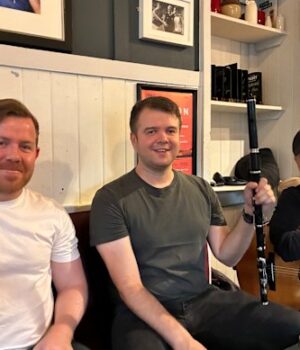
On my next night, the front corner is occupied by guitarist Paul Doyle and two flute players, Conor Healy and Iarlaith Mac Gabhann. Some of the music they’re playing has been passed on to them by musicians born in the 1920s and 1930s, they tell me during a short break. They can explore older music, as well, thanks to technology. Mac Gabhann digitises this audio and video in his day job at the Irish Traditional Music Archive.
“With the technology now, we’re actually able to go back even further than our parents’ generation,” he says.
So, while the internet age has presented plenty of challenges to live music, it has also produced ways to keep traditions alive. “I come from a musical family, but what about someone who doesn’t?” says Mac Gabhann. “They have the same chance to play music – they don’t have to be born into it.” They might even learn Irish tunes by seeing them on YouTube.
The three musicians end their break and prepare to play again. Doyle says he is not worried about the outlook for Irish music. “It’s as strong as ever,” he says. As I look around when the music resumes, I feel sure he is right.
Get a note directly from our foreign correspondents on what’s making headlines around the world. Sign up for our weekly What in the World newsletter.
 David Crowe is Europe correspondent for The Sydney Morning Herald and The Age.Connect via X or email.