SOURCE :- THE AGE NEWS
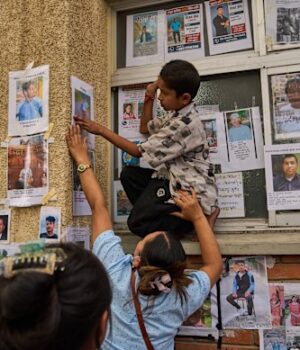
Kathmandu: A wall in Nepal’s largest hospital has been covered with photographs as relatives try to track down their loved ones.
Each day, visitors put pictures of the missing up at Tribhuvan Teaching Hospital in Kathmandu, in the hope that staff or passers-by will recognise the face and say they are alive.
Almost 4000 people, ranging from toddlers to the elderly, remain missing in Nepal after a flood swept down the country’s border with Tibet last week.
Among them is 31-year-old Bishal Nepali, whose sister, Sunita, broke down in tears as she added his photograph to the crowded rows.
“Urgent request for search and rescue. Our family is worried. After flooding we have no contact with him,” read the note attached to the poster.
Nepali’s wife, 26-year-old Monita Nepali, said he had often crossed the Chinese border.
Bishal and Monita Nepali last spoke at 7am on Wednesday, about two hours before the flood, when he went out for a morning walk in the border region. His phone has been off ever since.
“My heart is aching and my hope is fading. I feel he will come back but with each passing day I lose hope of his return,” Monita Nepali said.
Over the weekend, the Nepalese authorities began to use mass burial sites after morgues ran out of room to store the decomposing bodies.
With morgues full and humid temperatures speeding up decomposition, authorities said they had no choice but to bury bodies before they had been identified.
“We have decided to bury the unidentified bodies because we don’t have the capacity to preserve all the bodies recovered from the flood-affected areas,” said Rajendra Prasad Dhamala, a Nepalese government spokesman.
In Bharatpur, three hospital morgues had reached capacity, forcing authorities to establish makeshift facilities.
Some 200 unidentified bodies were buried in a nearby forest, beneath numbered metal markers in concrete pots.
At the burial site, security workers in protective gear carried the bodies, one by one, on stretchers as cameras recorded the process.
“Most of the bodies have already started decomposing after being stuck in mud and to prevent further decomposition we have kept them in plastic airtight bags before burying them 1.5 metres underground,” Dhamala said.
Of more than 900 bodies recovered in Nepal so far, only 20 have been identified.
After days under mud and floodwater, many have become disfigured, making them harder to identify.
In Pokhara, two families claimed the same body, forcing police to turn to DNA testing. Fingerprints and dental records have also been used.
Family members from abroad are also arriving in Nepal to search for loved ones. To help families, photos are displayed on small television screens at morgues.
The London Telegraph spoke to many families during the past week who said several relatives had died, but their names had not appeared on the official missing list, which suggests the death toll could rise further.
On Monday, Nepal once again raised the number of people confirmed as missing, with the total close to 4000, with a further 900 on the Chinese side of the border. Of that total, 600 are foreign nationals.
Rescuers in Nepal are racing against the clock to reach an estimated 900 hydropower workers trapped in tunnels submerged by a wave of mud that cascaded down the valley when the glacier collapsed.
The Nepalese army said search-and-rescue teams were using controlled explosions, excavators and searchlights to clear water and mud and reach the trapped workers.
Amid the devastation, stories of heroism have begun to emerge.
A teacher in the Trishuli Valley saved 900 schoolchildren after learning that a flood wave was surging down the river. Rajendra Dawadi was able to escort the children to higher ground before the wave ripped through the community, destroying their school.
The Telegraph, London
Australians in need of emergency consular assistance should contact the Department of Foreign Affairs and Trade’s 24-hour Consular Emergency Centre on 1300 555 135, or +61 2 6261 3305 (if calling from overseas).