source : the age
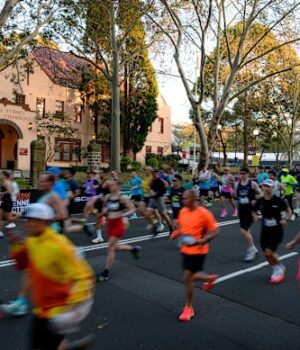
I was one of 40,000 people who ran the Sydney Marathon on Sunday.
For one morning, a city of more than 5 million people becomes unusually intimate. Nobody cares what you earn, where you were born, which god you believe in or which language your grandmother spoke. It is communal joy in its purest form.
So perhaps that is why what happened next felt so discordant.
Among all of that, I saw accusatory messages of hate directed against Israelis. I cannot know precisely who every person holding those signs intended to address. But in the current social climate, it was difficult not to understand them as being directed at Israelis participating in the Marathon, or at people perceived to be affiliated with Israel.
And for Jewish runners, particularly at a time when the distinction between criticism of Israel and hostility towards Jews is considered by many in the Jewish community as opaque, it was difficult simply to run past that language as though it existed in a vacuum.
What struck me most was not simply the politics of the signs. It was their spirit. It was inserted into an event whose entire character was the opposite of conflict: tens of thousands of ordinary people running the same course, drinking from the same cups, being cheered by the same strangers.
It was immediately dispiriting not because politics should be confined to parliament, or because protest should always be polite. Some of the most important protest movements in history have been disruptive and uncomfortable. But protest is supposed to communicate something. At its best, it persuades, illuminates, demands, challenges or mobilises. It identifies an injustice and asks other people to see it. These signs seemed to ask nothing.
Does telling a stranger they are hated move anyone closer to a solution?
Does importing the language of collective guilt into a community sporting event create empathy for Palestinians – or does it simply create another person who feels frightened, humiliated or despised?
Political movements can become so enclosed within their own language and moral certainty that they stop noticing how they sound to everyone outside them. Slogans become articles of faith. The same ideas circulate among people who already agree with one another until expression itself becomes confused with achievement.
If they were protesting against the Israeli runners – most of whom would be ex-service people given Israel’s policy of conscription – who were raising money for Shalva, a disability NGO that serves Jewish, Muslim, Christian and Druze Israelis, then it highlights the futility in protest that no longer seems interested in persuasion or nuance. If the person passing you is not someone whose mind you hope to change, and not someone with power to implement the change you seek, then what precisely is the purpose of confronting them?
Perhaps the answer is simply to make them feel unwelcome. If so, we should call that what it is.
It has been widely explored that criticism of the Israeli government and the Israeli Defence Forces (IDF) is not inherently antisemitic but neither is there an impermeable wall separating anti-Zionism from antisemitism.
There are circumstances in which the distance between them becomes for some of us very small indeed. Perhaps the most useful test is a simple one: would we apply the same principle to anybody else? Is this a world in which ordinary people may be publicly confronted with the actions of governments, leaders or countries with which they are associated?
Russians for Putin. Iranians for the Islamic Republic. Americans for American wars. Chinese Australians for Beijing. Palestinians for Hamas. Israelis for Netanyahu.
Australia works, imperfectly but remarkably, because people can arrive carrying different histories, religions, languages, loyalties and inherited griefs and nevertheless meet one another in a public space without demanding that every person answer for everything done by someone who shares their ethnicity, nationality or faith. That social contract is fragile.
None of this diminishes the suffering of Palestinians. None of it makes criticism of Israel antisemitic. Those are lazy binaries, and this subject deserves better than lazy binaries.
In our determination to make every public space another battlefield, I wonder whether we understand what we are giving up.
Orly Lavee is a doctor who lives in Sydney.
Get a weekly wrap of views that will challenge, champion and inform your own. Sign up for our Opinion newsletter.